







Agency
Stradvert Media Turns Street Interviews Into a Performance Play for DTC Brands

Audiences have learned to identify paid endorsers. Influencers, actors, and UGC creators all carry an implied financial relationship with the brands they promote, and viewers have grown alert to it. British creator Ryan Trevis, who started filming street interviews in 2022, founded Stradvert Media on the premise that the format most difficult to fake is also the one that converts: a stranger on the street, captured in a real encounter, with no script and no stake in the outcome.
Stradvert is a street-interview ad agency that sends hosts with microphones into public spaces to capture strangers’ reactions to a client’s product. Founded in 2024, Stradvert now runs productions across the UK and the U.S., with Ryan managing the company remotely from Bali.
“People in the street have got no reason to lie about the products,” he says. “Whereas an actor or an influencer or a UGC creator, people watching, they know they’re being sold to.”
Stradvert packages that premise into a production system: concepts developed against client briefs, multiple hooks and ad variants per shoot, manual editing calibrated to platform performance, and iteration driven by Meta results data. Packages range from 12 to 100 deliverable ad variants per engagement. The agency backs the work with a performance guarantee: if a client is unsatisfied after a fair test, Stradvert will reshoot the creative for free.
Not Every Person on Camera Is a Genuine Passerby
The format is not purely unscripted, however. Shoots operate from a structured skeleton with defined outcomes, and unrehearsed moments emerge within that frame. Ryan describes the competitive advantage less as a claim to total spontaneity than as a structural difference in how the resulting creative reads on screen. “I can copy UGC,” he says, “but they can’t copy street interviews.”
Some clients also request actors, which Stradvert accommodates. Ryan estimates that 40% to 50% of the videos on his company website feature paid actors rather than genuine passersby. He is direct about it: one client rejected actors on a call, then praised a specific example from the site. “And that video was with an actor,” Ryan recalls telling him.
The distinction Stradvert draws is less about whether every person on camera is a genuine passerby than about the structure of the encounter itself.
The Host Is the Least Important Variable
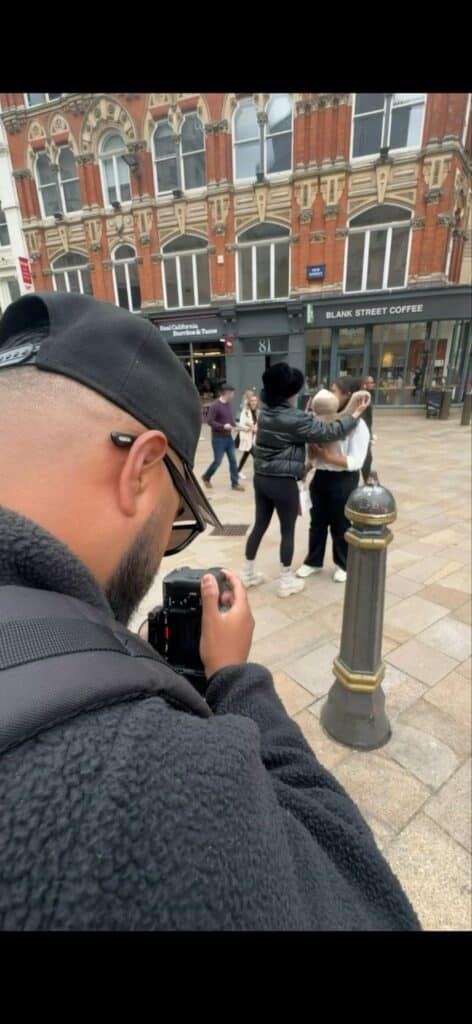
The most counterintuitive claim in Stradvert’s model concerns what does not drive performance. “The least important thing is actually the host of the microphone,” Ryan says, “because anyone can do that part, because it’s all about the person in the street.”
The variables that determine whether an ad converts are concept development and editing. Ryan has worked with the same editor since scaling the agency in January 2025 and describes the combination of script framework, editorial pacing, and volume of variants as the system that makes the guarantee viable. “We don’t always want to reinvent the wheel,” he says. “We’ll just take something that’s already been proven in that client’s ad account and then put it into a street format with real people.”
Typical production requires roughly one week to film and three additional days to edit. The bottleneck is almost never production. It is client-side review, compliance sign-off, and payment terms, a process Ryan says extends considerably when a brand’s procurement operation is involved.
The largest mistake brands make, by Ryan’s account, is buying raw footage and attempting to cut it in-house. “If the ad doesn’t perform,” he says, “it’s going to cost you money. Editing isn’t a commodity in direct response. Hook timing, pacing, ordering of responses, product reveal, and CTA can materially change the performance of the same underlying footage.”
Direct Response Lives on Meta, Not TikTok
Ryan is precise about where Stradvert has produced documented results. Meta is the primary platform and the only one for which he cites performance screenshots. “I don’t care about anything unless I’ve seen screenshots and I’ve seen proof,” he says. The distinction is, in his view, what separates Stradvert from comparable agencies that present aggregate figures without attribution.
For Ryan, the platform split matters operationally. For Stradvert specifically, Meta has been the clearest environment for measuring direct-response performance. The agency’s work also appears across TikTok, YouTube Shorts, X, and other placements, but Ryan is careful not to attribute performance results he cannot verify.
The agency’s most cited case study involves Real Mad Honey. The consumable DTC brand spent just under €864,000 on Meta advertising in the last 365 days, with approximately one-third of that budget allocated to Stradvert creative. Five Stradvert street interview ads produced a 2.73 blended return on ad spend across them, calculated from creative-level figures on 7-day attribution, according to the agency. The client reported that Meta consistently concentrated delivery on the street interview ads over the rest of the creative library once they were in the account.
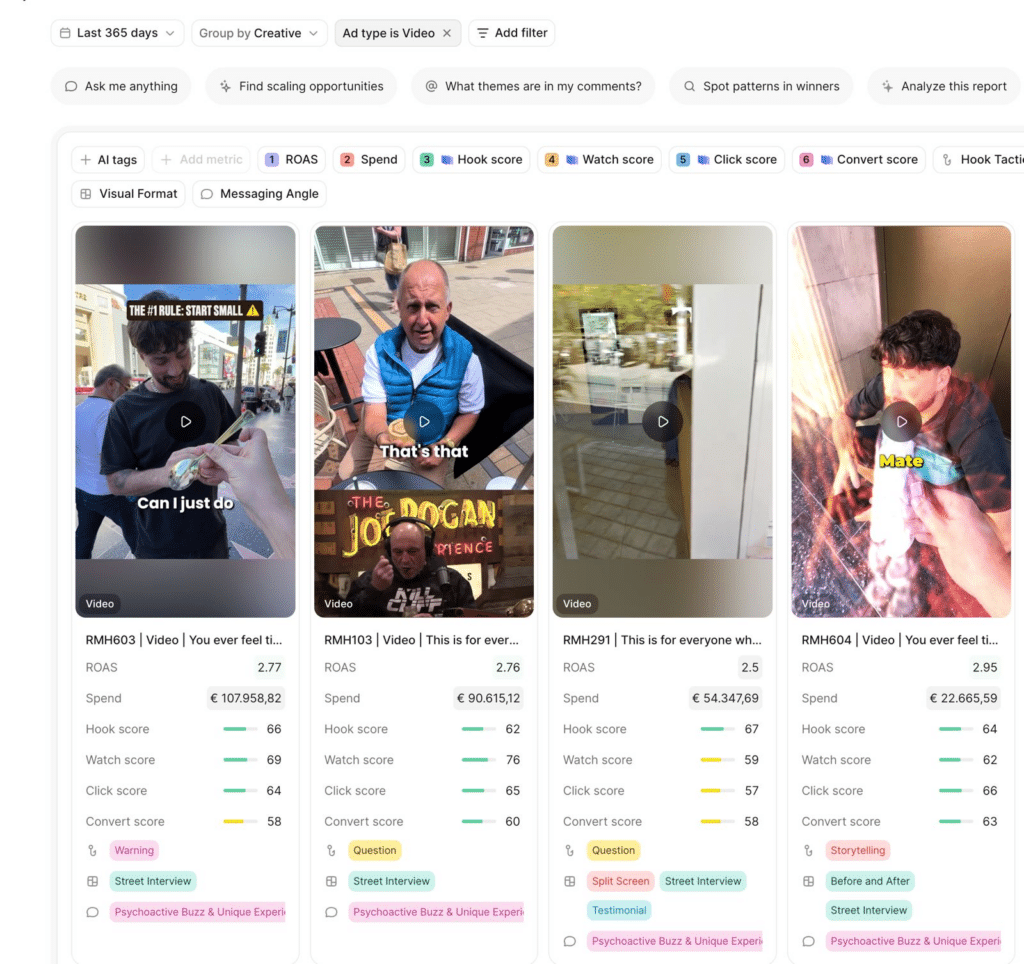
Image: The Motion grid of all five street interview ads
AI Writes the Script, Humans Film the Street
Ryan says he uses AI extensively on the concept and scripting side of the agency and not at all in production. His current workflow feeds a Claude instance with the agency’s library of winning ads, then uses voice notes to develop and refine concepts against client briefs. “It’s like 50% human, 50% robot,” he says of the scripting process.
AI-generated UGC, where a synthetic presenter replaces a real person on camera, is a different matter. Ryan views the format as a likely regulatory casualty. He cites the EU AI Act, which establishes transparency requirements for certain AI-generated/manipulated content, including disclosure by deployers of deepfake image, audio, or video content. “I think it’ll just go too far,” he says, “and then they’ll have to get rid of it.”
If AI-generated ad content faces tightening restrictions, demand for human-led creative formats should, in Ryan’s view, strengthen. He frames it as a market cycle he has already factored into his positioning rather than a threat to actively manage.
Reliable Hosts Are Harder to Find Than Winning Formats
Stradvert’s UK production operation is, by Ryan’s account, stable. His long-running UK team, hosts and primary editor included, performs consistently. The U.S. market is more complicated, for reasons that have less to do with the format than with a specific kind of skill.
The technical setup for a street interview shoot is relatively simple. What is harder to source is a host who can approach strangers without losing them, sustain a natural interaction, follow a framework without sounding scripted, and reliably produce usable footage across a full day of filming. “What is hard is finding people who are reliable to do it,” Ryan says.
The difficulty is visible in Stradvert’s U.S. expansion. The testing period is agreed with the client before launch; if they are unsatisfied with results after that test, the reshoot included in their package applies. “Test” and “Scale” packages each include one reshoot, while “Premier” includes two.
The constraint compounds as volume grows. Ryan manages both markets remotely from Bali, with no direct presence to supervise shoots. Building a reliable host roster in the U.S. while training an additional editor to maintain the agency’s editorial standards is the primary operational challenge at scale.
Concepts Saturate. The System Producing Them Is Built Not To.
Ryan does not argue that street interview advertising is immune to format fatigue, but his framing of the risk is specific. Individual concepts saturate, but the production format that contains them does not. “Saturation kills everything,” he says. The model’s response is continuous concept development and creative iteration, using Meta performance data to identify what works and adjusting from there.
The AI argument follows the same logic. As synthetic content becomes cheaper and more abundant, Ryan argues, genuinely human creative becomes more differentiated. The challenge for AI-generated video is not regulatory so much as perceptual: the more widespread it becomes, the more a real street encounter stands apart from it.
If the agreed creative does not improve performance after a fair test and the client is unsatisfied, Stradvert will film again at no additional production cost. “We work until we get you a winning ad,” Ryan says. “That’s how confident I am in what we do.”
Subscribe to Our Newsletter
Check Out Our Podcast