



Agency
A Business Check-In: How Influencer’s Toughest Strategic Decisions Shaped The ‘Thinking Like A Creator’ Framework

Ten years into building Influencer, CEO Ben Jeffries does not frame the company’s position as a matter of maturity, but as a necessity. “Brands don’t come to us anymore to ask if influencer marketing works,” he says. “They come to us because they’re operating at a scale their internal teams can’t support on their own.”

The shift from experimentation to execution at scale has forced Influencer, the creator marketing agency Ben co-founded with YouTube creator-turned-entrepreneur Caspar Lee in 2015, to make a series of defining strategic decisions. What began as a creative-first business built to prove the value of creators has grown into a full-service, creator-first marketing operation spanning North America, Europe, and the Middle East, working with brands such as Nike, Google, Disney, and SharkNinja.
As influencer marketing moved into a core marketing function, Ben and Caspar found themselves confronting a new problem: brands no longer needed convincing, but systems. They needed help operating at creator speed, integrating creators across the full marketing funnel, and delivering measurable performance in an environment reshaped by algorithms, platform fragmentation, and AI.
“The real question now,” Caspar says, “is how do we help brands do it better than they can internally?”
That market read ultimately led to Influencer’s “Thinking Like a Creator” framework, not as a thought leadership exercise, but as a practical response to how the business of creator marketing has changed. It reflects the strategic bets Ben and Caspar made over the past decade, the growth levers that proved durable at scale, and the operating principles they believe will define the next phase of the creator economy.
From Convincing Brands to Rebuilding Their Systems
In the early years, the challenge was existential. As Caspar recalls, Influencer was not competing on execution quality alone, but on legitimacy. “At the start, we were competing just to get brands to try influencer marketing,” he says. “Now they’ve been in the space for years and have built internal teams.”
That shift changed what brands expected from an agency. Instead of education, they wanted leverage. Instead of experimentation, they wanted scale. Ben describes this as the moment Influencer had to decide whether it would remain campaign-led or evolve into something more infrastructural. The company chose the latter, expanding into creative, media, commerce, and measurement, while maintaining what Ben calls a “creator-first” philosophy.
“When we started Influencer, creators were seen as a pure media buy,” Ben says. “We’ve always been, and will stay, an end-to-end marketing agency by remaining full-service, creator-first.”
That decision shaped the company’s growth trajectory and required a parallel investment in technology, data, and platform relationships to support enterprise-scale demands.
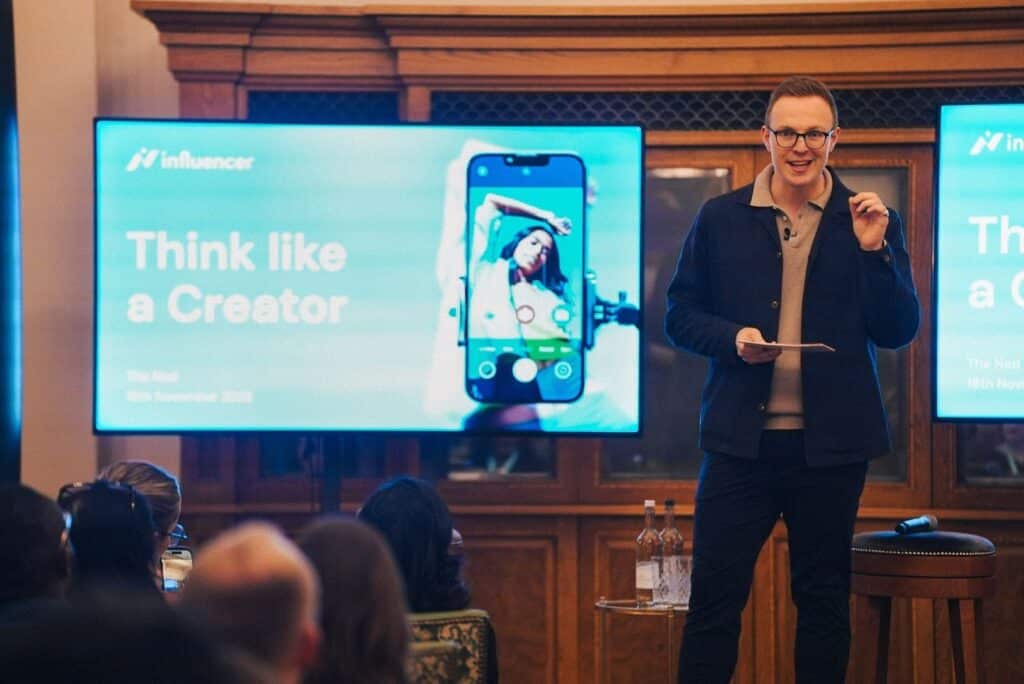
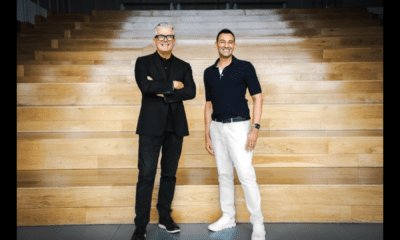
Photo: Ben Jeffries at the “Thinking Like a Creator” launch event
Source: Influencer
Platform Proximity as a Growth Lever
One of the most consequential moves Influencer made was its close alignment with major social platforms. As an official global marketing partner of TikTok, YouTube, Meta, Snap, Pinterest, and Twitch, the agency secured early access to platform tools and APIs (Application Programming Interface), which were later integrated into its proprietary operating system, Waves.
Waves, which Ben calls a “first-of-its-kind” system, was built to address long-standing issues around transparency and performance in influencer marketing. Real-time creator tracking, proof of performance, and cross-platform measurement became central to Influencer’s value proposition as brands demanded accountability comparable to other parts of the advertising ecosystem.
For Caspar, the combination of platform intelligence and creator-native insight remains critical. “We’ve always been a creator-founded business,” he says. “We didn’t start this because it looked like a hot market; we started it because we were already living it.”

Photo: Caspar Lee at the “Thinking Like a Creator” launch event
Source: Influencer
From Channel Thinking to Creator-First Strategy
As Influencer scaled, the founders began to notice a deeper shift in how brands approached influencer marketing. What had once been an add-on to a broader media plan increasingly moved upstream into the earliest stages of strategy.
Ben says brands are now asking Influencer to sit at the table before campaigns are defined, not after they are approved: “What would typically happen before is that the influencer marketing came at the end. Now, we’re seeing the opposite. Brands are saying, ‘We need this to be the first thing we think about.’”
This change has implications well beyond social media. Creators are now appearing across television, out-of-home, retail, and digital display, not as an afterthought, but as a starting point.
Caspar attributes this to changes in algorithms and audience behavior. “If the creative isn’t strong and relevant, even a creator with a million followers won’t necessarily reach the right audience,” he says.
Why ‘Thinking Like a Creator’ Became a Framework
The “Thinking Like a Creator” framework emerged from these accumulated insights rather than from a single moment of inspiration. While Influencer could have kept the methodology internal, Ben reveals that publishing it was a deliberate decision to advance the industry. “It’s not about keeping things close to our chest,” he says. “It’s about encouraging brands to think in a certain way that benefits the entire ecosystem.”
Rather than positioning the work as a traditional report, Influencer framed it as an operating guide. The framework draws on creator interviews, campaign data, and years of execution across regions, aiming to translate creator instinct into something brands can systematize without sacrificing authenticity.
For Caspar, the timing was also influenced by the acceleration of AI across marketing workflows. “AI will help us produce more content, remix it faster, and support creator engagement,” he says. “But people are still most interested in what other people are doing.”
AI, Scale, and the Question of Memory
Both founders are explicit that AI is not a threat to creator marketing, but a force that sharpens its importance.
Ben argues that while attention has become easier to capture, memory has not. “It’s very easy to pull attention,” he says. “It’s much harder to achieve memory with a consumer.”
That belief sits at the core of Influencer’s forward strategy. AI, in their view, should reduce friction and expand output, but human storytelling remains the differentiator.
Caspar draws a parallel between AI’s democratization of content creation and YouTube’s early disruption of traditional media. “When everyone can create,” he says, “curation becomes the premium.”
What Ben and Caspar Are Building Next
Looking ahead to 2026, Influencer’s priorities center on deeper integration between creativity and commerce, longer-term creator partnerships, and helping brands apply creator-led thinking across their entire marketing mix.
Ben shares that the ambition remains unchanged, even as the scale increases. “We want to continue to champion creators and redefine how the industry views them,” he says.
Caspar echoes that focus, framing creators not as a channel but as the connective tissue between brands and culture. “When real people share honest stories about brands they love,” he says, “those brands become part of daily conversations, not just logos on a screen.”
Subscribe to Our Newsletter
Check Out Our Podcast