







Tech
How Circle Built an AI to Run Creator Businesses From the Inside Out

The most profitable creators on Teachable weren’t the ones with the biggest audiences. They were the ones who had turned their audiences into communities.
Andrew Guttormsen observed that pattern across thousands of customer conversations during five years at the course platform, including two years as VP of Growth and Marketing through a $250 million acquisition. He co-founded Circle in 2020 to build around it. This month, with the launch of Circle Eclipse, the New York-based platform is testing how much of the business side of running a creator enterprise an AI can take over.

“We’re helping people build digital businesses where the community is the product,” says Andrew, co-founder and Chief Revenue Officer at Circle, where he oversees marketing, sales, customer success, and revenue operations. He founded the company alongside CEO Sid Yadav and Rudy Santino. The platform now powers more than 15,000 online communities.
Community Is the Product, Not the Add-On
The business case for Circle began with an inefficiency visible inside Teachable’s customer data. Creators charging $500 or $5,000 for a program were outselling those charging $50 for comparable content, and the explanation was not the teaching itself.
“Why is this small subset actually having outsized outcomes compared to everybody else?” Andrew says. “And it was, well, they had their students and customers on a Slack group, or maybe at the time a separate Discord group, or maybe a Facebook group. They also had bigger average deal sizes.”
The problem was context. A premium digital education product sitting inside a free Facebook group, alongside unrelated ads and family arguments, did not hold up as a premium experience. Circle was built to give creators a dedicated, branded home for their communities, one that justified higher prices and supported recurring memberships that high-earning creators were already running on fragmented workarounds.
Today, Circle targets what Andrew calls “creator entrepreneurs”: coaches, educators, and subject-matter experts whose product is the transformation they deliver rather than entertainment. That distinction shapes how the platform positions itself relative to Discord and similar tools.
“A lot of folks aren’t necessarily going to Discord to get a transformation,” he says. “They’re going there to be entertained or watch some type of gaming experience. Ours kind of skews a little bit more on the transformation side.”
Why Follower Count Is the Wrong Target
The creators building durable businesses on Circle often do not have the largest audiences. They have the most valuable ones.
“To really make money, but then have the staying power. You gotta get like 20 things right,” Andrew says. “You have to have the right offer, you have to efficiently acquire customers, and once you acquire those customers, you need to deliver the value well.”
The creators generating $1 million or more annually tend to run at premium price points with what Andrew describes as “a thousand true fans,” a subscriber base that is high-value rather than high-volume. A recurring membership at $100 or $500 a month, with a small committed audience, can generate more revenue than a large audience converting on low-ticket content once.
“We find that a lot of the folks who are building the durable businesses have premium pricing, but they might have a thousand true fans,” he says. “You don’t have to have 10,000 people who are customers to have some really big business.”
That orientation shapes Eclipse’s design logic: the tools are built to help creators extract more value from existing audiences, not to reach more people.
Building a Community Business Used to Take Months. Now It Takes an Hour.
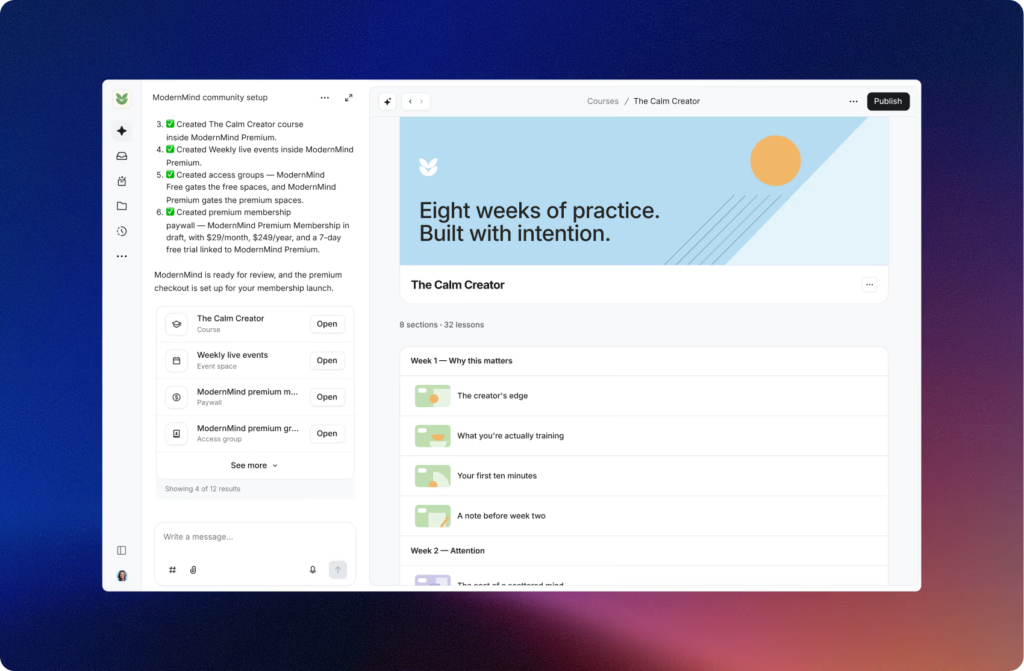
The centerpiece of Circle Eclipse is Circle AI, an agentic platform that builds and manages a creator’s community business through conversation.
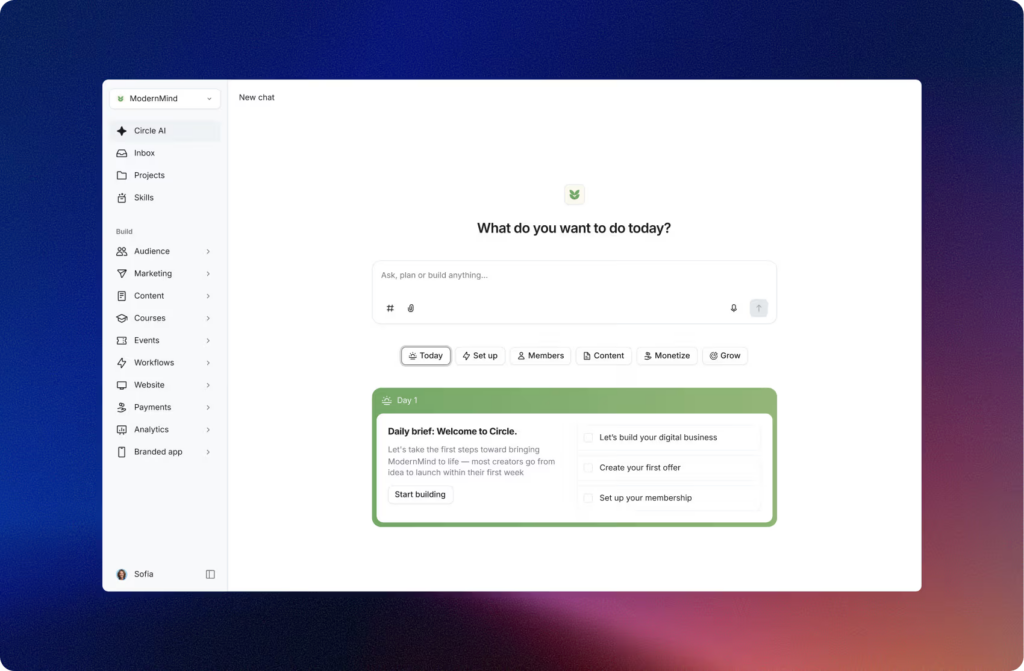
Andrew’s analogy is “vibe coding,” the emerging category of AI-native development tools like Replit or Lovable, applied to community businesses rather than software engineering. A creator describes what they want, the platform proposes a complete plan, and Circle AI executes it with the creator’s approval.
“You can start just having a conversation,” Andrew says. “Say, hey, I want to build a community for whatever it’s going to be. It’ll consult you for a few minutes and ask you some questions. Then it’ll say, ‘Okay, here’s what the plan is.’ And it’ll literally start building it all in front of you.”
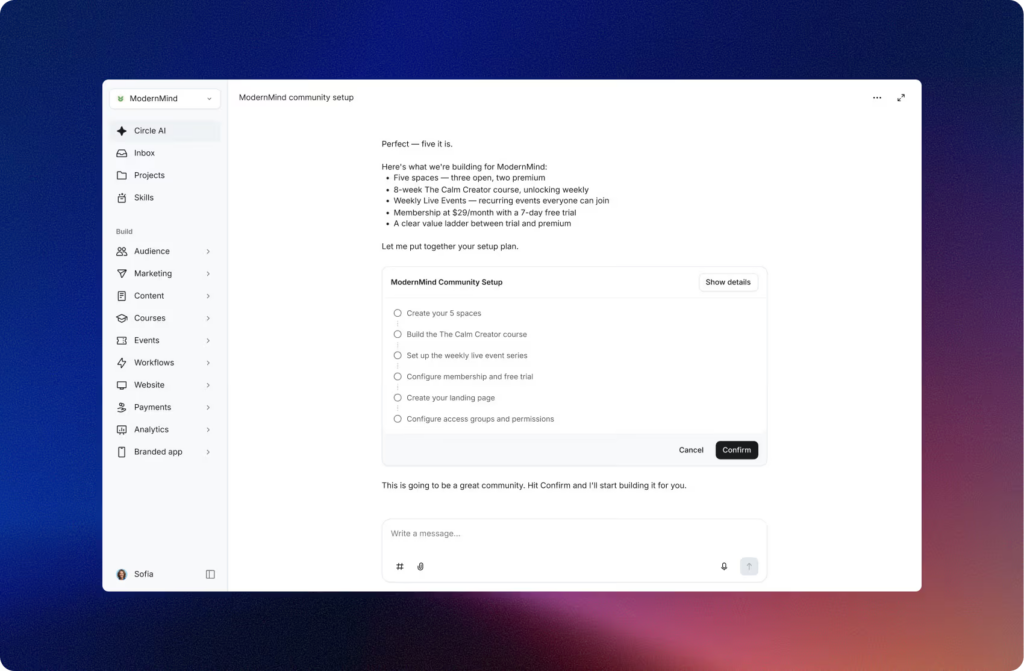
The build covers concrete tasks: the community website, access groups and paywall configuration, member invitation emails, event planning, and ongoing operational recommendations. Circle AI launches with more than 50 specialized skills trained on data from approximately 20,000 creator businesses, covering areas including event management, community moderation, and pricing strategy.
Andrew cites the timing as deliberate. The underlying AI models became capable enough only in the past several months, and Circle spent the preceding years constructing the infrastructure, courses, memberships, live events, CRM, payments, and email tools that the AI layer now operates across.
“I don’t think the LLMs were good enough a year ago,” Andrew says. “And all of this gets a lot more powerful when layered on top of having all of that capability.”
Circle AI Will Run the Business. It Won’t Write the Content.
The distinction Andrew draws most sharply is the one most AI-for-creators tools blur.

Circle AI is built to handle operations: building infrastructure, analyzing member behavior, managing workflows, moderating communities, and optimizing pricing decisions. It is explicitly not designed to generate content on a creator’s behalf. The reasoning is strategic.
“We’re helping you run your business, create your business with AI,” Andrew says, “but we’re not helping you create your content with AI.”
He argues that AI-generated content erodes the trust that creator businesses are built on. “If you start to go out and use AI to create a bunch of content, that actually loses the trust pretty quickly,” he says. “And that’s so far from what we’re doing.”
The split also reflects what Andrew sees as the real constraint for most creators: not a shortage of ideas, but an abundance of admin. “A lot of creators actually like the creating part more than the business part,” he says. “It’s a huge unlock for a lot of them.”
Studios and Discover Target the Hardest Creator Problem
Eclipse also introduces two products aimed at what Andrew describes as the most common question Circle receives from its customer base: how do I get more members?
Circle Studios is a full-service partnership model for creators with large existing audiences who want to build a premium community business without operating it themselves. Circle handles program design, community setup, marketing funnels, and ongoing delivery. The model draws on an operations team Circle acquired with experience running cohort-based course businesses for Thiago Forte and writer David Perel, both of whose programs generated millions in annual revenue.
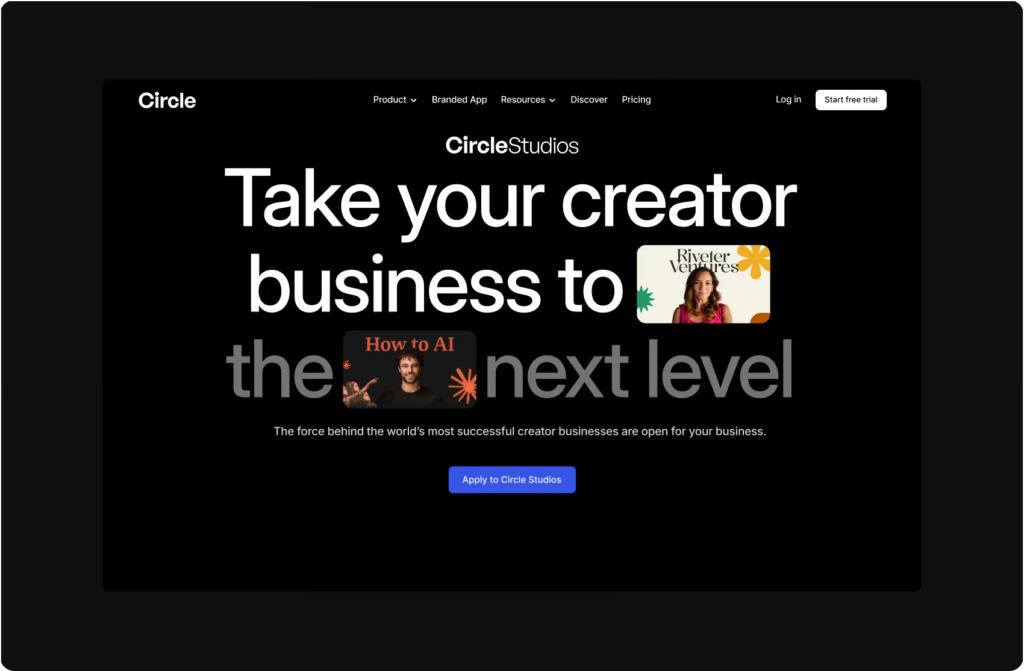
“You go do your thing, you be the creator, you build the audience,” Andrew says. “We are going to build your business alongside you, but also for you.”
Circle Discover 2.0, the platform’s updated community marketplace, addresses the same problem on a broader scale. Members share their goals when joining Discover, and the platform routes them to communities positioned to deliver relevant outcomes. Discover currently draws more than 100,000 monthly visitors, according to Circle. For creators, it operates as a passive acquisition channel that requires no changes to existing content strategy.

The Creators Eclipse Is Built to Unlock
Andrew is direct about whom the platform was designed to include. A sustainable creator business currently requires someone who can produce compelling content and also manage pricing, build funnels, operate a community, and run their own data analysis. The combination has historically excluded a significant share of people with real expertise but limited operational bandwidth.
“I really think people that maybe wouldn’t have been successful before are now going to be,” Andrew says. “With AI, there’s a huge chunk of people that would have been kind of cut out before, that won’t be now.”
The Eclipse beta opened June 16, with full access rolling out to all Circle customers by August 1. Close to 10,000 people RSVPed to the announcement launch event.
Andrew’s pitch to skeptics echoes his own first encounter with AI-native tools.
“I didn’t believe it until I actually just did it,” he says. “And then I was in there and I felt it. And I think that’s what you’ve got to do with Circle.”
Subscribe to Our Newsletter
Check Out Our Podcast