




Influencer
For Brandon Hans, $23M in TikTok Shop Sales Starts With Getting Someone to Stop Scrolling

In the first months of his TikTok Shop account, Brandon Hans sold roughly $2 million worth of books before the publisher whose catalog he was promoting ever reached out. “I remember I sent a message the day after I sold,” he says. “I was like, ‘Hi, I’m Brandon.’”
The run gave him an early lesson in TikTok Shop’s strange economics. A creator could move serious volume before a brand, competitor, or broader industry noticed. But that advantage did not last. Once other sellers copied the format, Brandon had to prove the business was bigger than one publisher, one category, or one viral content style.
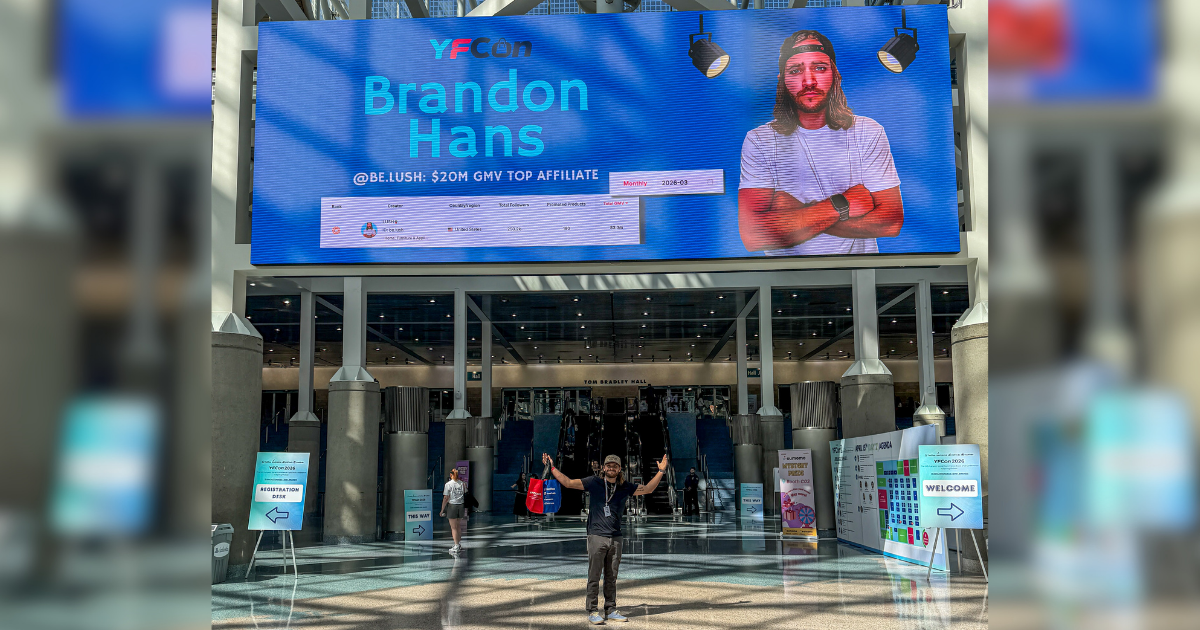
That reinvention became the foundation for @be.lush, the BELUSH-branded TikTok Shop account that has now generated more than $23 million in gross merchandise value. Brandon is TikTok Shop’s second-highest independent creator by all-time GMV and the platform’s 2026 “TikTok Shop Home Creator of the Year.”
His following, roughly 262,000, is not the metric he talks about most. His business depends on something more basic: getting someone to stop scrolling long enough for the sale to begin.
The Book Run That Forced a Reinvention
Brandon’s first sustained success came from a single publisher’s catalog: holistic self-help books, off-grid project manuals, and survival guides. The format worked at a scale he had not anticipated. “In the first four months or something like that, I sold about $2 million worth of those books,” he says.
The problem with that success was its visibility. Once competitors discovered the approach and began replicating it, Brandon realized he had built everything on a narrow foundation: five products, all from one publisher, using the same format month after month. His response was categorical.
“I just decided I would try anything and everything,” he says. The logic was competitive and self-diagnostic: if he could generate sales across any product category, he would have proof the business could last. To this day, his catalog spans home appliances, kitchen tools, automotive products, fashion, and sports gear.
Why the First Two Seconds Determine Everything
The most fundamental belief Brandon operates on is that a TikTok Shop video’s entire architecture collapses before it does anything useful if no one stops scrolling to watch it.
“Before you can even sell anyone anything, you have to get them to stop,” he says. “If I don’t get anyone to stop, then TikTok’s algorithm doesn’t reward me with more views.” Every downstream metric, engagement, watch time, and conversions depend on that initial pause. A video with low views represents a failed stop. High views paired with low conversions mean something broke in the middle.

Brandon has developed this into a diagnostic habit that extends well beyond his own content. “If I’m scrolling and I stop on a video, I catch myself mindlessly, and I’m like, wait, hold on. Why did I stop on that?” he says. “And I try to understand that on everything.” The trigger might be an unintended light flashing in the background, an unexpected visual movement, or something with no direct relationship to the product being promoted.
The payoff came recently. After roughly six months developing a faceless voiceover format, in which he demos a product while narrating over the footage, a vacuum video became his highest-performing to date. “It had been six months in the making of failing and trying again and trying to perfect it,” he says. That video generated over a million dollars in sales.
Brandon reads each video in stages. Low views usually mean the opening failed to stop the scroll. High views with weak sales point to a different problem: the demonstration, the offer, the product’s price, or the trust built in the middle of the video. Since GMV Max can begin evaluating a post within its first thousand views, he also weighs performance against what he knows from sellers about ad budgets and product-push schedules. A weak post on a low-spend day may not mean the creative failed; it may mean the video has not yet had a fair test.
Running Multiple Content Styles Like a Portfolio
Brandon runs several distinct formats simultaneously: on-camera talking head videos, faceless product demos, and the newer voiceover approach. Each has its own audience behavior and took real time to develop.
“What I always tell people is that the key to success is having a ton of different successful styles of content,” he says. When one format performs well, he leans into it while maintaining the others. When conditions shift, he has alternatives. He is direct about the competitive reality for new entrants. Starting today is harder than it was two years ago, simply because the field is more crowded. But the opportunity structure has not closed.
“You’re coming into this; it may be a harder time to get into it than ever, but everyone has an opportunity to be successful very quickly,” he says. “People just aren’t self-analytical and don’t piece apart” why one video works and another doesn’t.

The 3 Criteria That Actually Drive Product Selection
Ask Brandon how he picks products, and the product itself comes up last.
1) Inventory – A viral video can sell out a product in a day, forcing a restart. He needs brands that can sustain demand over time.
2) Ad Spend – TikTok’s GMV Max system evaluates videos for conversion within the first thousand views, then either amplifies or suppresses them based on that window. He notes that the era of consistently organic TikTok Shop results has largely passed. “There are still products that go viral organically,” he says, “but not like it did two years ago.”
3) Brand Relationship – “When I first started, I sold a million dollars for that book company,” he says. “I never spoke to a single person there.” At the volume he now operates, the quality of communication with sellers shapes how he interprets his analytics and times content to advertising schedules. “I see a significant value in that,” he says.
Brandon’s partnership with SharkNinja illustrates what alignment across all three criteria makes possible. He says he helped drive $100 million in sales for the brand in their first year on TikTok Shop, during a period when the company had no dedicated inventory allocation for the platform and was piecing together the model in real time.
Commission First, Brand Deals Second
Brandon’s revenue comes primarily from affiliate commission, not brand deals. The distinction shapes everything. Commission pays for results. Brand deals pay for placement. He declines most deal proposals and accepts them only on terms he defines, capping them at a handful of videos per month.
Early in his career, he took contracts requiring large volumes of content for fixed fees. “I quickly figured out that I wasn’t going to make 30 good videos for that product,” he says. Commission-based income imposes its own discipline: because revenue depends on conversion, every video has to function. “If I were not to do that and just pick the products I think are going to work, my sales vastly outweigh what that deal was going to be.”
He still accepts the occasional deal, partly to maintain the brand relationships that sustain his broader strategy. “I’m thankful for everything else we do together,” he says. “I’m going to take on and find a way to make that work for them.”
A $1M/Month and a Platform Still in Its Infancy
Brandon’s current goal is a single-month commission figure of $1 million, timed for Q4, when Black Friday volume produces the platform’s largest numbers. No creator has reached that mark. The current industry high sits at over $200,000 in a single month.
He has been in this position before, at a smaller scale. When he was earning $100,000 per month in commission, everyone said “that’ll never be sustainable,” he says. “And then I did it for almost two years.”
The broader argument he makes about TikTok Shop extends beyond any single milestone. Large brands that watched early movers succeed are now entering with inventory, advertising budgets, and affiliate networks already prepared. The window when a creator could quietly sell $2 million in books before anyone noticed has closed. What has replaced it is a more competitive and considerably larger market. Total platform sales, in his estimate, could be ten times higher within a year.
“I still think we’re on a really big incline as far as the growth of TikTok Shop,” he says. “I think it’s still truly in its infancy for what’s about to happen.”
Subscribe to Our Newsletter
Check Out Our Podcast