





Tech
Creator Economy Deals Are Getting Lost in Personal Inboxes. rep’d Is Building a Representation Directory

A major brand opportunity sat in one of Arielle Harris’s clients’ personal inboxes until the brand followed up multiple times. When the client finally forwarded the email thread to Arielle, she recognized it immediately, and it became the client’s largest brand deal to date. rep’d, a digital directory she is building for the Creator Economy, exists because that detour should not have happened.
Arielle is a music and talent manager who has run RELMORE Entertainment, her Beverly Hills management firm, since 2020. Her path through the industry includes music supervision training, a Master’s in Music Industry from the University of Southern California, and early career work under Trudy Green, whose clients have included Michael Jackson, Janet Jackson, Aerosmith, The Rolling Stones, Jay Shetty, and more. She later moved to Scale Management, working with creators including Doctor Mike, Tabitha Brown, Boman Martinez-Reid, and Sam & Colby, among others, before going independent. That crossover between music and digital talent management gave her a view of the Creator Economy’s operational problems before most of the industry had fully mapped them.
“I’m not just some random tech person coming into a trending space I know nothing about, ” Arielle says. “I’m trying to solve a problem I personally have encountered.”
rep’d, co-founded with business partner Kevin Nguyen in November 2025, is a digital directory for creator representation. The model draws from two industries with established precedents: ROSTR, which the music industry uses to map representation, signings, and tour routing, and IMDb, which catalogs anyone with a film or television credit. The Creator Economy is estimated to comprise more than 350 million creators globally, the bulk of them operating entirely outside existing entertainment databases because they’ve never released music or appeared on screen. “If TV, film, and music have representation databases, why doesn’t the Creator Economy?” Arielle says. “It’s the fastest-growing vertical in entertainment.”
rep’d is designed specifically for Creator Economy brands and agencies seeking accurate contact data, management companies maintaining roster visibility, and unsigned creators looking for representation or collaboration opportunities. The platform is currently in invite-only beta ahead of a formal public launch targeted for 2027.
Fragmented Contact Data Is Costing Real Deals
The problem rep’d is designed to address shows up on both sides of the deal table. Brands building creator campaigns default to whatever contact information is accessible, often a creator’s personal email address or a direct message. Managers end up processing inquiries their clients have already partially reviewed, which defeats the purpose of having someone vet opportunities on a creator’s behalf. That assumes the creator checked their personal inbox at all, and knew which brand inquiries were worth forwarding.
“My clients get emails sent to their personal Gmail accounts,” Arielle says. “While I encourage them to use my work email address in their bio, not all of them do. I can’t force them if they don’t want to, but I can build a resourceful database to disclose that I’m the right person to reach out to get brand deal flows working efficiently. When brands directly come to me to negotiate, and I bring the offer to the client, it makes me look better as a rep. I’m doing my job.”
Outdated records compound the issue. Arielle says she still receives campaign inquiries for creators she stopped representing more than a year ago, because brands have no reliable source for updated contact information. On the outbound side, she has reached out to creators she believed were unsigned, only to receive a reply from their manager confirming they had been signed for some time. The impression that creates, she notes, is that she failed to do her research when the information was simply not available.
Instagram’s platform mechanics add another friction point. The email button visible in the mobile app does not appear on desktop, where brands often build campaigns. Arielle says she has gathered screenshots of brand agencies telling creators directly that inaccessible contact information is why they are being passed over for partnerships.
rep’d Is a Directory First, Not a Campaign Platform
rep’d is not a campaign management platform where creators can apply for brand deals. Arielle and Kevin are building around a narrower function: Is this creator represented? Who represents this creator and how do you reach them?
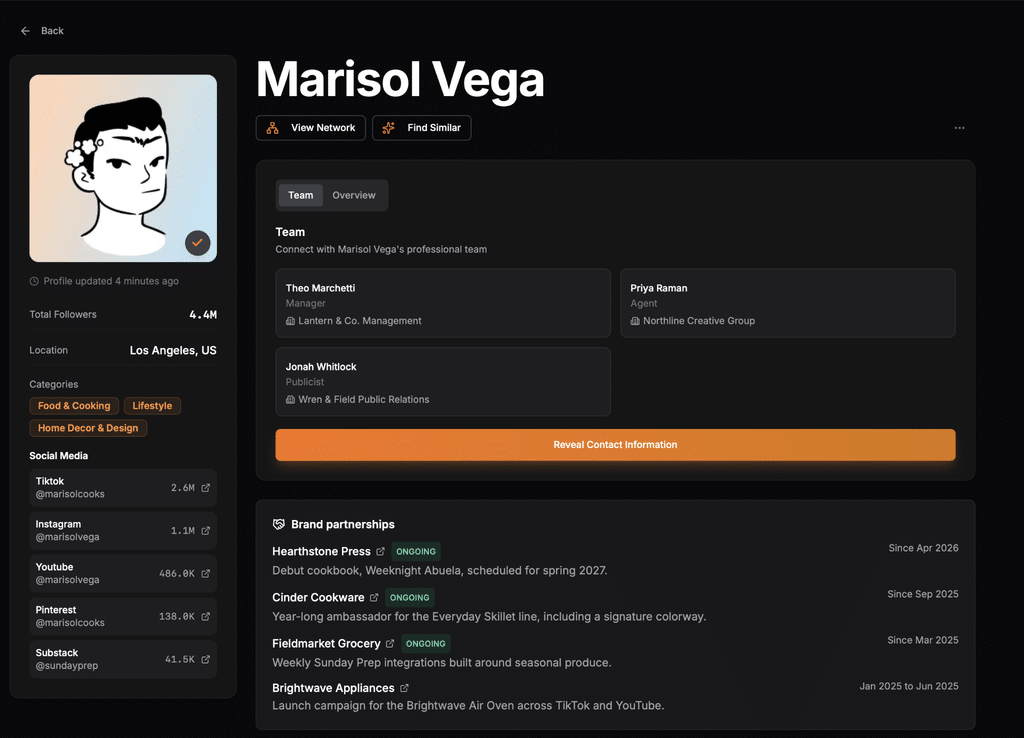
Image: Due to platform confidentiality, rep’d is unable to share an actual creator profile at this time. “Marisol Vega” is a placeholder account created to illustrate what users can expect. In this case, it’s a Food & Lifestyle creator represented by a manager, agent, and publicist.
Creator profiles include past brand partnerships, press mentions, and representation contact details. A “View Similar” function returns creators whose content is comparable to a searched profile. A “View Network” button surfaces other creators represented by the same agent, management, or firm. A search function filters by niche, follower range, and location.
The minimum threshold for a creator profile is 5,000 Instagram followers, but Arielle says human review handles edge cases. Gaming creators typically build their primary audiences on Twitch rather than Instagram, for example; a creator whose account reflects one viral post and minimal sustained output does not qualify regardless of momentary reach.
“Our platform is not just this automated button that has no nuance,” Arielle says. “There is this human element of criteria that we verify.”
Data in the system comes from three sources: Arielle’s personal network that she’s developed over the last decade of her career, publicly available information Arielle and her team have aggregated from social media, agency websites, and trade announcements, and first-party roster submissions from management companies who upload their own client lists directly.

The Pricing Model Puts Brands First
The Beta program is free for users. With the public launch, rep’d will introduce a tiered subscription structure. A basic plan will provide access to company names and indicate whether a creator is signed, while an enterprise tier will add contact information for signed creators, data on trending unsigned creators, and customized bi-weekly newsletters featuring industry news and rising creators in a subscriber’s designated category.
“You get the warning signs, in a good way, of: this one’s next,” Arielle says.
The enterprise tier targets brands and agencies as its primary audience. The commercial logic Arielle describes runs in one direction: if rep’d becomes a reliable source for creator representation data, agencies and management firms that want inbound brand business will be motivated to maintain accurate, current rosters on the platform. “We’ve seen how successful platforms like this are for other verticals of entertainment,” she says. “We need one dedicated to the digital space.”
The Poaching Objection Does Not Survive Scrutiny
The most common resistance Arielle has encountered comes from managers and agents who worry that a searchable roster database makes their clients more accessible to competitors. She believes that concern is both overstated and internally inconsistent.
“I have been able to find almost 9,000 creators and their reps just because of the internet and social media,” she says. “If you’ve tagged your client, if you have posted anything with your client, you are posting your roster.”
She also inverts the logic. A competing manager who wanted to solicit a signed creator would, on a platform like rep’d, be directed to the creator’s existing representative rather than to the creator directly. The resulting interaction would be manager-to-manager, more accountable and more visible than an unsolicited approach to the talent.
“The argument of poaching doesn’t hold to me because I feel like the less information about who reps you that is out there, the easier it is to get poached,” she says.
A Beta That Must Prove a Need Exists on Three Fronts
The invite-only beta structure serves a protective function as much as a research one. Arielle says it limits early access to verified managers and agents whose roster submissions she can trust, and it rewards early adopters with subscription discounts. The beta’s primary task is demonstrating demand across the three constituencies rep’d serves: brands and agencies, representatives, and creators.
According to Arielle, the Creator Economy’s infrastructure lags behind both music (ROSTR) and film and television (IMDb). rep’d is her argument that the category has grown large enough to deserve the same.
“If there’s a place that brands can go to find all the information they need,” she says, “managers and agents are going to do what they have to do to get their clients in front of them and to close.”
Cover photo credit: Liana Grigoryan
Subscribe to Our Newsletter
Check Out Our Podcast