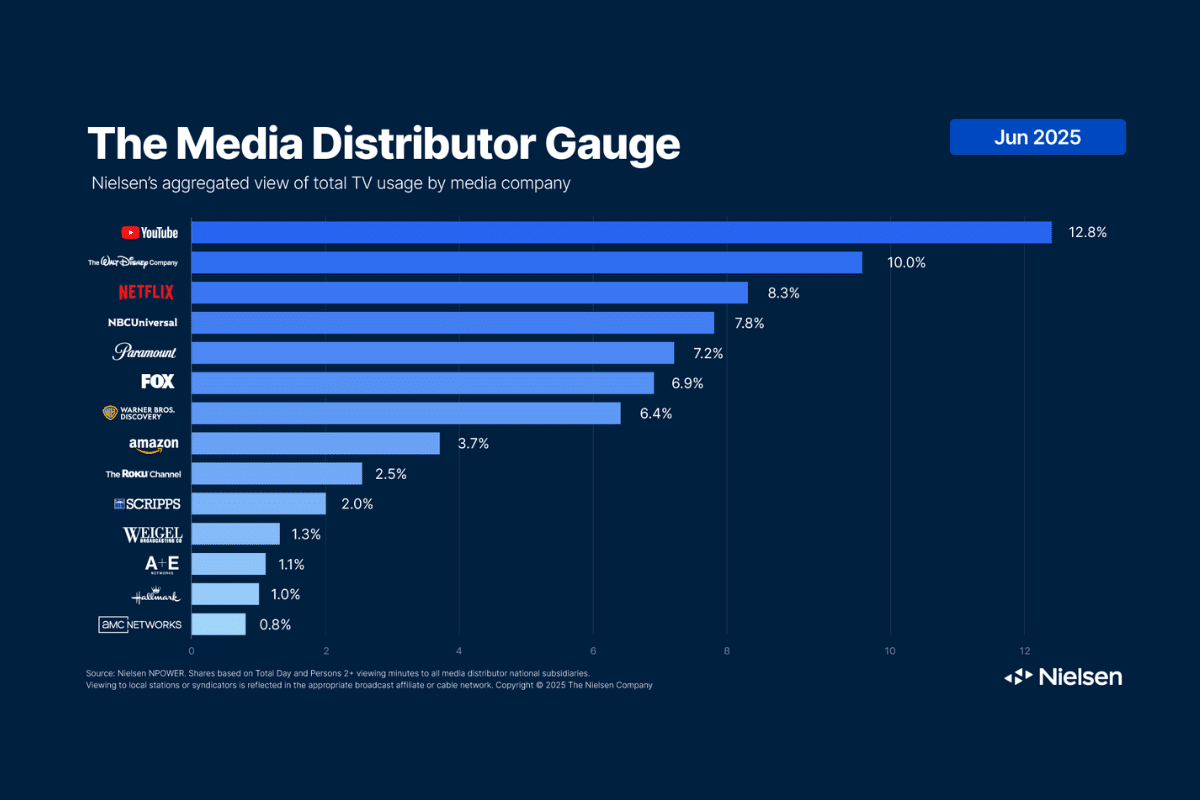
YouTube has strengthened its position as the leading media distributor according to Nielsen’s latest “Media Distributor Gauge” report, capturing a record 12.8% of total TV usage in June as the platform competes with Netflix in the streaming market. This marks YouTube’s fifth consecutive month at the top of the rankings and establishes its largest share of television to date.
The Google-owned video platform widened its lead over competitors, establishing a 2.8-point margin ahead of second-place Disney – the largest gap since Nielsen began tracking these metrics. YouTube viewership increased by 6% from May, benefiting from the summer surge in engagement among school-aged audiences.
Image source: Nielsen
According to a report by management consulting firm Owl & Co, YouTube’s global engagement reached an estimated 835 billion hours in the first half of 2025, representing an 11% year-over-year increase. This engagement volume dwarfs Netflix’s reported 95 billion viewer hours for the same period, which grew by only 1% year-over-year.
Continued Growth Trajectory
This performance extends YouTube’s growth trend throughout 2025. In April, the platform reached 12.4% of total TV viewing time, marking its third consecutive month of record viewership at that time. Year-over-year, YouTube’s share has increased by 2.8 percentage points from April 2024.
According to YouTube CEO Neal Mohan, TV screens have become the primary viewing medium for YouTube in the United States, with viewers watching over 1 billion hours of YouTube content on TVs daily. The platform’s audience composition has changed significantly, with viewing from adults aged 65 and above nearly doubling over the past two years, increasing by 96% since February 2023. This demographic now represents 15.4% of YouTube’s audience.
While YouTube has made major inroads into living room viewing, Owl & Co notes that most of YouTube’s viewership still comes from mobile devices. This cross-platform presence gives YouTube what Owl & Co describes as a “unique superpower” – when users begin watching on mobile in the morning, the algorithm can recommend perfectly tailored content when they return to their TV screens in the evening.
Streaming Shifts
While YouTube leads, other media distributors are experiencing notable shifts in their market positions. Disney maintained its second-place ranking with 10.0% of total TV viewing in June, with its ABC affiliates accounting for the top 33 broadcast telecasts driven primarily by NBA Finals coverage and “ABC World News Tonight.”
Netflix achieved a milestone by breaking into the top three media distributors for the first time, capturing 8.3% of total television viewing in June – its largest share since January. Netflix posted the largest monthly share increase among all media companies, adding 0.8 percentage points from May, driven by a 13.5% surge in viewership compared to the previous month.
In its recent earnings call, Netflix executives addressed the inevitable comparison to YouTube, emphasizing their “different profit model” and “strong profit model” compared to other services. According to Owl & Co, Netflix Co-CEO Greg Peters specifically highlighted their strategy to “compete to win more moments of truth for sure, but especially compete to win those most profitable moments,” in what Owl & Co characterized as “a subtle jab at less-profitable YouTube.”
NBCU ranked fourth with 7.8% of TV viewership, with its streaming service, Peacock, seeing a 13.4% monthly viewing increase, bolstered by 4.4 billion minutes of viewing for its reality series, “Love Island USA.”
Financial Performance and Monetization
YouTube’s financial performance reflects its market dominance. According to Alphabet’s latest earnings report, YouTube generated $9.8 billion in ad revenue for Q2 2025, representing a 13% year-over-year increase and an acceleration from Q1 performance.
Despite YouTube’s significantly higher engagement numbers compared to Netflix, the platforms monetize their viewership differently. Owl & Co analysis shows that while YouTube leads in total viewing hours, Netflix maintains higher Revenue Per Thousand Viewing Hours (RPMVH) – a key metric that measures how effectively platforms convert engagement into revenue. Netflix’s RPMVH increased from $201 in the first half of 2024 to $228 in the first half of 2025, while maintaining stable content costs.
YouTube and Netflix combined generated approximately $10 billion in operating income from streaming in the first half of 2025, according to Owl & Co research.
Find more information on the Owl & Co report here.
Dragomir is a Serbian freelance blog writer and translator. He is passionate about covering insightful stories and exploring topics such as influencer marketing, the creator economy, technology, business, and cyber fraud.


















YouTube has strengthened its position as the leading media distributor according to Nielsen’s latest “Media Distributor Gauge” report, capturing a record 12.8% of total TV usage in June as the platform competes with Netflix in the streaming market. This marks YouTube’s fifth consecutive month at the top of the rankings and establishes its largest share of television to date.
The Google-owned video platform widened its lead over competitors, establishing a 2.8-point margin ahead of second-place Disney – the largest gap since Nielsen began tracking these metrics. YouTube viewership increased by 6% from May, benefiting from the summer surge in engagement among school-aged audiences.
Image source: Nielsen
According to a report by management consulting firm Owl & Co, YouTube’s global engagement reached an estimated 835 billion hours in the first half of 2025, representing an 11% year-over-year increase. This engagement volume dwarfs Netflix’s reported 95 billion viewer hours for the same period, which grew by only 1% year-over-year.
Continued Growth Trajectory
This performance extends YouTube’s growth trend throughout 2025. In April, the platform reached 12.4% of total TV viewing time, marking its third consecutive month of record viewership at that time. Year-over-year, YouTube’s share has increased by 2.8 percentage points from April 2024.
According to YouTube CEO Neal Mohan, TV screens have become the primary viewing medium for YouTube in the United States, with viewers watching over 1 billion hours of YouTube content on TVs daily. The platform’s audience composition has changed significantly, with viewing from adults aged 65 and above nearly doubling over the past two years, increasing by 96% since February 2023. This demographic now represents 15.4% of YouTube’s audience.
While YouTube has made major inroads into living room viewing, Owl & Co notes that most of YouTube’s viewership still comes from mobile devices. This cross-platform presence gives YouTube what Owl & Co describes as a “unique superpower” – when users begin watching on mobile in the morning, the algorithm can recommend perfectly tailored content when they return to their TV screens in the evening.
Streaming Shifts
While YouTube leads, other media distributors are experiencing notable shifts in their market positions. Disney maintained its second-place ranking with 10.0% of total TV viewing in June, with its ABC affiliates accounting for the top 33 broadcast telecasts driven primarily by NBA Finals coverage and “ABC World News Tonight.”
Netflix achieved a milestone by breaking into the top three media distributors for the first time, capturing 8.3% of total television viewing in June – its largest share since January. Netflix posted the largest monthly share increase among all media companies, adding 0.8 percentage points from May, driven by a 13.5% surge in viewership compared to the previous month.
In its recent earnings call, Netflix executives addressed the inevitable comparison to YouTube, emphasizing their “different profit model” and “strong profit model” compared to other services. According to Owl & Co, Netflix Co-CEO Greg Peters specifically highlighted their strategy to “compete to win more moments of truth for sure, but especially compete to win those most profitable moments,” in what Owl & Co characterized as “a subtle jab at less-profitable YouTube.”
NBCU ranked fourth with 7.8% of TV viewership, with its streaming service, Peacock, seeing a 13.4% monthly viewing increase, bolstered by 4.4 billion minutes of viewing for its reality series, “Love Island USA.”
Financial Performance and Monetization
YouTube’s financial performance reflects its market dominance. According to Alphabet’s latest earnings report, YouTube generated $9.8 billion in ad revenue for Q2 2025, representing a 13% year-over-year increase and an acceleration from Q1 performance.
Despite YouTube’s significantly higher engagement numbers compared to Netflix, the platforms monetize their viewership differently. Owl & Co analysis shows that while YouTube leads in total viewing hours, Netflix maintains higher Revenue Per Thousand Viewing Hours (RPMVH) – a key metric that measures how effectively platforms convert engagement into revenue. Netflix’s RPMVH increased from $201 in the first half of 2024 to $228 in the first half of 2025, while maintaining stable content costs.
YouTube and Netflix combined generated approximately $10 billion in operating income from streaming in the first half of 2025, according to Owl & Co research.
Find more information on the Owl & Co report here.
Subscribe to Our Newsletter
Check Out Our Podcast