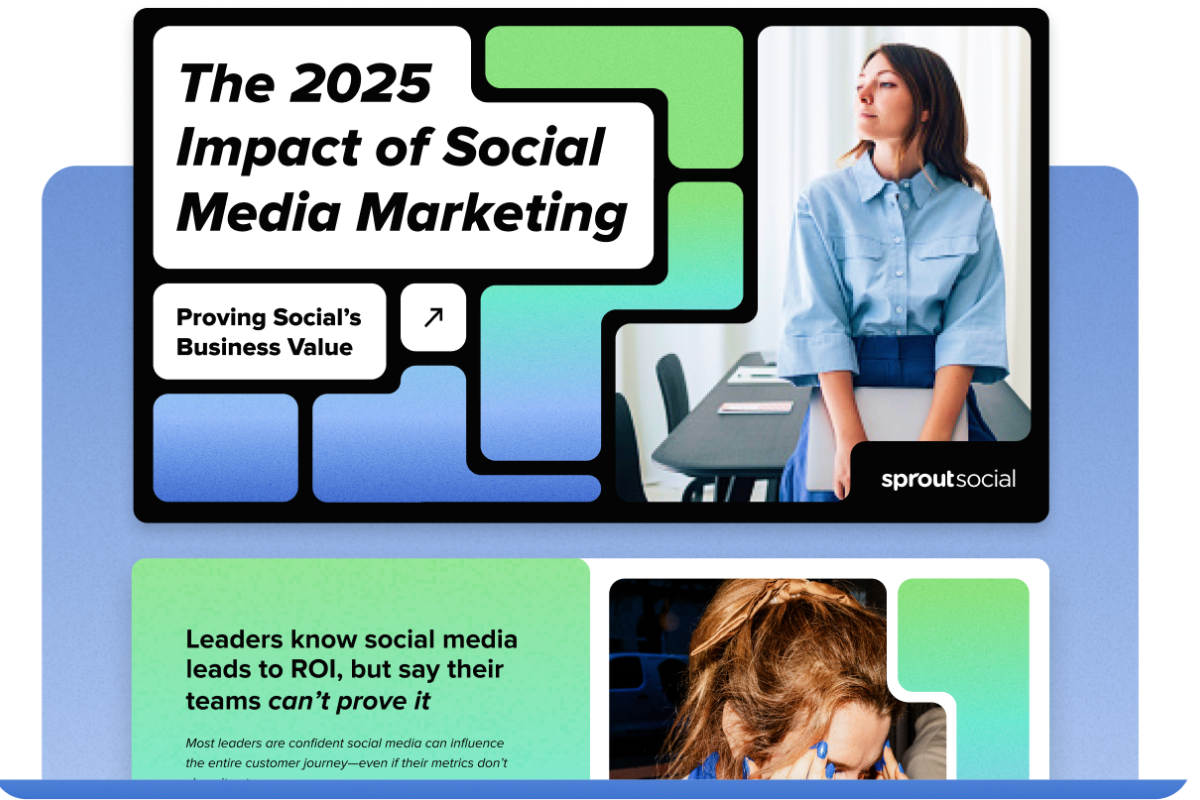
Marketing leaders widely recognize the contribution of social media to business outcomes, but struggle to measure and demonstrate its full value, according to Sprout Social’s “2025 Impact of Social Media Marketing” report.
The survey of 1,200 global marketing leaders reveals that while 56% of marketing leaders believe social media drives revenue, less than half (44%) rate their social teams as experts at measuring business impact. The confidence gap is even more pronounced with top-of-funnel metrics – 67% are confident that social media generates brand awareness, but as social networks approach peak saturation and economic conditions remain uncertain, these metrics carry less weight with leadership.
“Which puts social media marketers under increased pressure to close attribution gaps and tell more compelling data stories,” the report states.
The primary obstacle cited is incompatibility between social media management tools and the rest of the marketing tech stack. Leaders also point to difficulties in establishing reliable attribution models and a lack of internal knowledge on how to connect social efforts to business goals.
Jordan Tennenbaum, Head of Social at Talkdesk, explains: “We define ROI (Return on Investment) with the ratio of opportunities created to pipeline generation. We track leads and UTMs (Urchin Tracking Module) on all social content. If a lead engages with social media content, we see that in Salesforce. Through the magic of attribution, we can see the entire journey, all the way from interacting with social content at the top of the funnel to becoming a customer.”
Current Measurement Approaches
Marketing teams primarily define social ROI through:
Engagement (68%)
Conversion (65%)
Revenue (57%)
Efficiency (55%)
Discoverability (51%)
Despite recognition that social drives more than awareness, teams lack the infrastructure to prove it. The report reveals that less than half of all marketing leaders say their teams embed social data into any form of customer relationship management (CRM) software, creating a significant barrier to comprehensive attribution.
What are Expert Teams?
The research identified key differences in the 44% of teams rated as “expert” at measuring social media’s business impact:
Revenue-focused metrics: Expert teams are significantly more likely to track revenue and efficiency metrics rather than just engagement.
Higher tech adoption: 58% of expert teams use social media management software, compared to lower rates among emerging teams.
Sophisticated measurement tools: These teams rely more heavily on link tracking and marketing automation systems, and report fewer struggles with setting up reliable attribution models.
Confidence correlation: 72% of leaders whose teams excel at measurement also rate them as experts at understanding how to drive more business impact, suggesting that “the more data (and data literacy) teams have, the more strategic they become.”
Despite these advantages, even expert teams face challenges integrating social data with the rest of their tech stack, indicating room for improvement across the industry.
Breaking Down Data Silos
Currently, digital marketing teams are the primary users of social data, but leaders envision broader applications across their organizations. They specifically want social insights to inform decisions in:
Customer experience and success (58%)
Customer care and support (49%)
Business development (49%)
Sales (44%)
Product/Research & development (38%)
Shirley Tat, Global Head of Social at Canva, provides a successful example: “We are integrating social data into the larger marketing mix by analyzing community conversations on social to learn more about what our audience needs from our product. By tracking all of these conversations in Sprout, we’re able to tag thousands of incoming messages and eventually close the loop with our community and show them we listened. We launched all of our new products this year based on user feedback.”
Platform Effectiveness and Content Strategy Insights
The report identifies the platforms driving the most business impact:
For all brands: Facebook (70%), YouTube (68%), TikTok (64%)
For B2B specifically: LinkedIn (70%), Facebook (59%), YouTube (56%)
While 85% of marketing leaders believe their brand needs to be present on more networks, there are significant disagreements about content strategy. The majority of Marketing Directors (71%) and CMOs (69%) believe increasing publishing volume is necessary to drive impact, but only half of social media managers agree.
This disconnect is particularly notable, given that benchmark data show a decrease in publishing volume from 2023 to 2024, yet engagement increased by almost 20%. “Consumers want more originality, authenticity, and community – not brands posting just to post,” the report states.
Interestingly, VPs are more likely to trust their teams’ judgment, with 46% preferring that teams recommend posting cadence versus only 13% of C-suite executives and 12% of Directors.
Investment Shifts
The data shows a significant reallocation of marketing resources toward social channels:
80% of marketing leaders plan to shift funds from other channels to social
87% expect to increase paid social spending
Over 80% will boost investment in influencer marketing and organic social
81% are reallocating funds from traditional SEO to social channels
This investment extends to staffing, with three-quarters of marketing leaders anticipating an increase in headcount for social teams next year. The top hiring priorities are social media search optimization (SOSEO), social customer service and support, paid social, influencer marketing, and social listening and analytics.
The report notes that content creation roles rank lower in hiring priorities, “which is unexpected as so many think their brands need to post more.”
Additionally, 71% of leaders have increased investment in agencies and freelancers since adopting AI, suggesting that implementation is driving third-party resourcing.
Regional Differences in Social Maturity
The report reveals notable variations in social media sophistication across regions:
Australia: Leading in social media measurement with higher rates of teams rated as experts (54% vs. 44% globally) and higher adoption of social media management tools (71% vs. 55% globally). Australian leaders are more likely to tie social to acquisition (71%) and revenue metrics (65% vs. 57% globally).
United Kingdom: Most UK teams are at an “evolving” stage (49%) in measuring social’s business impact. They uniquely rank TikTok as their #1 platform (66%) and focus more on conversion metrics than engagement or revenue. UK leaders are also more likely to advocate for decreased publishing volume.
United States: U.S. marketing leaders are the most likely to rate their teams as “emerging or evolving” (57%) and express dissatisfaction with social reporting. They prioritize hiring for SOSEO and customer care roles more than their global counterparts.
The Path Forward
The report concludes that social media has evolved beyond an awareness lever to become “a measurable driver of revenue, loyalty and decision-making – demanding investment that reflects its full-funnel impact.”
To demonstrate this value, teams require more effective attribution models, seamless tech integrations, and the ability to transform insights into strategic action. The report suggests that social teams can begin earning executive trust by reframing reporting to align with business impact.
Laura Donadio, consultant and former Global Head of Influencer & Partnerships at Wild, summarizes this evolution: “It isn’t just that brands should increase investments to social, it’s that they should incorporate social insights and experiences across the customer journey – from email to out-of-home advertising to their brick-and-mortar stores. Social should be at the center of everything you do.”
Image credit: Sprout Social The full report is available here
Dragomir is a Serbian freelance blog writer and translator. He is passionate about covering insightful stories and exploring topics such as influencer marketing, the creator economy, technology, business, and cyber fraud.
















Marketing leaders widely recognize the contribution of social media to business outcomes, but struggle to measure and demonstrate its full value, according to Sprout Social’s “2025 Impact of Social Media Marketing” report.
The survey of 1,200 global marketing leaders reveals that while 56% of marketing leaders believe social media drives revenue, less than half (44%) rate their social teams as experts at measuring business impact. The confidence gap is even more pronounced with top-of-funnel metrics – 67% are confident that social media generates brand awareness, but as social networks approach peak saturation and economic conditions remain uncertain, these metrics carry less weight with leadership.
“Which puts social media marketers under increased pressure to close attribution gaps and tell more compelling data stories,” the report states.
The primary obstacle cited is incompatibility between social media management tools and the rest of the marketing tech stack. Leaders also point to difficulties in establishing reliable attribution models and a lack of internal knowledge on how to connect social efforts to business goals.
Jordan Tennenbaum, Head of Social at Talkdesk, explains: “We define ROI (Return on Investment) with the ratio of opportunities created to pipeline generation. We track leads and UTMs (Urchin Tracking Module) on all social content. If a lead engages with social media content, we see that in Salesforce. Through the magic of attribution, we can see the entire journey, all the way from interacting with social content at the top of the funnel to becoming a customer.”
Current Measurement Approaches
Marketing teams primarily define social ROI through:
Despite recognition that social drives more than awareness, teams lack the infrastructure to prove it. The report reveals that less than half of all marketing leaders say their teams embed social data into any form of customer relationship management (CRM) software, creating a significant barrier to comprehensive attribution.
What are Expert Teams?
The research identified key differences in the 44% of teams rated as “expert” at measuring social media’s business impact:
Despite these advantages, even expert teams face challenges integrating social data with the rest of their tech stack, indicating room for improvement across the industry.
Breaking Down Data Silos
Currently, digital marketing teams are the primary users of social data, but leaders envision broader applications across their organizations. They specifically want social insights to inform decisions in:
Shirley Tat, Global Head of Social at Canva, provides a successful example: “We are integrating social data into the larger marketing mix by analyzing community conversations on social to learn more about what our audience needs from our product. By tracking all of these conversations in Sprout, we’re able to tag thousands of incoming messages and eventually close the loop with our community and show them we listened. We launched all of our new products this year based on user feedback.”
Platform Effectiveness and Content Strategy Insights
The report identifies the platforms driving the most business impact:
While 85% of marketing leaders believe their brand needs to be present on more networks, there are significant disagreements about content strategy. The majority of Marketing Directors (71%) and CMOs (69%) believe increasing publishing volume is necessary to drive impact, but only half of social media managers agree.
This disconnect is particularly notable, given that benchmark data show a decrease in publishing volume from 2023 to 2024, yet engagement increased by almost 20%. “Consumers want more originality, authenticity, and community – not brands posting just to post,” the report states.
Interestingly, VPs are more likely to trust their teams’ judgment, with 46% preferring that teams recommend posting cadence versus only 13% of C-suite executives and 12% of Directors.
Investment Shifts
The data shows a significant reallocation of marketing resources toward social channels:
This investment extends to staffing, with three-quarters of marketing leaders anticipating an increase in headcount for social teams next year. The top hiring priorities are social media search optimization (SOSEO), social customer service and support, paid social, influencer marketing, and social listening and analytics.
The report notes that content creation roles rank lower in hiring priorities, “which is unexpected as so many think their brands need to post more.”
Additionally, 71% of leaders have increased investment in agencies and freelancers since adopting AI, suggesting that implementation is driving third-party resourcing.
Regional Differences in Social Maturity
The report reveals notable variations in social media sophistication across regions:
Australia: Leading in social media measurement with higher rates of teams rated as experts (54% vs. 44% globally) and higher adoption of social media management tools (71% vs. 55% globally). Australian leaders are more likely to tie social to acquisition (71%) and revenue metrics (65% vs. 57% globally).
United Kingdom: Most UK teams are at an “evolving” stage (49%) in measuring social’s business impact. They uniquely rank TikTok as their #1 platform (66%) and focus more on conversion metrics than engagement or revenue. UK leaders are also more likely to advocate for decreased publishing volume.
United States: U.S. marketing leaders are the most likely to rate their teams as “emerging or evolving” (57%) and express dissatisfaction with social reporting. They prioritize hiring for SOSEO and customer care roles more than their global counterparts.
The Path Forward
The report concludes that social media has evolved beyond an awareness lever to become “a measurable driver of revenue, loyalty and decision-making – demanding investment that reflects its full-funnel impact.”
To demonstrate this value, teams require more effective attribution models, seamless tech integrations, and the ability to transform insights into strategic action. The report suggests that social teams can begin earning executive trust by reframing reporting to align with business impact.
Laura Donadio, consultant and former Global Head of Influencer & Partnerships at Wild, summarizes this evolution: “It isn’t just that brands should increase investments to social, it’s that they should incorporate social insights and experiences across the customer journey – from email to out-of-home advertising to their brick-and-mortar stores. Social should be at the center of everything you do.”
Image credit: Sprout Social
The full report is available here
Subscribe to Our Newsletter
Check Out Our Podcast