

Influencer
RHEI’s Shahrzad Rafati On Building A Creative Operating System For The Human Signal In The Creator Economy

For more than two decades, Shahrzad Rafati has been building technology across media, creators, and scale. As founder and CEO of RHEI, Shahrzad leads a company that positions itself not as a platform, agency, or marketplace, but as a creative operating system designed to amplify human creativity across the creator economy.
Founded in 2005 and headquartered in Vancouver, Canada, RHEI reports more than 600 million unique viewers each month across 150 countries, working with creators and media companies to build, grow, and monetize audiences at scale. In recent years, the company has reoriented its strategy toward becoming a pure technology business, focusing on agentic AI systems that operate alongside creators as proactive digital teammates rather than reactive tools.
“We founded RHEI on a very simple and uncompromising vision,” Shahrzad says. “To build the next generation creative operating system that makes the human genius unstoppable.”
The framing of human genius as the core asset runs through both Shahrzad’s philosophy and RHEI’s product roadmap. As generative AI floods the market with tools optimized for efficiency, RHEI is betting that the next phase of the creator economy will be defined not by automation alone, but by how well technology protects and elevates what Shahrzad repeatedly calls the “human signal.”
From Media-Tech to Creative Operating System
RHEI’s early years were shaped by the expansion of online video and the emergence of creators as a new class of media entrepreneurs. For much of its history, the company operated as a media-tech provider, building tools and services that helped creators and media companies distribute content, grow audiences, and generate revenue across platforms.
That positioning shifted decisively about three years ago as advances in generative AI created both new opportunities and new risks for creators.
“We were always a tech-first business,” Shahrzad says. “But we made a conscious decision to disrupt ourselves rather than wait for someone else to do it.”
The rebrand to RHEI marked a transition from bundled services to a singular focus: building AI systems that operate across the entire creative workflow. Rather than optimizing for dashboards or point solutions, the company began investing in agentic orchestration: AI agents designed to collaborate with one another and proactively support creators’ day-to-day work.
Shahrzad describes the shift as necessary to expand RHEI’s addressable market. “The old model allowed us to serve a subset of creators and enterprise clients,” she explains. “The opportunity with agentic AI was to go far beyond that, without losing sight of the creator’s voice.”
The Problem: Scale Without Burnout
At the center of RHEI’s strategy is a problem Shahrzad sees as structural, rather than temporary: creators are expected to operate as full media companies without the support systems of traditional organizations.
“When you sign up to be a content creator, you don’t sign up to be a channel manager, a strategist, a director, an editor, a distributor, and a rights manager,” she says. “But that’s what the job has become.”
Shahrzad cites RHEI internal data and industry research indicating that more than two-thirds of creators experience some level of burnout. The causes are familiar: platform fragmentation, constant format changes, and the pressure to publish at increasing volume across multiple channels.
RHEI’s response to that problem is not to replace creators with automation, but to remove what Shahrzad refers to as “the tyranny of logistics.”
“Our goal is to free creators so they can focus on their unique vision and craft,” she says. “Not to turn them into prompt engineers.”
Introducing Made: A Creative Operating System
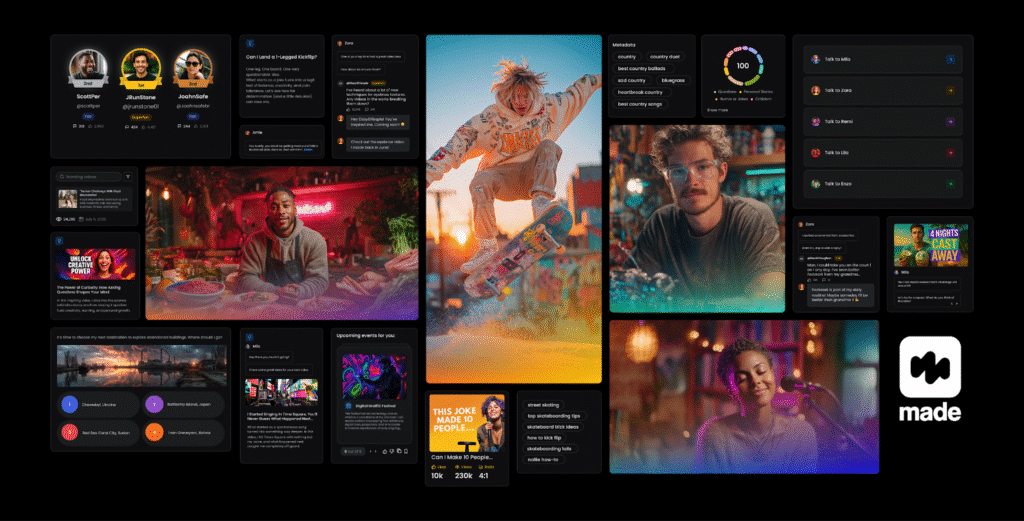
RHEI’s philosophy materialized most clearly with the launch of Made, the company’s agentic AI platform designed specifically for creators and media companies. Built on proprietary, licensed audiovisual data (approximately eight petabytes in total), Made functions as what Shahrzad describes as a “creative operating system.”

Rather than a single assistant, Made comprises multiple AI agents that operate as a specialized team across the creative lifecycle, each designed to remove friction at a specific stage of scale.
- Milo, a creative director focused on ideation, storytelling, and visual decision-making, including thumbnails and creative framing.
- Zara, a community manager who analyzes audience behavior at scale, helping creators understand fandom segments and engagement patterns that would be impossible to track manually.
- Amie, a relationship manager who supports onboarding, workflow optimization, and day-to-day collaboration with the platform.
- Remi, a production specialist designed to address post-production bottlenecks by extracting high-engagement moments from long-form footage and transforming them into platform-specific, shareable clips.
- Lila, a distribution and rights management agent who helps creators maintain visibility and control once content travels beyond its original channel, including identifying reuploads and understanding how fans redistribute content.
“What makes Made different is that the agents are proactive,” Shahrzad says. “They don’t wait for you to ask the right question. They surface ideas, insights, and actions before you even think to ask.”
Trained on each creator’s existing content, audience data, and behavioral patterns, the agents adapt to tone, voice, and creative intent over time. As output increases, the system scales alongside the creator, reducing the operational burden that often follows growth rather than replacing the creative process itself.
Proactive, Not Reactive
Shahrzad is explicit about how this approach diverges from most AI tools currently available to creators.
“The era of tools was defined by dashboards,” she says. “The era we’re building toward is conversational and collaborative.”
Traditional chatbots, she argues, are reactive by design and trained largely on public datasets, resulting in outputs that trend toward the average. Made’s agents, by contrast, operate on private, licensed data and are designed to act independently within defined parameters.
For creators, that proactivity translates into tangible workflow changes. Shahrzad says Milo can generate thumbnail concepts before a creator logs in. Zara can segment fandoms (identifying superfans, casual viewers, and even anti-fans) at a scale no individual could manage manually. Remi can transform long-form footage into platform-specific short-form clips without requiring creators to rethink how they shoot content in the first place.
“Editing takes a lot of time, and it’s not the most enjoyable task,” Shahrzad says. “With Remi, you’re automating something that previously required a dedicated editor.”
Monetization as an Output, Not a Starting Point
While monetization remains a core concern for creators, RHEI does not frame Made as a direct revenue tool in the narrow sense.
“The way we think about monetization is more fundamental,” Shahrzad explains. “If you have ten views, the ad rate doesn’t matter that much. What matters is building an engine that drives sustained audience growth.”
By increasing content output, improving distribution efficiency, and deepening audience engagement, Made is designed to multiply the inputs that ultimately drive subscriptions, advertising, licensing, and partnerships.
Shahrzad notes that Lila, the platform’s distribution and rights agent, plays a critical role here. By tracking how content is reuploaded and shared across platforms, Lila helps creators understand where value is being created and where it may be leaking.
“It’s about protecting your content while maximizing reach,” she says. “And understanding how your fandom is interacting with your work.”
Enterprise Roots, Creator Focus
Although Made is now available to individual creators through tiered plans, its architecture has been shaped by years of enterprise deployments. RHEI has worked with major media and entertainment companies, including Sony Pictures, Warner Music Group, Paramount Global, Lionsgate, and Universal, generating tens of thousands of content variants and billions of views.
According to Shahrzad, some enterprise customers have achieved channel expansion and revenue growth of 400%-1,200% by leveraging RHEI’s agentic systems.
“These partners challenge us to build better products,” she says. “And that discipline carries over when we build for creators.”
Ethics, Compensation, and the Quadruple Bottom Line
Underlying RHEI’s technical strategy is a broader governance framework Shahrzad refers to as the “quadruple bottom line,” measuring success across financial, people, social, and environmental outcomes.
This philosophy informs how RHEI sources and licenses data for its AI systems. Unlike many foundational models, RHEI works directly with creators and media companies to license audiovisual content, ensuring contributors are compensated for how their work is used.
“We wanted to make sure that as this technology gets built, the people who contributed to it are fairly compensated,” Shahrzad says. “That’s foundational for us.”
Internally, RHEI reports a 0% pay gap and approximately 40% female representation across its workforce and leadership, metrics Shahrzad sees as inseparable from long-term business performance.
What the Human Edge Looks Like in 2026
As AI-generated content becomes more pervasive, Shahrzad believes the differentiator for creators will not be speed or volume alone.
“It’s creative vision,” she says. “It’s the life experiences, the imperfections, the emotions that only humans can bring to a story.”
She compares the future content landscape to food systems: processed content will always exist, but demand for authentic, meaningful work will continue to rise. The role of AI, in her view, is to support creators in reaching that higher standard, not to replace them.
“Learn the technology,” Shahrzad advises creators. “Use it so you can spend more time on your story.”
RHEI in 2026
RHEI’s 2026 roadmap focuses on expanding Made’s capabilities through deeper agent specialization, improved orchestration, and a more intuitive user experience. Shahrzad describes the goal as making the platform’s interaction feel “magical,” i.e., a product that disappears into the background while amplifying creative output.
Most of RHEI’s future development, she says, will flow through Made.
For Shahrzad, the guiding principle remains consistent: build systems that scale creativity without erasing the human signal.
“My ask for everyone building in the creator economy,” she says, “is to care more about the human signal and about safety. Those two things should be at the forefront as we build what comes next.”
Image source: Made
Checkout Our Latest Podcast