



Technology
Redflag AI: Bringing Enterprise-Grade Content Protection To The Creator Economy

For years, content protection has been a problem solved primarily for the largest media companies: film studios, broadcasters, and global rights holders with the budgets and internal teams to monitor piracy at scale. Max Eisendrath, founder and CEO of Redflag AI, believes that model no longer reflects how modern media is created or monetized.
“The volume of output that people create and distribute everywhere across all these platforms is far beyond what someone could manage manually,” Max says. “Automated assistance for that is definitely needed now.”
Founded in 2019, Redflag AI is a San Francisco-based technology company focused on automated content protection and monetization across the internet. The company builds software that detects unauthorized reuploads, live-stream leaks, and content misuse at scale – then either removes the content or redirects revenue to the rightful owner.
While Redflag AI spent its first several years serving enterprise clients such as major studios and sports broadcasters, Max says the company’s most important shift is happening now: extending those same tools to creators themselves.
From Social Listening to Content Protection
Max’s path to building Redflag AI did not begin in media enforcement. After college, he worked as a software developer, building products across social listening, sentiment analysis, and large-scale web crawling. Between 2017 and 2020, his work focused on analyzing public perception at scale: tracking how brands, campaigns, and ideas moved across the internet.
That technical foundation later proved critical. “We were already working with high-volume web crawling, which is a very tedious process by itself,” he explains. “From the technical side, it became clear this was worth automating.”
The market signal came from an unexpected direction. Max and his team began receiving repeated requests to automate anti-piracy services, initially from movie studios. Those requests quickly expanded to book publishers, music companies, software firms, and live sports broadcasters, all facing similar challenges as content distribution shifted to streaming and digital platforms.
“Copyright infringement and general content protection just wasn’t automated,” Max says. “It’s still largely done manually by individual creators themselves or even large teams of people. And that sucks.”
Redflag AI was founded to tackle that gap by building a software-first, automated alternative to labor-intensive enforcement workflows.
Enterprise Roots, Creator Focus
For its first three years, Redflag AI operated almost exclusively in the enterprise market. Max views that period as foundational, rather than transitional.
“When you work with Disney- or ESPN-tier enterprises, they have very high standards and a lot of demands on how this stuff is done,” he says. “It was good to cut our teeth with the largest content owners and really get familiar with all the ins and outs of takedown, monetization, and protection.”
That experience shaped Redflag AI’s core architecture, including proprietary watermarking, fingerprinting, and machine-learning-based crawling systems designed to operate at scale while minimizing false positives.
Only in the past year has the company expanded its focus to creators. The motivation, Max notes, is structural rather than opportunistic.
“Creators are by far the most untapped and least serviced group of content owners, even though there are the most of them and it’s the fastest-growing category,” he says. “They just haven’t had the same menu of options to work with.”
Redflag AI now positions itself as a bridge between enterprise-grade enforcement and creator-friendly usability.
How Redflag AI Works
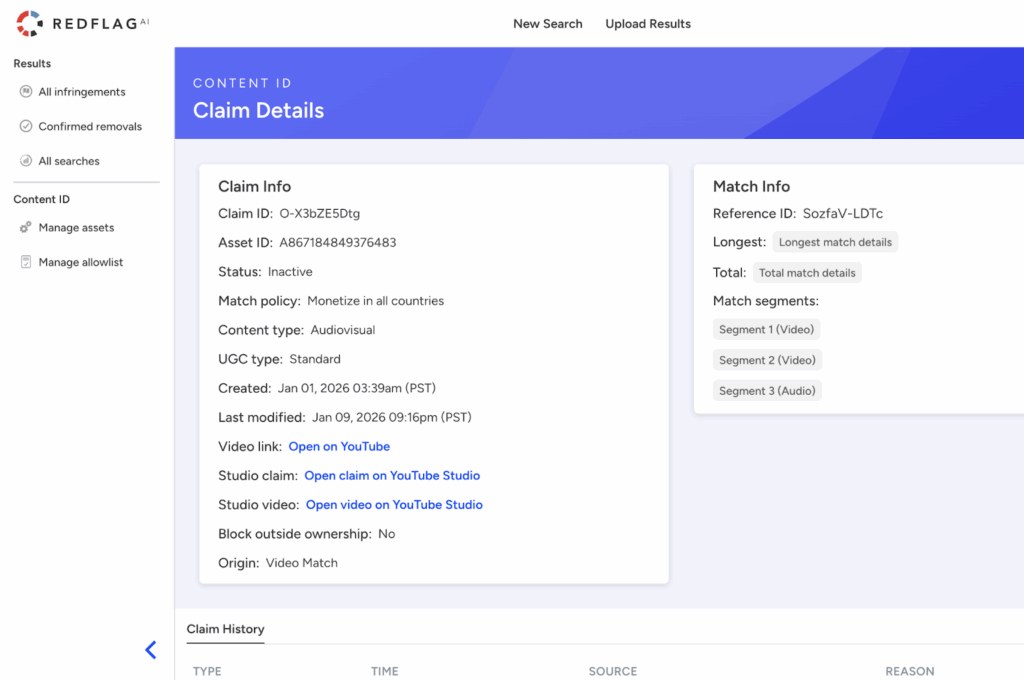
At its core, Redflag AI provides automated content protection and monetization through a self-service dashboard. Creators and rights holders upload their content (videos, livestreams, or catalogs) and define rules for how infringements should be handled.
Those rules can vary. As Max notes, some users prefer takedowns. Others opt to leave infringing content live while reclaiming the ad revenue. Many choose a combination of both.

Creators have a choice. “If you find anything of mine on whatever platform, just monetize it,” he explains. “Or always take it down. Once they set that configuration, it’s all automated.”
The system integrates directly with ad and distribution infrastructure, allowing Redflag AI to redirect revenue from infringing uploads back to the original creator in subsequent payout cycles.
For live content, the stakes and the technology are different. Redflag AI’s system, internally known as Cyclops, focuses on real-time detection and enforcement for live streams and events.
“With live events, there’s always an original source that’s leaking the stream,” Max says. “We use watermarking to track down the specific session or account that’s leaking it and turn that off in as close to real time as possible.”
He believes that capability has made Redflag AI particularly relevant in sports, paywalled content, and creator-led live experiences where timing directly impacts revenue.

Why Platform Tools Aren’t Enough
Most major platforms already offer some form of content protection, including YouTube’s Content ID and Meta’s Rights Manager. Max is careful not to dismiss those tools outright.
“Some of the tools are good,” he says. “They’re not terrible by any means.”
The limitation, he argues, is scope and scale. Platform-native tools are constrained by what happens within a single ecosystem, while infringement often occurs across dozens of platforms, regions, and formats, according to Max.
“When we use Redflag plus the platform tools together, we regularly see at least two to three times more detections,” he says. “The platform tools can only do so much. They’re not comprehensive.”
Automation also plays a role. Max points out that manually managing enforcement, even with platform tools, can become a full-time job as content libraries grow.
“It’s the kind of thing you really can’t do at scale unless it’s automated,” he says.
The Revenue Creators Don’t See
One of the most consistent surprises Max encounters when working with creators is the scale of unauthorized distribution.
“I talked to a channel recently where there were something like 10 million views of their content on other channels in just four to six weeks,” he says. “That was more than the views on their own channel.”
According to Max, the issue is often visibility. Content may be translated, clipped, or redistributed in languages and regions that creators do not actively monitor.
“I’m not looking for my videos in Vietnamese somewhere,” Max notes. “So I could see how somebody would miss that.”
For enterprise clients, Redflag AI has uncovered similar blind spots. In some cases, Max says, total viewership, including unauthorized streams, can be five times higher than subscription data alone suggests.
AI and the Next Wave of Risk
Max believes AI-generated content will dramatically increase the scale and complexity of infringement.
“There’s just going to be a flood of AI-generated copies of everything – likeness, mirror content, all of it,” he says. “The amount of piracy and infringement is just going to explode.”
Redflag AI is already preparing for that shift. In Q2 2026, the company plans to launch a new product, Redflag Shield, designed to watermark original content in ways that make unauthorized AI training more expensive and traceable.
“It gives creators more ownership over when and where their content is trained on,” Max says, adding that creators may eventually be able to license or monetize that access directly.
Beyond individual products, he expects broader industry change. “Creators are not going to want to be in an arms race with AI versions of themselves,” he says. “New ground rules are going to be urgently needed.”
A Standard for the Internet
In the near term, Max’s priorities are pragmatic: making Redflag AI’s creator-facing tools as simple and plug-and-play as possible, while onboarding a meaningful cohort of creators to refine the product.
Long-term, the ambition is larger.
“We want to be the standard for content protection and monetization on the internet,” Max says. “The go-to solution for anybody who owns or creates content and wants to make sure they have control over it and are earning all the money they deserve from it.”
For Max, the creator economy’s next phase will depend less on individual platforms and more on interoperable systems that give creators direct control over their work wherever it travels. “Each individual creator has to have control over their content and their likeness across the internet,” he says. “It can’t just be one-to-one. That’s not how people use the internet anymore.”
Subscribe to Our Newsletter
Check Out Our Podcast