



Strategy
How Ryde: Turned Rob Gronkowski’s Wellness Failures Into the Strategy Behind Its Functional Shot Launch

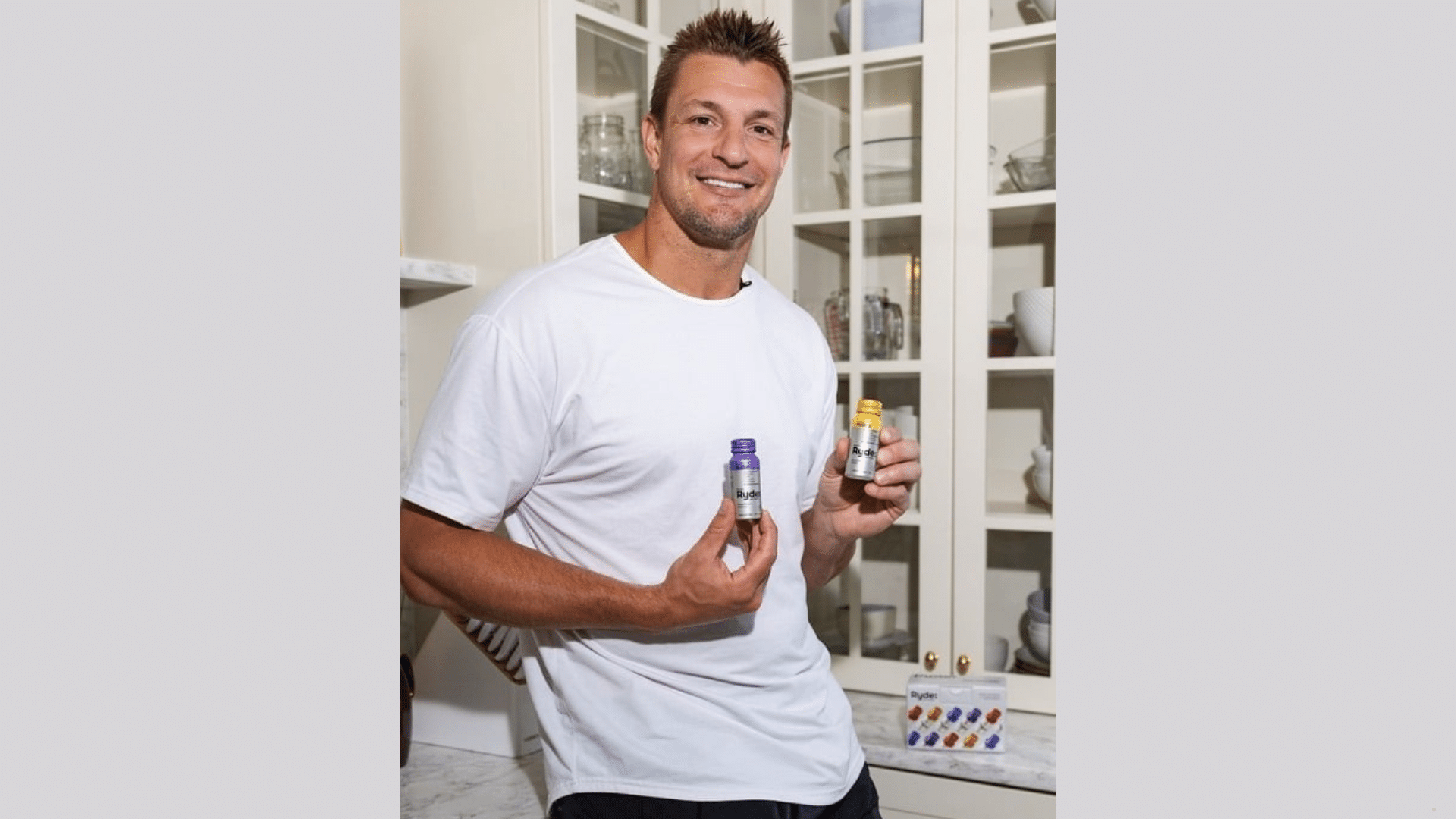
Rob Gronkowski’s job in Ryde:’s SLEEP shot launch was not to demonstrate a perfected nighttime routine. He was hired to fail at one.
The campaign, developed in roughly 90 days and filmed at Gronkowski’s personal home in Boston, cast a four-time Super Bowl champion wrestling an undersized weighted blanket and choking on lavender mist, then resolved both scenes with a two-ounce supplement shot as the plain fix. The creative strategy behind it carries a specific argument about how wellness brands should structure athlete partnerships.
Alexandria Whitaker Cheadle, Associate Vice President at Autumn Communications, led the campaign across the agency’s PR and talent divisions. Lauren Belair-Rouleau, Senior Brand and Social Manager at The Water Street Collective, which manages Ryde:’s brand strategy and social channels, coordinated from the brand side and flew from London to Boston for the shoot. The nine-person team, six on the day-to-day account and three from Autumn’s talent and creator division, ran press outreach, talent negotiations, and content production simultaneously.
Ryde: was founded in 2016 and is headquartered in Dallas. The brand sells a line of two-ounce dietary supplement shots, including ENERGIZE, FOCUS, RELAX, and the newly launched SLEEP, formulated with melatonin, GABA, L-theanine, and chamomile.
“Ryde: has always been about making well-being feel easier and more approachable, which means being willing to poke fun at how overly complicated modern well-being culture has become,” Lauren says. That framing made a former athlete known for high-intensity performance an unlikely but coherent face for a campaign about winding down, and it explained why the central creative concept connected with Gronkowski at the first briefing call.
Rob Was on the Short List Before Anyone Had Seen a Script
Gronkowski came into the conversation specifically for the SLEEP launch, not as a general brand ambassador later matched to a product. The selection criteria had two components: the brand’s playful tone and the credibility argument that, for a former professional athlete, sleep and recovery are not peripheral wellness concerns.
“His personality is so aligned with the brand,” Alex says. “Rob is known for being fun as well as known for being an athlete. And sleep is a big part of recovery.” Autumn’s talent team already had close relationships with Gronkowski’s representation, which compressed the front end of the deal. The agency was able to get product in front of him quickly, and his reaction before signing shaped how committed the partnership became.
“Once Rob tried the product and began incorporating it into his own routine, the fit became even more authentic,” Lauren says. Getting product to potential partners before finalizing the deal, rather than after, is part of what Alex describes as the structural basis for a partnership worth building. Gronkowski remains on Ryde:’s product replenishment list, according to Alex.
‘Zonk the Gronk’ Landed in the First Briefing Call
Autumn brought several high-level creative directions to the initial meeting with Gronkowski. One, framing his retirement as a “soft era,” was considered and set aside. “Zonk the Gronk,” which placed him at the mercy of every overclaimed sleep trend on the market before landing on Ryde:, was on the internal short list from the start.
“That was one of the initial concepts we loved internally,” Alex says. It connected with Gronkowski at the first briefing. She attributes that reception to the concept being grounded in a shared frustration: wellness culture has made the basic act of going to sleep feel like a project requiring special equipment and optimized habits.
The concept works, Alex argues, because it does not position Gronkowski as incapable. It positions the surrounding wellness industry as unnecessarily complicated. “I don’t think we see him as the punchline at all,” she says. “It’s very much his personality.”
Lauren notes that Gronkowski had full creative input throughout both campaign videos, from initial concept development through final content, and the team built the process around preserving his actual register rather than scripting over it.
Filming at His Home Was the Strategy
The choice to shoot at Gronkowski’s Boston home rather than a rented studio produced a key piece of footage the team did not plan for. During the FOCUS video, Gronkowski’s dog Ralphie repeatedly interrupted the workout scene. The team kept it.
“It was very authentic to what was going on in his real life,” Alex says. Lauren characterizes the moment as a direct product of the production philosophy. “Some of our favorite shots came from completely unscripted moments, like Rob’s dog continually crashing the set,” she says. “Embracing those spontaneous moments made the finished content far more engaging.”
The broader production was intentionally lean. “A natural instinct with a talent partner like Rob would have been to create a really polished campaign, a big studio shoot, everything highly scripted and controlled,” Lauren says. “But that didn’t feel genuine for Ryde: or Rob.” Alex describes the overall approach as “pretty scrappy,” contrasting it with fully produced studio campaigns Gronkowski has appeared in elsewhere.
Integrated Coverage Kept a Three-City Production on a 90-Day Schedule
Moving from a signed deal to live content in roughly 90 days, while coordinating athlete negotiations, earned media outreach, and brand sign-off across New York, Boston, and London, required a specific operational structure. Alex argues that fragmented agency relationships, where a PR team brings in outside talent vendors or production firms, routinely add friction that tight-timeline campaigns cannot absorb.
Autumn’s scope for Ryde: spans PR, talent and creator, creative, and AI-enabled monitoring and reporting. On this campaign, the talent team operated from the same brand context as the account team that sold the campaign in.
“It’s not like they’re just flying in blind and throwing names at a wall,” Alex says. “It’s very well informed by everything that the day-to-day account team knows about the brand and the project.” Pre-existing relationships between Autumn’s talent team and Gronkowski’s representation removed a common source of delays. “They were able to jump on the phone or shoot him a text,” she says. “That really helped with the timeline.”
Alex identifies working with non-integrated outside partners as a predictable cost in campaigns requiring speed. “Just the fact that those aren’t your day-to-day coworkers is always a little bit more challenging,” she says.
Athlete Wellness Partnerships Are Moving Past the Performance Brief
The Gronkowski campaign reflects a directional shift both Alex and Lauren see accelerating: athlete partnerships in the wellness category are moving away from authority positioning and toward content that places athletes inside routines that look like the audience’s own life.
“Consumers are wanting to see more real life,” Alex says. “Even though he is a professional athlete, he is still dealing with wellness concerns that all of us are. We all want to sleep better.” “Athlete partnerships in well-being are shifting toward real-world routines rather than pure physical performance,” Lauren says. “The most compelling collaborations give athletes the space to be themselves and create content that people actually want to engage with.”
Ryde:’s collegiate athlete program with Baylor Athletics operates on the same principle: student-athletes share how the product fits the demands of balancing training, academics, and recovery. For both, the principle is the same, according to Lauren: the product should appear in a real routine, not a curated one.
The common failure mode, in Alex’s view, is straightforward. “I’ve seen so many comments on a brand post where people say, ‘This looks like they’re reading off a cue card,'” she says. “That is my nightmare as a publicist.”
Subscribe to Our Newsletter
Check Out Our Podcast