



Strategy
Canada’s Gen Z Puts Friends Before Dating, Research Shows, Giving Tinder a Summer Opportunity

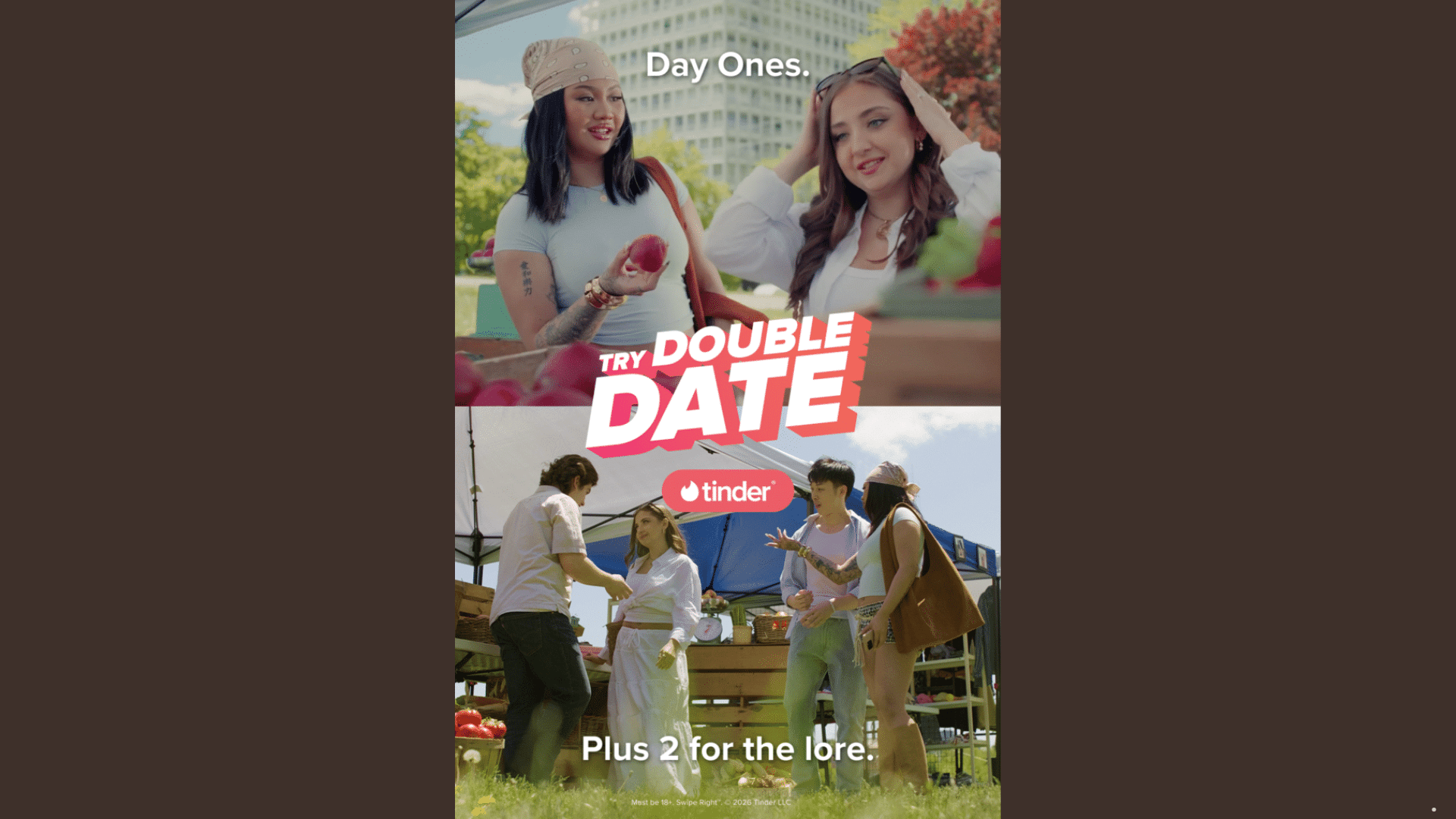
Tinder Canada’s summer 2026 campaign for Double Date was built on a specific finding: Gen Z users in Canada were spending their time with friends rather than on dates. The campaign, “Day Ones, Plus Two,” treated that behavior as an opportunity rather than a problem to solve.
The Double Date feature, which allows two friends to pair their profiles and match with other pairs, had been in the Canadian market since the prior year. Its debut had been crowded out by the simultaneous rollout of another product, Face Check, and it had never received a standalone campaign push.
“This summer campaign was our big push to really get the message out there about Double Date, even though it had been in the app,” says Caitlin Benn, Senior Marketing Manager for Tinder Canada.
Caitlin briefed agency partners AntiSocial and Thinkingbox in April 2026. Sara Sabzehzar, Group Strategy Director at AntiSocial, and Jaimie Hallarn, Creative Director at Thinkingbox, led the agency response. The campaign ran from early July across paid and owned social channels, starring eight creators across roles defined in advance by distinct briefs. Caitlin, Sara, and Jaimie had worked together before, a relationship both sides describe as material to how freely the team was able to revise its own assumptions during production.
Friendship as the Entry Point for a Dating Feature
The original brief gave AntiSocial a starting concept: make Double Date feel low-pressure. The agency found a more specific frame.
A combination of Tinder’s internal strategy team research and AntiSocial’s cultural reporting produced a pattern in the Canadian Gen Z audience. “It was really compelling to see that Gen Z was deprioritizing dating a little bit and focusing more on friendship,” Sara says. “That seemed like a compelling area for us to focus on.” Canadian summers added practical weight to the finding. “Summer in Canada is so short,” Caitlin says. “Nobody wants to risk on a bad date.”
The campaign’s argument was that Double Date resolved a trade-off: you keep the plans you already have with your friends and add a potential connection to them. “The opportunity for you to not only spend time with your friends, but also to explore potential connections, and you don’t have to sacrifice one for the other,” Caitlin says.
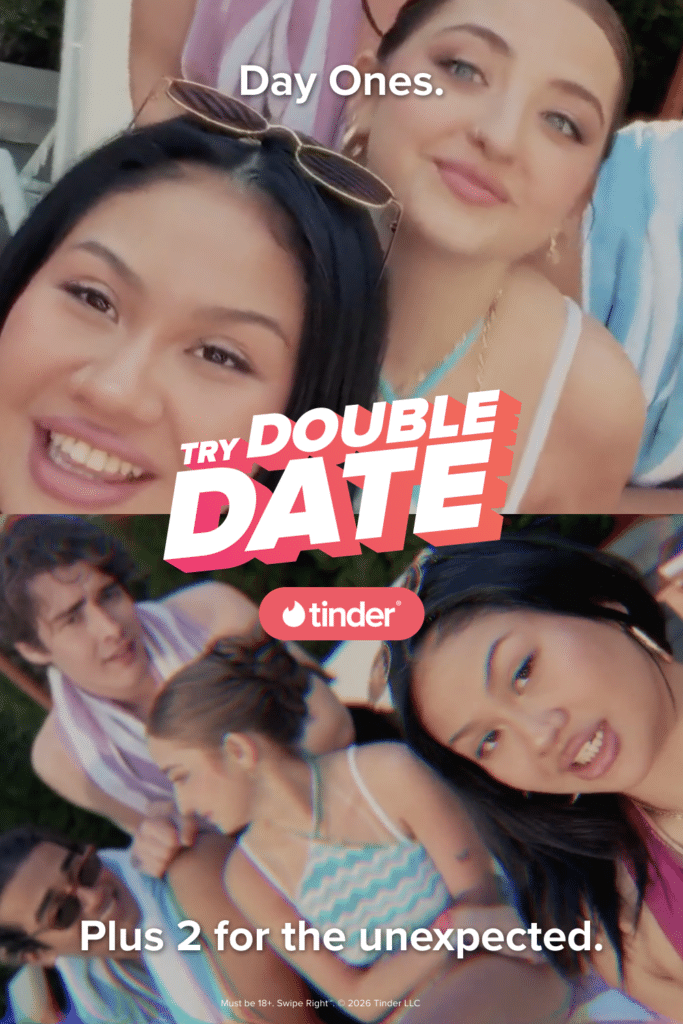
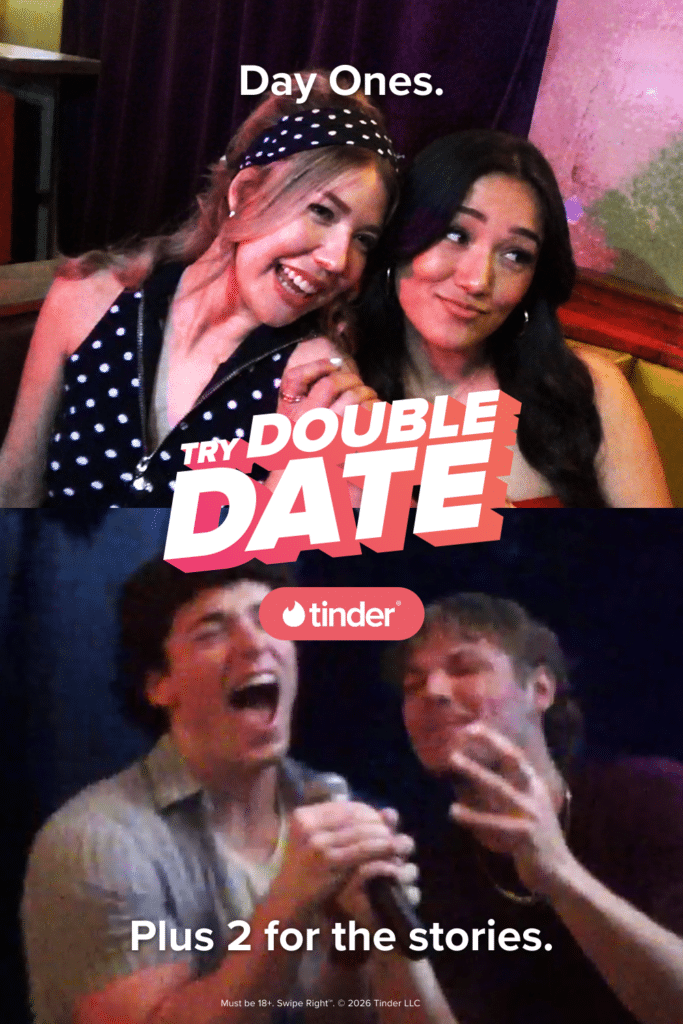
The campaign name distilled that idea. “Day Ones” is Gen Z shorthand for a close friend. The “+2” refers to the date or dates who might join. Supporting taglines, “+2 for the lore,” “+2 for the plot,” “+2 for the unexpected,” positioned a Tinder outcome as something that happens alongside an already-good night. “Gen Z is a little bit more scrupulous with their time,” Jaimie says. “We tried to position that back to them in a way that would resonate.”
Eight Creators, Eight Campaign Functions
The roster numbered eight creators, organized across lead and supporting roles, each carrying a distinct brief within the campaign structure.
Sahar Dahi, Brianna Renee, and Carly Sarah, alongside her friend Diana Miorr, starred in the paid assets. Their scripted and filmed content followed the Double Date feature across three stages: pre-date, during the outing, and post-date debrief. Sahar and Brianna are real-life best friends who both work as influencers. Diana, Carly’s counterpart in the campaign, was, as Caitlin puts it, “just a regular pal. We wanted to show the true dynamic of friendship and not make this overly staged.”
Across the 12 spots produced for the campaign, six were premium films and six were UGC-style executions; four English-speaking creators and two French-speaking creators appeared across them.
The five supporting creators each carried a separate function: Donae as an advocate encouraging friends to try Double Date, Kenzie Phillips in vlog format to put viewers alongside the experience, Jasmine Alisha delivering a post-date debrief, Sara (the creator) capturing a spontaneous side quest, and Johnny Orlando using skit-style humor with his own engaged audience. Johnny’s inclusion was uncertain going in.
“We went in with this ideal persona in mind for the types of creators that we wanted to work with that were primarily Gen Z female,” Jaimie says. His content outperformed the team’s expectations and, in Jaimie’s account, opened up what the campaign could accommodate in terms of format and tone.
What Over-Prescriptive UGC Frameworks Revealed
The campaign ran two parallel content tracks: polished, scripted spots developed with the creators, and UGC-style content those same creators produced with more latitude.
For the scripted spots, Caitlin’s team provided what she describes as guidepost scripts rather than locked copy, leaving room for creators to add their own language and scenarios. On set, Jaimie preserved time for improvisation alongside the scripted read-throughs. “Audiences can easily sniff out when something doesn’t feel authentic to a creator,” she says. The approach yielded direct results: Sara points to the “girls room” video, in which Carly and Diana debrief after a date, as content shaped largely by the creators themselves. “They pulled dialogue from conversations they had in real life,” Sara says.
The UGC track worked differently. Caitlin’s team built what she calls “ghost frameworks” to guide creator-made content, expecting the structure to free up creative voice. It did the opposite. “We thought we had opened it up to have them inject their personalities,” Caitlin says. “It was very interesting to see, ‘Oh, maybe this was a little too spoon-fed compared to what we had wanted.’”
Her diagnosis? “There is a tendency for us to get excited about big ideas and kind of the overall creative direction, and then we’ll brief influencers to become a part of that as opposed to having them at the table earlier on to help them come up with the campaign idea together,” she says. Sara and Jaimie independently identified the same issue. It is the one change all three would do differently.
Registrations First, Earned Conversation Third
Caitlin tracks tent-pole campaigns on three tiers, ordered by business priority.
Registrations and reactivations sit at the top, with Gen Z women as the primary target. Women are what she calls the campaign’s “North Star”: maintaining gender balance in the app ecosystem is, in her framing, the foundational condition for the product to function for anyone.
Second is whether the creative lands specifically with women as a segment, measured through media performance data.
Third is earned conversation, the organic comments, shares, and engagement that indicate a shift in how users talk about the brand. “We have so much work to do in terms of changing brand perception in market,” Caitlin says. “Having those earned conversations and seeing people talk about Tinder in a positive way is crucial to our success here.”
Early influencer metrics, which Caitlin describes as directional, show a 32% increase in content engagements across Instagram and TikTok compared to the prior “Astrology Mode” campaign. TikTok engagements rose 66%. Average watch time across both platforms increased 17% against the same comparison, with TikTok watch time up 60%. Hook rates also improved, according to Caitlin, who says the Double Date campaign was outpacing its predecessor across most tracked media indicators.
The French-language executions represent a separate build. Caitlin’s team worked with a Montreal-based creative and production team to develop content for Quebec around local Gen Z dating behaviors, local places, and local talent. “It was important that the Quebec work felt adapted, not translated,” Caitlin says, noting that some of that content was still launching at the time of the interview.
Why Tinder Canada Isn’t Competing on Relationship Outcomes
“Day Ones, Plus Two” is one of several product-forward campaigns Tinder Canada has run, each designed to put a specific feature at the center and demonstrate how the app has changed.
“There are a lot of other apps out there that are focused on outcomes, like deleting the app, where Hinge is concerned, and that kind of white picket fence,” Caitlin says. “Of course that might happen with Tinder, but there are so many other outcomes that are possible as well.” Her framing for Tinder’s brand idea is “fun translates to progress,” treating a positive experience on the app, regardless of where it leads, as movement forward.
Jaimie frames the campaign’s brand coherence question in product terms. “I don’t think any other dating app could have made this campaign because they’re not creating these products and evolving in a way that is reaching the audience in the same way,” she says.
The Two Learnings the Team Is Taking Forward
The campaign was produced in approximately two and a half months. Both Caitlin and Jaimie identified the changes they would implement in a subsequent campaign.
From Jaimie: narrow the creative strategy. The campaign tested a wide variety of formats, hooks, and content styles simultaneously, and those tests produced useful data. The next step, in her view, is acting on it. “Taking those learnings and going in with a more narrow strategy, bigger, better, fewer,” she says. “Just taking everything that we’ve learned from that overarching test through the creative.”
From Caitlin: bring creators in before the brief is finalized. The lesson from the UGC track applies more broadly. “There’s something very rich that can come out of that by involving them a little bit earlier on,” she says. “I know I would definitely be taking forward into future campaigns.”
Both changes point toward a more collaborative, less top-down production model. The existing agency-brand relationship, predating this campaign, has made space for that growth. “On the brand side, we want to constantly be pushed as much as we want to push our agency partners,” Caitlin says. “And I think that only comes with time and comfort.”
Subscribe to Our Newsletter
Check Out Our Podcast