



Technology
The Creator Economy Built Tools for Influencers. MOVEMENTS Wants to Do the Same for Activists

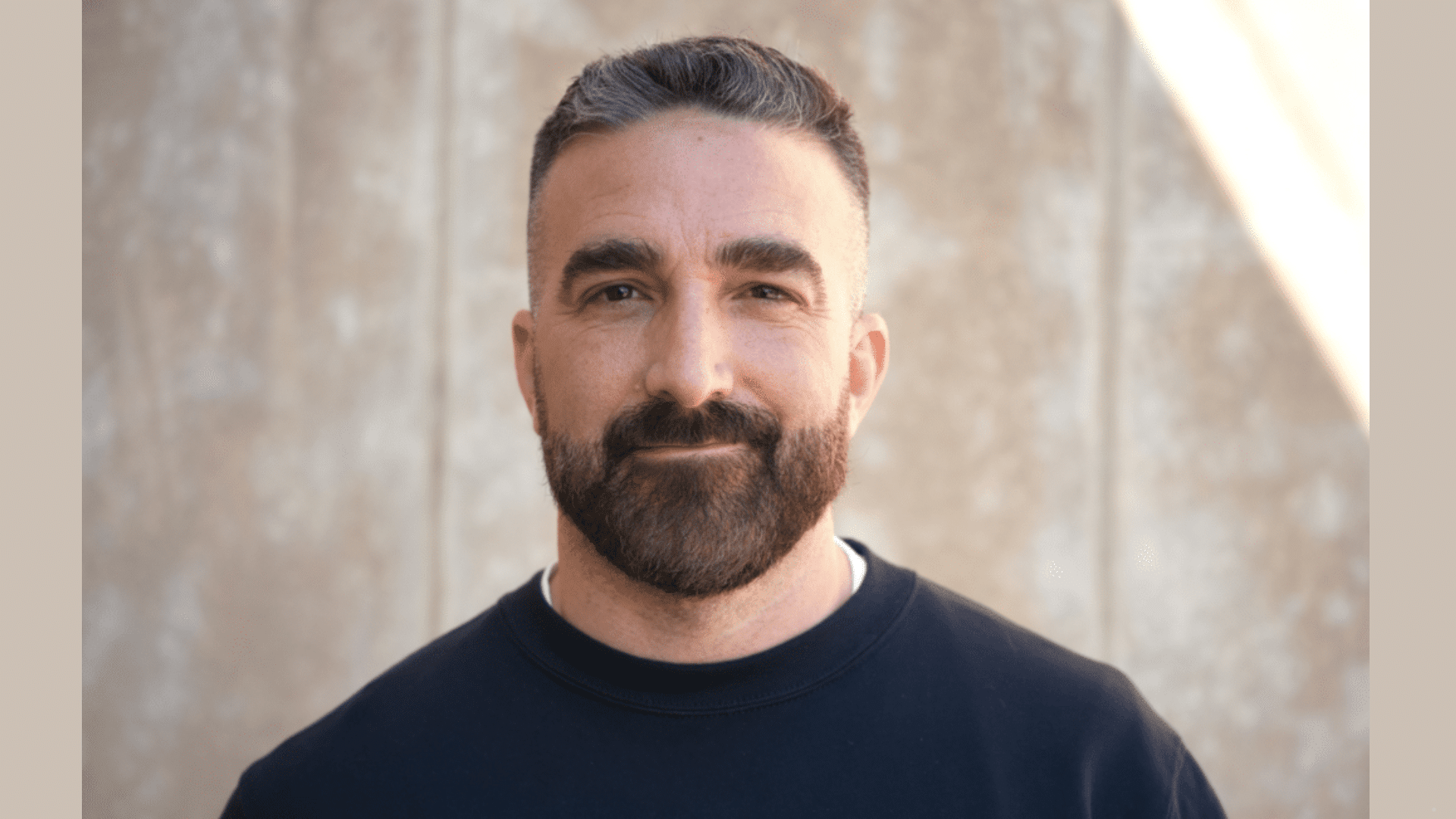
Francisco Polo spent 15 years building petition platforms and watched what he describes as a consistent pattern: campaigns catch public attention, then collapse. Fewer than 1% of movements launched each year grow large enough to drive real-world impact, he contends. MOVEMENTS, the platform he first conceived in Barcelona in early 2025, is built on the premise that cause-driven creators deserve the same infrastructure as anyone else in the Creator Economy.
“We are opening what we think is going to be a new category: the Creator Economy for causes,” Francisco says. That claim draws on firsthand experience at scale. He co-founded Actuable in 2010, which grew from zero to 2.5 million users before being acquired by Change.org, where he worked on global expansion as the platform reached 250 million users across nearly 190 countries.
The specific story that crystallized the MOVEMENTS concept came from his time at Change.org. An activist with celiac disease, organizing around the cost of gluten-free food in Spain, where such products can run up to 10 times the price of standard equivalents, built a petition drawing close to 500,000 signatures and sustained significant press attention. She never converted that momentum into a change in the law. When Francisco checked on the movement she had subsequently created, roughly 18 months after it launched, it had disappeared entirely. The problem, he concluded, was not her commitment but her tools. Petitions, email, fundraising, and community management all lived on separate platforms, requiring her to manage an operational stack in addition to running her campaign.
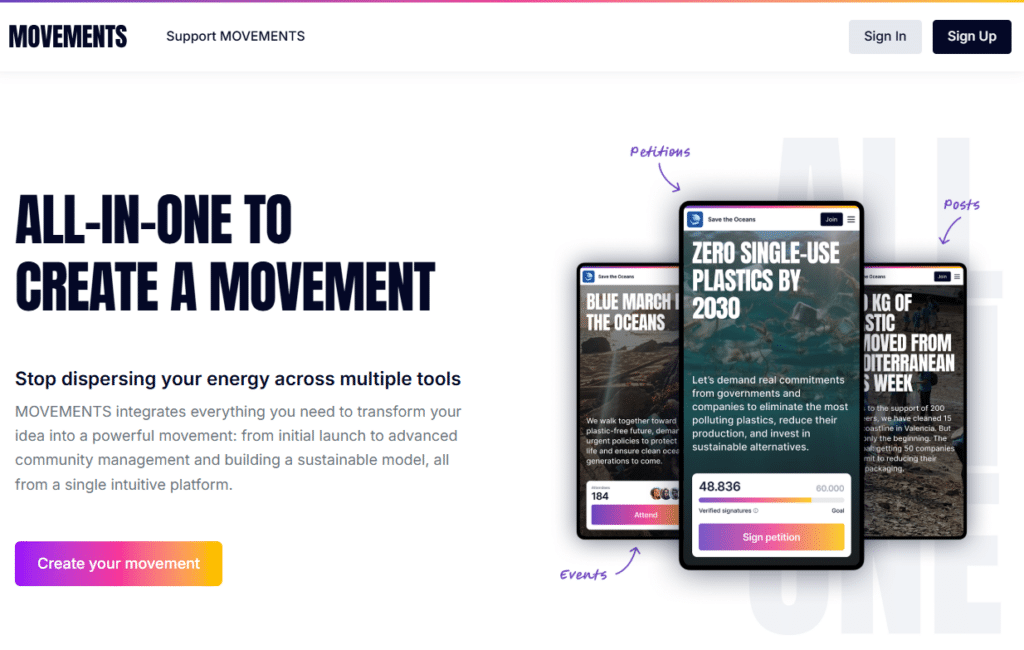
That observation shaped MOVEMENTS’s product logic. The platform targets individual organizers, cause-driven creators, and small nonprofits rather than established NGOs, which Francisco says already have the team resources to manage fragmented tools. Since launching its product in early 2026, the company has grown to more than 230,000 community members, reaching 100,000 within its first 30 days, according to Francisco. A paid membership feature for creators, introduced in recent weeks, marks the beginning of the platform’s revenue phase.
Cause Creators Have No Patreon
Patreon serves artists. Substack serves writers. Twitch serves streamers. Cause-driven organizers, Francisco notes, have none of the above, arguing they have paid for that absence at scale.
“When you’re thinking about someone who has a cause, it’s not the same,” he says. “You need some of those tools, but you also need a different set of tools. Like petitions. On Substack, on Patreon, you don’t have that.”
The consequence, in his telling, is that most campaigns collapse before reaching the scale at which they can force institutional change. The reason is almost entirely operational: organizers must assemble petitions, email newsletters, event coordination, community management, and fundraising across separate platforms, each with its own subscriber system and learning curve.
“That generates a lot of runaround and leaves a lot of people outside of it,” Francisco says. MOVEMENTS consolidates those tools into a single platform. The premise is that simplification is not a convenience feature but the core condition for activism to scale.
Algorithm-Driven Platforms Constrain the Activist’s Reach. Email Doesn’t.
A central design decision at MOVEMENTS is its email-first delivery model. Every post, event update, and petition a creator publishes is sent automatically by email to their full member list, without competing for algorithmic feed placement.
Francisco cites data putting email at 25% of total internet time, compared to 10% for YouTube, as the basis for the approach. For activists, a campaign’s critical window for public pressure often does not align with when a platform’s algorithm chooses to amplify a given post.
The case he points to is Tamara Contreras, a Spanish intensive-care physician campaigning for patient safety reforms in the country’s public health system. Before joining MOVEMENTS, she had built 80,000 Instagram followers and a petition with 200,000 signatures, and had experienced the platform’s unpredictability firsthand: the same message could reach thousands of followers one day and only a few hundred the next.
On MOVEMENTS, she grew from zero to 100,000 members in five weeks, according to Francisco. “Every person that signed her petition was not a number,” he says. “It was data that she had in her movement, and she was the owner of that data, so she could own the relationship. That connection was forever.” Tamara subsequently organized an in-person delivery of signatures to the Spanish Parliament, coordinated through the platform’s event tools.
Reaching 1,000 Members in a Month
Francisco pegs 1,000 members as the threshold at which creators typically decide to activate paid subscriptions, converting from audience-building to revenue-generating. The benchmark he uses for context is Substack.
“On Substack, the average creator takes 425 days to get to 1,000 members,” he says. “On MOVEMENTS, it only takes 29 days. We can get you there 15 times faster.”
The mechanism behind that speed is the petition tool, which Francisco describes as the platform’s primary acquisition engine. When a creator launches a petition, each signatory is enrolled directly into the movement’s member list rather than recorded as an anonymous data point on a third-party platform. Those members then receive all subsequent content by email, compounding the relationship across every campaign action.
MOVEMENTS’ paid membership model gives creators control over whether to activate subscriptions, what to charge, and how often (monthly, quarterly, or annually), with the platform taking a percentage of each transaction. Francisco says the current number of paying members is small, reflecting how recently the feature launched. “What we need right now is to get more and more creators to the platform, help them go from zero to this magic number of 1,000 members,” he says, “so they can think about activating their memberships and help us make the platform sustainable.”
Society Pays Tobacco Executives. Why Not Impact Creators?
Francisco frames the monetization question as more than a product feature. He describes what he calls an “inverted morals” problem in how societies allocate money and attention.
“We reward and pay things, and we assume it’s normal to be financing things that are even harmful for people or society,” he says. His examples include the tobacco and gambling industries, whose executives earn substantial compensation with little public scrutiny. For activists who ask their communities to pay for their work, the same acceptance does not apply.
“If you think about people who are working towards a positive cause, we are always suspicious when they ask for money,” Francisco says. “Why do we assume that the people who do things that are good for others need to do it for free?”
MOVEMENTS’s paid membership model is, in this framing, partly a product decision and partly a cultural argument. Whether the platform can shift that norm depends on whether organizers can demonstrate to their communities that sustained financial support produces sustained campaigns.
AI Agents Will Handle the Bottlenecks Activists Can’t
Francisco sees AI not primarily as a content generation tool but as a mechanism for eliminating the operational knowledge barriers that stop individual organizers before they reach scale.
“AI is going to generate a huge impact, and not in the way that most people assume,” he says. The agentic ecosystem MOVEMENTS is developing will target the bottlenecks the company says it has documented across 25 years of working on activist infrastructure: growth tactics specific to civic campaigns, and the media relations expertise that most organizers without communications backgrounds entirely lack.
One planned feature is a press agent designed to help creators handle outreach to journalists and publications. “The person that maybe starts a campaign or a cause, they don’t know how to do it,” Francisco notes. That knowledge has historically resided inside organizations with dedicated communications staff, and its absence, he argues, is one of the most consistent reasons individual campaigns plateau.
These features are not yet live. Francisco describes them as the platform’s next phase.
500 Million Users and a New Category of Creator
Francisco sets an explicit target: 500 million users within 10 years. “If we are halfway there in five years, we will know that we are on the right track,” he says.
The larger ambition connects the platform’s roadmap to a claim about what the Creator Economy has not yet built. Patreon, Substack, and Twitch expanded who could earn a living as a writer, artist, or streamer. Francisco believes the same shift is overdue for people working toward social causes, and that the infrastructure to make it possible has simply not existed.
“What we are building now is a platform so anyone can become a social entrepreneur,” he says. “Where we can own the data, we can own the relationship, we can build our business, we can do the campaigning, and we can become this impact creator.”
Subscribe to Our Newsletter
Check Out Our Podcast