


Technology
Inside VwD’s Push to Bring Creator Sourcing and Brand Safety Into One Workflow

VwD was built around the argument that brands partnering with creators were making high-stakes decisions without the data to back them up. Two and a half years after launch, the NYC-based brand safety platform is releasing a set of 2026 updates.
Theo Ruzhynsky, co-founder of VwD, spent nearly two decades scaling enterprise software systems before building the platform. Eric Hadley, who joined as Chief Business Officer after senior marketing roles at Microsoft, iHeartMedia, and Pinterest, provided the commercial architecture for a platform launched with a focus on brand safety, suitability, and compliance for creator partnerships.
“We feel we are the only platform we know of that’s primarily focused on this problem,” Theo says, a position the company has not moved from. Regarding the new updates, Theo says that they have expanded the platform’s scope. The 2026 updates add creator discovery, an AI assistant for querying creator data, brand-specific relevance scoring, and a self-serve token pricing model, shifting VwD’s role from a tool that scanned creators after brands sourced them to one that can surface, evaluate, and vet in a single workflow.
The market, Theo says, has started to move in the same direction. Where two years ago conversations with brands centered on whether creator vetting mattered, clients now arrive with budgets already established and a narrower question: how to do it faster and at greater depth. “More and more brands have the pressing need to do creator scans and actual deep intelligence, not just overall keyword matches,” he says.
A Flag Without Context Is Not a Decision
VwD’s original scan would surface a category label: alcohol detected, for example. It did not show where in a creator’s content the flag occurred, what surrounded it, or why the system triggered it. Reviewers who needed to understand the flag were left watching full videos to determine whether they were looking at a meaningful risk or a false alarm.
That bottleneck has been addressed through a feature the company calls “X-Ray.” The updated view shows the specific timestamp and frame in which a category was detected, the reason for the flag, and the context in which it appeared. A brand that previously received a label now receives a description: not “alcohol flagged” but a summary indicating, for example, that a creator referenced champagne during social occasions across two posts, with links to the exact points in the content. “Instead of watching a full TikTok video, you know exactly which frame was flagged and why,” Theo says. “You can go right to it.”
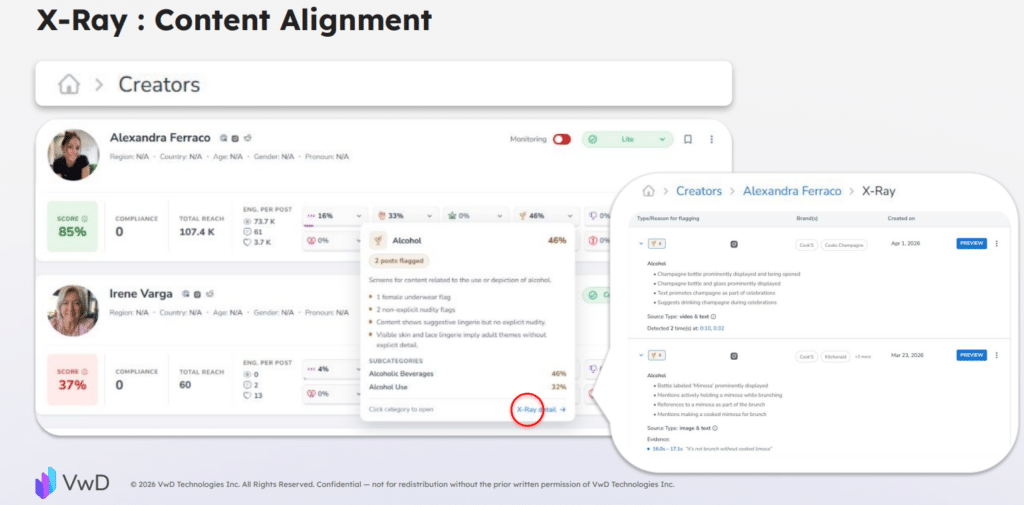
Alongside that change, the platform now allows brands to build custom monitoring subscriptions around topics specific to their competitive environment, receiving alerts when creators in their pool produce content touching on a competitor brand or a defined subject area. New scanning categories added in the same update include child safety and TTB (Alcohol and Tobacco Tax and Trade Bureau) compliance, adding regulatory coverage for brands in those industries.
Safety Defined by the Brand, Not the Platform
VwD’s universal score has always measured a creator’s content against a standard set of risk categories. A new Brand Center feature now allows each client to define its own values, restricted topics, and industry context, which the platform uses to generate a relevance score calibrated to that brand specifically. The same creator carries different scores for different clients by design, reflecting the criteria each brand has set rather than a single platform-wide standard.
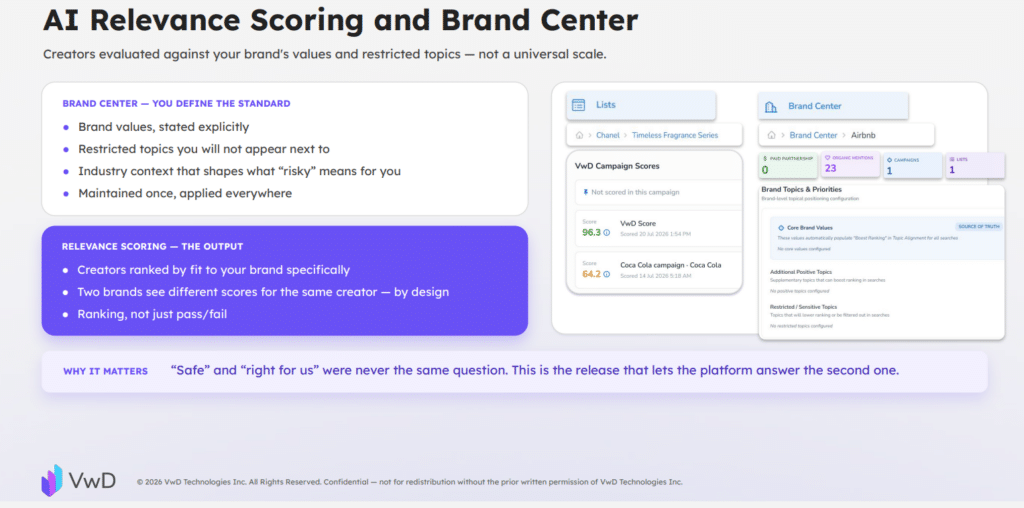
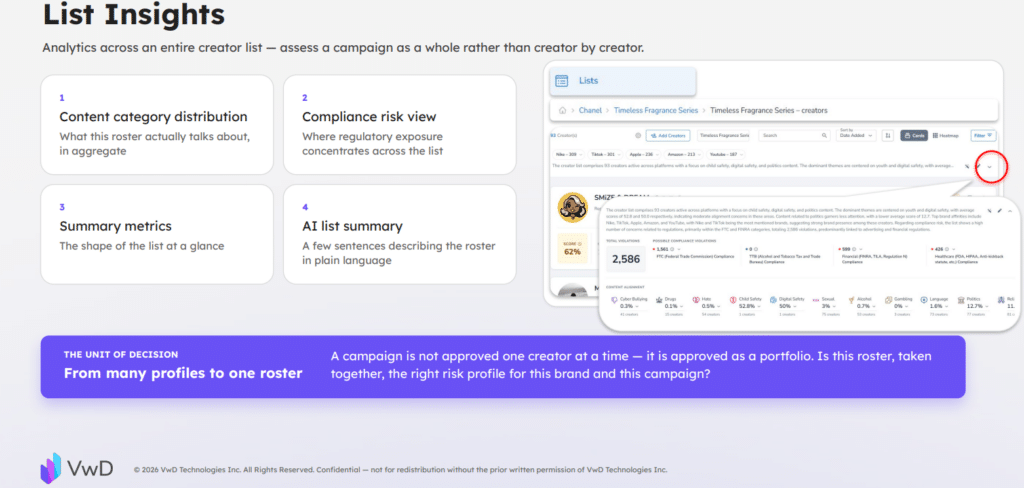
“VwD score is your umbrella definition of safety,” Theo explains. “And then you have niche, brand and campaign-focused scores.” A List Insights feature extends that logic to the roster level, aggregating scoring across an entire creator list so teams can assess whether a campaign slate, taken together, meets the brand’s risk threshold rather than evaluating each creator in isolation.
Of 21 creators a top-five CPG advertiser had already cleared through internal manual review, VwD surfaced disqualifying findings on four. The company also reports a 97% improvement in overall vetting efficiency for the same client, a figure it attributes to replacing sequential video review with automated, contextual scoring.
Vetting Without the Enterprise Contract
The prevailing pricing model in creator vetting software required an enterprise SaaS commitment before a first scan could run. A brand with a single campaign and a short creator list had no practical entry point, and the economics of a large annual contract made the category inaccessible to smaller advertisers.
VwD has replaced that model with token-based, self-serve access. Brands sign up, purchase tokens via Stripe, and pay per scan, from one token for a light review of recent content to three tokens for a comprehensive historical scan. There is no required sales conversation, no minimum contract, and no seat licensing. Larger accounts buying at volume receive pricing discounts, but the per-scan cost does not change based on company size.
“If you want to scan one person, pay us for one person,” Hadley says. The shift also includes guest access for sharing creator reports with stakeholders outside the platform, and PDF reports that can be emailed directly to approvers who do not hold platform seats, eliminating the download-then-attach step that previously added friction to internal approval workflows.
Sourcing No Longer Happens in a Separate Tool
Previously, clients imported creators they had sourced elsewhere into VwD for review. The platform now includes a creator discovery catalog of approximately 3 million creators, searchable through an AI-native interface that accepts natural language queries. A brand looking for a specific type of creator on a specific platform can build a shortlist from the catalog and move candidates directly into a scanning queue, paying only for those they choose to assess further.
“It would be great if I could just find the needed creators right in the platform and just click scan,” Theo says, describing the client request that drove the feature. A new AI assistant, Vera, enables users to query their existing creator pool in plain language, asking the platform to recommend creators for a specific campaign brief and receiving an answer with reasoning rather than navigating filter menus. “She reduces your time to decision,” Theo says.
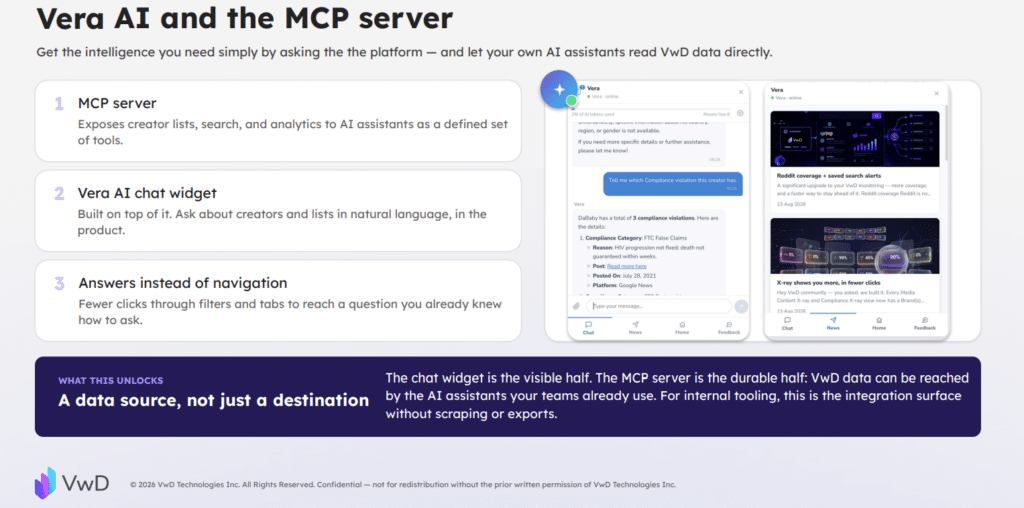
The addition of discovery raised a question the company anticipated. If VwD both surfaces creators and scores them, is the scoring still independent? “We do not represent creators, we do not take a cut of any partnership, and we do not earn more if a creator gets booked,” Theo says.
The criteria used to score a discovered creator are set by the client, not the platform. The company’s stated boundary also defines what it will not build: campaign management and ROI attribution remain outside its product scope by policy. “The line is data versus workflow,” Theo says. “We build anything where the answer depends on understanding what a creator has actually published.”
Creator Vetting Is Becoming a Standard Line Item
Creator safety verification in Influencer Marketing is on the same trajectory as brand safety took in display advertising, according to Hadley. Before tools like DoubleVerify and Moat gave display buyers a common measurement standard, brands had limited visibility into where their ads ran. After that infrastructure became established, buying display without third-party verification became unusual. “You’d never run a campaign that didn’t get a Moat score, a DV score,” Hadley says. “It’s the cost of doing business.”
The analogy holds if the adoption curve follows the same path. But the shift Theo describes in day-to-day client conversations, from explaining why vetting matters to advising on which level of scan a campaign requires, points in that direction.
“We brought the platform to the standards of a modern AI-native creator intelligence solution,” he says. “That should be the case.”
Subscribe to Our Newsletter
Check Out Our Podcast