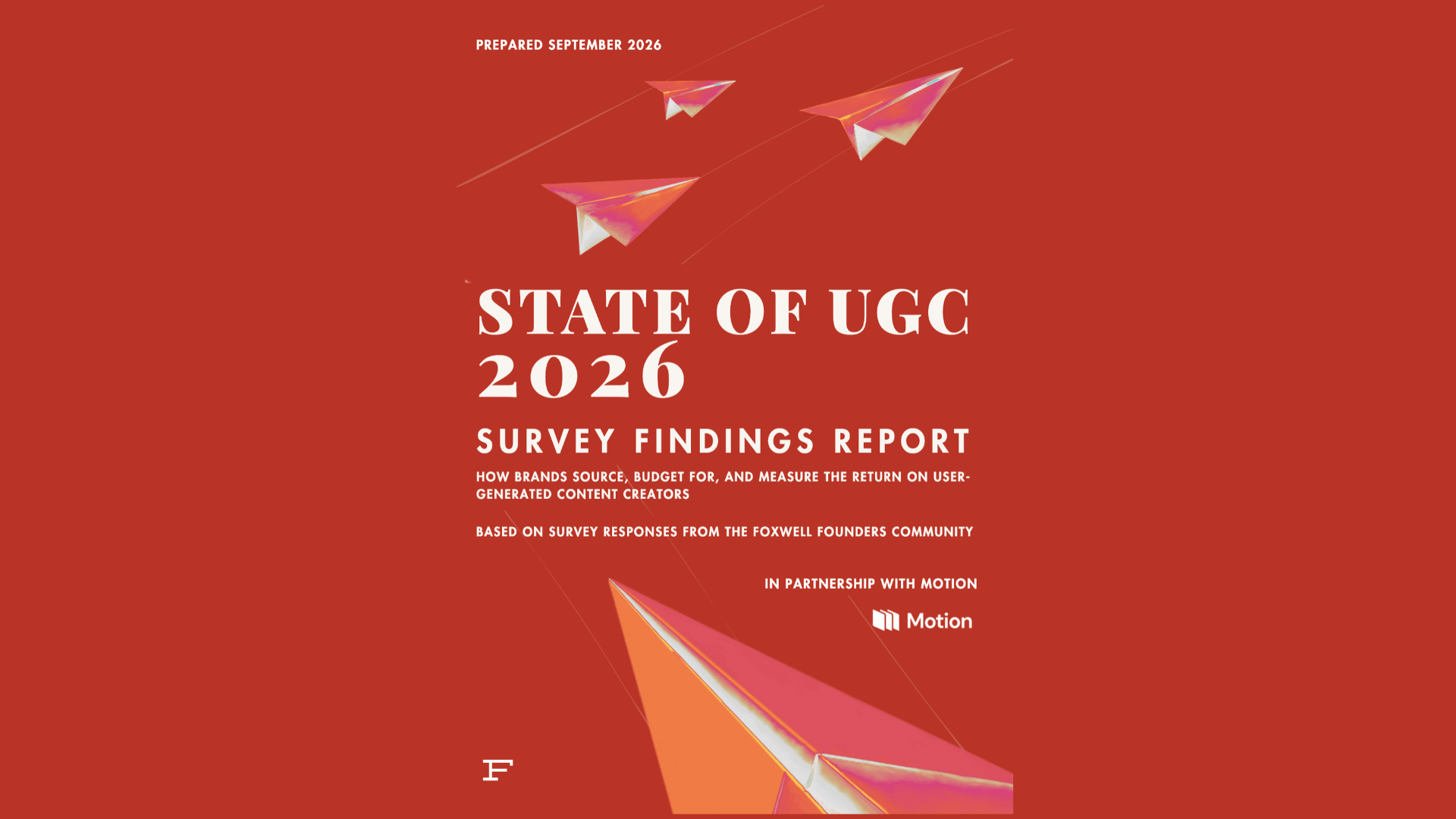
More than half of marketers surveyed (57%) have no clear read on whether spending on user-generated content (UGC) creators pays back, according to the “State of UGC 2026” report from Foxwell Founders, a community of marketing leaders. The report, prepared in September 2026 in partnership with creative analytics company Motion, found that 38% of respondents do not measure whether creator costs are justified by acquisition economics. Another 19% do not evaluate creators primarily on customer acquisition cost (CAC) or return on investment (ROI).
The report found that 14% of respondents reported positive ROI above 20% after fees, while another 14% reported ROI above 30% after fees. It put break-even at 10% and negative ROI at 5%. The report cautioned that teams motivated to measure creator ROI may also be the ones running more disciplined programs.
Foxwell Founders describes itself as a community of more than 600 agency and brand marketing leaders. The report does not state the number of respondents. Its methodology note says the results should be read as a directional signal from this group rather than a market-wide benchmark.
Budgets Remain a Minority of Ad Spend
Monthly UGC creator budgets were spread across brackets. The most common range was $5,000 to $10,000, cited by 26% of respondents. Thirteen percent spend $20,000 or more per month, and 22% spend under $1,000. For 48% of teams, UGC accounts for less than 5% of total ad spend. The report said this indicates that even teams with meaningful dollar budgets treat UGC as a supporting content channel.
Sourcing and Usage Rights
Instagram and TikTok were the leading sourcing channels, with 74% of teams finding creators directly on the platforms. Inbound applications followed at 39%, agencies at 35% and referrals at 30%. Hive Haus, a creator marketplace, was used by 26% of respondents, while 52% said they had not tried it. The report’s author, Andrew Foxwell, co-founded Hive Haus, according to the report’s author biography. Dedicated UGC marketplaces such as Billo, Trend.io, Fiverr, and Upwork were also used by 26%.
On usage rights, whitelisting, which allows a brand to run a creator’s content as paid ads from the creator’s handle, was the most common requirement at 57%. Thirty-nine percent said they require no exclusivity, 22% limit use to organic social, 13% use time-limited licenses, and 13% require exclusivity. Four percent seek full rights through an outright buyout.
What Marketers Look for in Creators
Ninety-six percent of respondents named “authentic on camera” as a top quality in their favorite creators. “Good storytelling” followed at 65% and “takes direction well” at 61%. “Understands the brand” and “brings creative ideas” were each cited by 52%. “High production quality” was named by 30% and “strong personal brand” or follower size by 17%.
In-House Production Still Leads Creative Output
In-house production remains the largest source of creative. Seventy-one percent of respondents said it makes up at least a quarter of their total creative output, and 43% said it is the majority source. Thirty-five percent of teams get roughly 25% or more of their creative from UGC creators, with the most common single band being 10% to 25%, also at 35%. Twenty-one percent get 25% or more from AI-generated content and 18% from influencer content. For 58% of respondents, AI-generated creative makes up less than 10% of output.
Program size varied. Thirty-five percent of respondents work with one to three creators per month, another 35% work with four to seven, and 22% work with 11 or more. Creator sourcing, briefing, and communication most often sit with a creative strategist (26%), followed by a marketing manager (17%) and a paid media manager (13%).
Image source: Foxwell Digital The full report can be foundhere
Dragomir is a Serbian freelance blog writer and translator. He is passionate about covering insightful stories and exploring topics such as influencer marketing, the creator economy, technology, business, and cyber fraud.









More than half of marketers surveyed (57%) have no clear read on whether spending on user-generated content (UGC) creators pays back, according to the “State of UGC 2026” report from Foxwell Founders, a community of marketing leaders. The report, prepared in September 2026 in partnership with creative analytics company Motion, found that 38% of respondents do not measure whether creator costs are justified by acquisition economics. Another 19% do not evaluate creators primarily on customer acquisition cost (CAC) or return on investment (ROI).
The report found that 14% of respondents reported positive ROI above 20% after fees, while another 14% reported ROI above 30% after fees. It put break-even at 10% and negative ROI at 5%. The report cautioned that teams motivated to measure creator ROI may also be the ones running more disciplined programs.
Foxwell Founders describes itself as a community of more than 600 agency and brand marketing leaders. The report does not state the number of respondents. Its methodology note says the results should be read as a directional signal from this group rather than a market-wide benchmark.
Budgets Remain a Minority of Ad Spend
Monthly UGC creator budgets were spread across brackets. The most common range was $5,000 to $10,000, cited by 26% of respondents. Thirteen percent spend $20,000 or more per month, and 22% spend under $1,000. For 48% of teams, UGC accounts for less than 5% of total ad spend. The report said this indicates that even teams with meaningful dollar budgets treat UGC as a supporting content channel.
Sourcing and Usage Rights
Instagram and TikTok were the leading sourcing channels, with 74% of teams finding creators directly on the platforms. Inbound applications followed at 39%, agencies at 35% and referrals at 30%. Hive Haus, a creator marketplace, was used by 26% of respondents, while 52% said they had not tried it. The report’s author, Andrew Foxwell, co-founded Hive Haus, according to the report’s author biography. Dedicated UGC marketplaces such as Billo, Trend.io, Fiverr, and Upwork were also used by 26%.
On usage rights, whitelisting, which allows a brand to run a creator’s content as paid ads from the creator’s handle, was the most common requirement at 57%. Thirty-nine percent said they require no exclusivity, 22% limit use to organic social, 13% use time-limited licenses, and 13% require exclusivity. Four percent seek full rights through an outright buyout.
What Marketers Look for in Creators
Ninety-six percent of respondents named “authentic on camera” as a top quality in their favorite creators. “Good storytelling” followed at 65% and “takes direction well” at 61%. “Understands the brand” and “brings creative ideas” were each cited by 52%. “High production quality” was named by 30% and “strong personal brand” or follower size by 17%.
In-House Production Still Leads Creative Output
In-house production remains the largest source of creative. Seventy-one percent of respondents said it makes up at least a quarter of their total creative output, and 43% said it is the majority source. Thirty-five percent of teams get roughly 25% or more of their creative from UGC creators, with the most common single band being 10% to 25%, also at 35%. Twenty-one percent get 25% or more from AI-generated content and 18% from influencer content. For 58% of respondents, AI-generated creative makes up less than 10% of output.
Program size varied. Thirty-five percent of respondents work with one to three creators per month, another 35% work with four to seven, and 22% work with 11 or more. Creator sourcing, briefing, and communication most often sit with a creative strategist (26%), followed by a marketing manager (17%) and a paid media manager (13%).
Image source: Foxwell Digital
The full report can be found here
Subscribe to Our Newsletter
Check Out Our Podcast