A consultation commissioned by YouTube and conducted by Public First surveyed more than 20,000 creators across all 27 European Union member states this summer, finding that many respondents say they receive too little or no support across government recognition, industry representation, training, funding, and workspace access. YouTube is using the findings to argue against proposed EU “prominence” rules that would require platforms to give certain media priority placement.
Public First ran the anonymous survey between June 1 and July 8, 2026, gathering 20,617 completed responses alongside 20 one-to-one interviews with creators. YouTube published the results in a report titled “Creative Capital,” framed as a set of policy recommendations for EU institutions.
Recognition and Representation Gaps
According to the survey, 64% of respondents said greater acknowledgment of creators’ cultural and economic contributions by government and policymakers would help them feel more integrated into the broader EU creative industry. A separate 63% said creators receive too little or no support with government representation.
On industry standing specifically, 64% of respondents said more recognition from industry would help them thrive, and 60% said more representation of creators at creative industry awards would help them feel integrated into the sector. A creator from Romania quoted in the report said creators “are still not fully respected like actors, musicians or traditional media professionals,” while a creator from Germany described being seen as “scrappy upstarts” by the creative industries despite audience size.
Training, Funding and Space
The survey found 60% of respondents said creators receive too little or no support with training and skills, whether for themselves or their employees. On financial support, 65% said creators receive too little or no support accessing funds or grants from government agencies, and 65% of professional creators specifically said the same about access to recording spaces and studios.
The Economic Case
YouTube’s report cites Oxford Economics research attributing a contribution of more than €8.4 billion to EU GDP in 2025 to YouTube’s creative ecosystem, along with support for more than 220,000 full-time-equivalent jobs. The report also states that 66% of survey respondents who earn revenue from their content said they typically reinvest that revenue into improving content quality.
Five Recommendations
YouTube’s report proposes five areas for EU action: government recognition, industry representation, training and skills, support with content creation, and open discovery. Specific proposals include a dedicated NACE sub-classification for digital creators within Eurostat, a “European Year of Creators,” an Erasmus+ Creator Exchange pilot, EU-funded creator apprenticeships, opening the Creative Europe MEDIA programme to digital-native productions, and InvestEU guarantees for lenders serving creator businesses with irregular income patterns.
Opposition to Prominence Mandates
The report’s final section argues against EU “prominence” rules under discussion that could require platforms to prioritize certain designated media organizations. According to the survey, 83% of respondents said YouTube’s recommendation and discovery algorithms are important to their channel’s growth and revenue, and 71% of respondents with more than 100,000 subscribers or followers said reduced visibility from changes to recommendation systems would affect their income and ability to grow.
YouTube’s report states that any new prominence mandates “should avoid harming independent creators,” and frames audience-driven discovery, rather than government-designated placement, as the model that has supported the growth of the EU Creator Economy over roughly two decades. A creator from Spain quoted in the report said policymakers “should not interfere with the platform algorithm,” while a creator from France said in the same section that institutions “should be helping to level the playing field between creators and legacy media,” cautioning that algorithm changes could instead benefit “media channels owned by billionaires.”
Pedro Pina, YouTube’s VP for Europe, the Middle East and Africa, wrote in the report’s foreword that creators described “barriers that slow their growth down and stop them from reinvesting,” citing a funding scheme “written before this kind of business existed” and a training programme that “does not recognise the job title ‘content creator’” as examples. “Europe does not need to build new institutions for its creators,” Pina wrote. “It needs to open the ones it already has.” Image source: “Creative Capital – A Proposal for Unlocking the EU Creator Economy” The full report can be foundhere
Dragomir is a Serbian freelance blog writer and translator. He is passionate about covering insightful stories and exploring topics such as influencer marketing, the creator economy, technology, business, and cyber fraud.











A consultation commissioned by YouTube and conducted by Public First surveyed more than 20,000 creators across all 27 European Union member states this summer, finding that many respondents say they receive too little or no support across government recognition, industry representation, training, funding, and workspace access. YouTube is using the findings to argue against proposed EU “prominence” rules that would require platforms to give certain media priority placement.
Public First ran the anonymous survey between June 1 and July 8, 2026, gathering 20,617 completed responses alongside 20 one-to-one interviews with creators. YouTube published the results in a report titled “Creative Capital,” framed as a set of policy recommendations for EU institutions.
Recognition and Representation Gaps
According to the survey, 64% of respondents said greater acknowledgment of creators’ cultural and economic contributions by government and policymakers would help them feel more integrated into the broader EU creative industry. A separate 63% said creators receive too little or no support with government representation.
On industry standing specifically, 64% of respondents said more recognition from industry would help them thrive, and 60% said more representation of creators at creative industry awards would help them feel integrated into the sector. A creator from Romania quoted in the report said creators “are still not fully respected like actors, musicians or traditional media professionals,” while a creator from Germany described being seen as “scrappy upstarts” by the creative industries despite audience size.
Training, Funding and Space
The survey found 60% of respondents said creators receive too little or no support with training and skills, whether for themselves or their employees. On financial support, 65% said creators receive too little or no support accessing funds or grants from government agencies, and 65% of professional creators specifically said the same about access to recording spaces and studios.
The Economic Case
YouTube’s report cites Oxford Economics research attributing a contribution of more than €8.4 billion to EU GDP in 2025 to YouTube’s creative ecosystem, along with support for more than 220,000 full-time-equivalent jobs. The report also states that 66% of survey respondents who earn revenue from their content said they typically reinvest that revenue into improving content quality.
Five Recommendations
YouTube’s report proposes five areas for EU action: government recognition, industry representation, training and skills, support with content creation, and open discovery. Specific proposals include a dedicated NACE sub-classification for digital creators within Eurostat, a “European Year of Creators,” an Erasmus+ Creator Exchange pilot, EU-funded creator apprenticeships, opening the Creative Europe MEDIA programme to digital-native productions, and InvestEU guarantees for lenders serving creator businesses with irregular income patterns.
Opposition to Prominence Mandates
The report’s final section argues against EU “prominence” rules under discussion that could require platforms to prioritize certain designated media organizations. According to the survey, 83% of respondents said YouTube’s recommendation and discovery algorithms are important to their channel’s growth and revenue, and 71% of respondents with more than 100,000 subscribers or followers said reduced visibility from changes to recommendation systems would affect their income and ability to grow.
YouTube’s report states that any new prominence mandates “should avoid harming independent creators,” and frames audience-driven discovery, rather than government-designated placement, as the model that has supported the growth of the EU Creator Economy over roughly two decades. A creator from Spain quoted in the report said policymakers “should not interfere with the platform algorithm,” while a creator from France said in the same section that institutions “should be helping to level the playing field between creators and legacy media,” cautioning that algorithm changes could instead benefit “media channels owned by billionaires.”
Pedro Pina, YouTube’s VP for Europe, the Middle East and Africa, wrote in the report’s foreword that creators described “barriers that slow their growth down and stop them from reinvesting,” citing a funding scheme “written before this kind of business existed” and a training programme that “does not recognise the job title ‘content creator’” as examples. “Europe does not need to build new institutions for its creators,” Pina wrote. “It needs to open the ones it already has.”
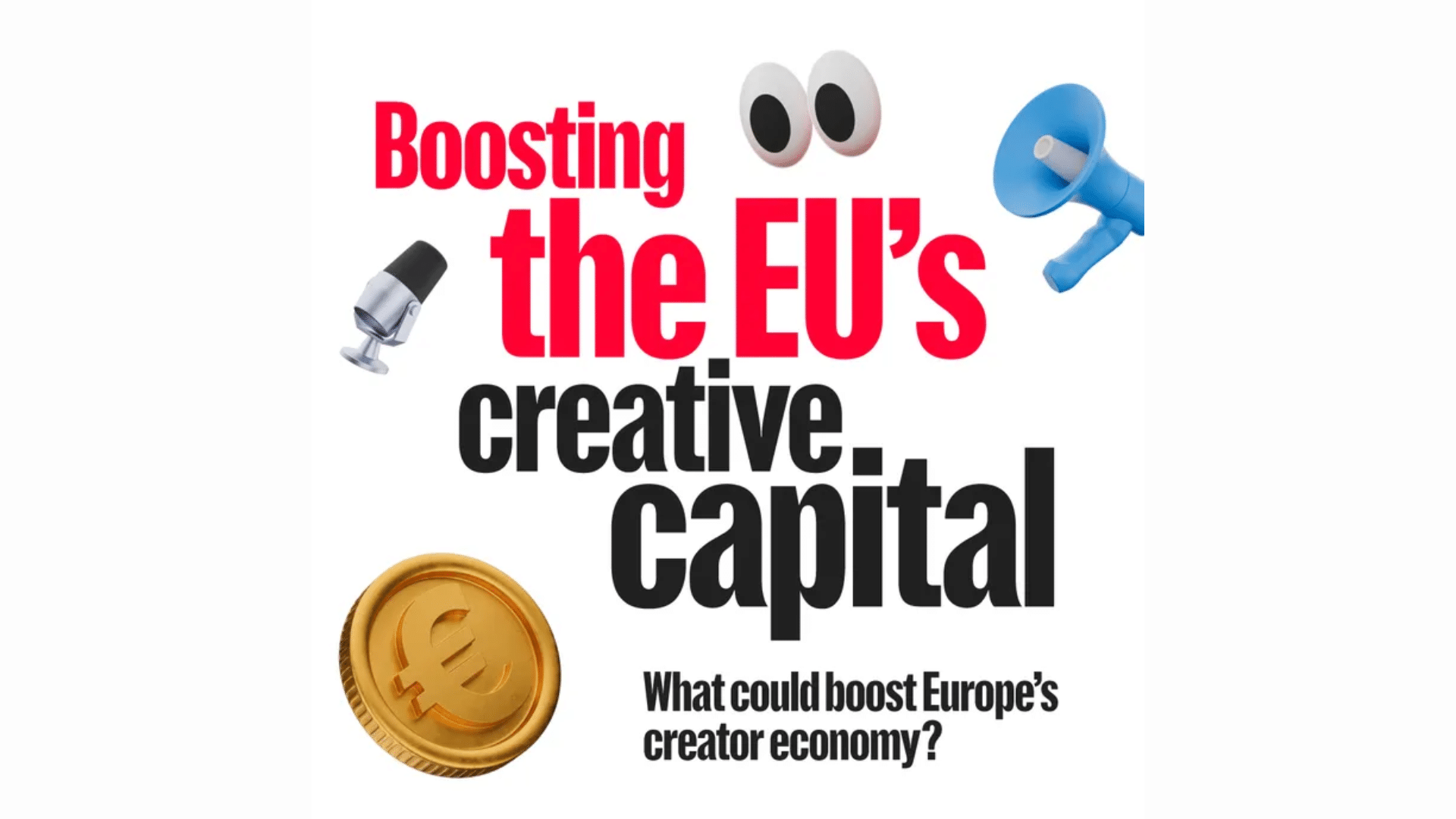
Image source: “Creative Capital – A Proposal for Unlocking the EU Creator Economy”
The full report can be found here
Subscribe to Our Newsletter
Check Out Our Podcast