Tech
Kale’s Isha Patel: Why Fan-Powered Marketing Works Better Than Average Influencer Campaigns

Brands spend millions activating paid influencers while their most enthusiastic customers post nothing. Not because they don’t want to, according to Isha Patel, but because no one built them a way in.
That problem is what Isha set out to solve. In 2021, she and co-founder Luis Molina left LinkedIn to build Kale, a fan advocacy platform that turns a brand’s existing customer base into a scalable, trackable marketing channel. The company targets marketing teams at consumer brands looking to move beyond polished influencer deals toward community-driven content that drives measurable results.
“While brands continued to rely on traditional influencer models, everyday customers were increasingly driving the conversations, trends, and cultural moments that truly moved the needle,” Isha says.
The insight came directly from her time at LinkedIn, where Isha spent nearly five years building the platform’s first video ecosystem and creator programs across more than a billion users and 30 million brands.
What LinkedIn Taught Them About Influence
For Isha and Luis, the LinkedIn years were less a career stop than a research lab. They watched as video adoption grew and ordinary users generated content that drove engagement at levels brand-produced assets rarely matched.
“We realized how authentic, low-lift content from real people outperformed polished campaigns,” Isha explains. “And how brands had no scalable way to harness that influence.”
After COVID, the shift became harder to ignore. Social media conversations grew more peer-driven, with audiences trusting recommendations from friends and followers over traditional brand messaging. Brands were struggling to cut through the noise. “That gap told us the market was ready for a platform like Kale,” Isha says.
The Advocacy Gap Brands Created for Themselves
Before platforms like Kale, fan advocacy existed largely as an afterthought. Brands recognized their customers as powerful drivers of word-of-mouth, but had no systematic way to activate them. There was no reward structure, no tracking, no mechanism to turn enthusiasm into output.
“There was no scalable way to reward real fans or track the impact of their influence,” Isha says. “Brands were missing one of the most powerful and authentic ways to reach new audiences in today’s social landscape.”
The gap wasn’t a lack of willing participants. According to Isha, only 10% of a brand’s superfans are comfortable sharing content publicly. The other 90% are still eager to engage. They simply need a format that fits them. That insight shapes much of what Kale has built.
Why Fan Content Outperforms Paid Campaigns
The case against purely polished influencer-led marketing isn’t philosophical for Isha. It’s operational.
Fan-created content, she argues, is more relatable and rooted in personal experience. Unlike influencer campaigns, which can feel staged or transactional, content from real customers resonates because it reflects genuine interaction with a brand. “That authenticity drives higher engagement, stronger word-of-mouth, and measurable business impact,” she says.
Kale’s model gives fans a structure for participation: campaigns with clear deliverables, cash rewards for sharing content, and real-time analytics for brands to track reach, engagement, and conversion. “When fans or employees understand the goal, have clear deliverables, and feel like they’re part of something bigger, they really lean in,” Isha notes.
Isha is careful not to position fan advocacy as a replacement for traditional creator partnerships. Influencers still drive awareness and trend-setting at scale. The most effective approach, she says, is to use creators to spark the moment and real fans to carry it forward.
DoorDash, 50 Cent, and the Super Bowl Test
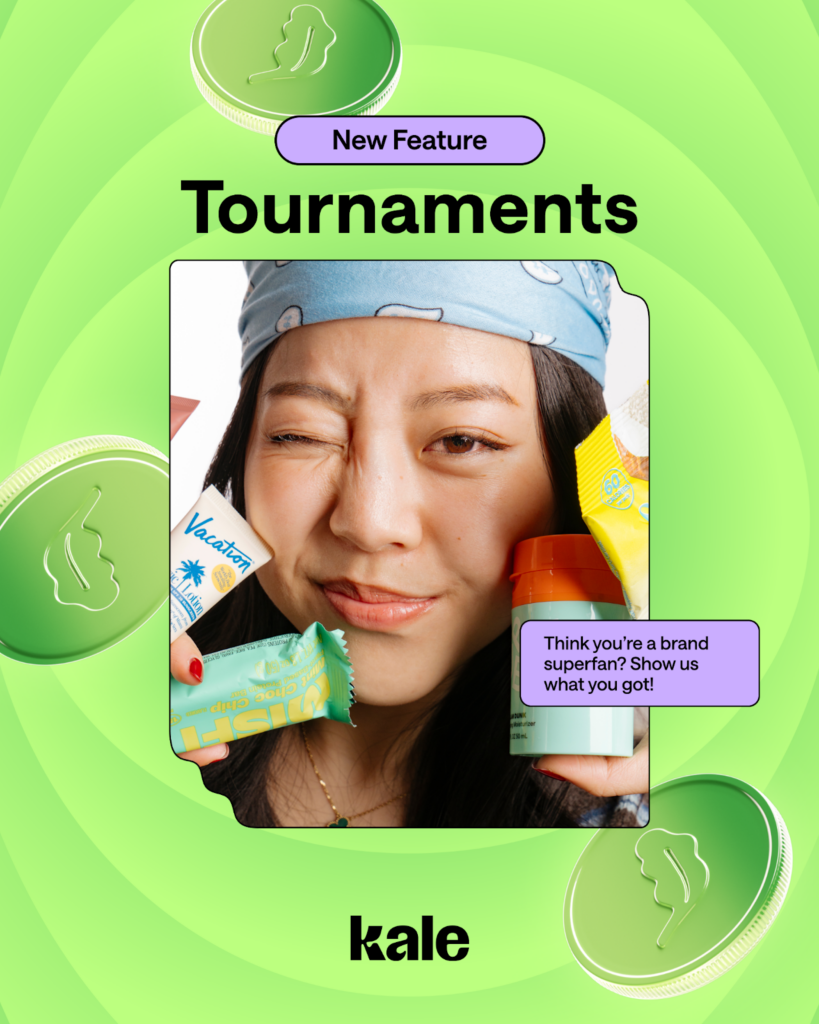
Kale’s Tournaments product, launched in November 2025, represents its most direct attempt to reach the broader 90%. Tournaments are time-limited, gamified competitions where fans earn points and climb a leaderboard by completing actions such as posting to social media, tagging brands, making purchases, or leaving comments. No video required.
The format got a live test during the Super Bowl, where cultural stakes are high, and brand noise is at its peak. The DoorDash campaign that ran through the Tournament mechanic produced results Isha describes as a clear validation of the model.
According to her, DoorDash recorded its most engaged post ever, with +368% TikTok follower growth and +123% Instagram follower growth. A post featuring 50 Cent became a live catalyst, with users engaging every 6.6 minutes. Share of voice lifted measurably across platforms.
“Fans weren’t just watching, they were actively involved,” Isha says. “That level of live participation turns social from something you scroll past into something you want to be part of.”
The DoorDash campaign illustrates why Isha believes gamification is the next major lever in fan marketing. The Tournament structure created urgency and competition. People posted and shared not only because they cared about DoorDash, but because they wanted to win, in Isha’s view.
The Biggest Operational Mistake Brands Make
For all the interest in fan advocacy, Isha says most brands approach it incorrectly from the start. The most common mistake: treating it as a one-off activation rather than a continuous strategy.
“A lot of brands want employee or fan advocacy, but don’t have the resources or tools to manage and execute it effectively,” she says. Without structure, incentives, and guidance, participation drops off quickly. Campaigns produce a brief spike, then go quiet.
The fix, according to Isha, isn’t more spend. It’s more system. Brands that treat fan advocacy as an ongoing channel, with recurring campaigns, clear deliverables, and rewards that accumulate over time, see compounding returns on engagement and share of voice. “People already want to talk about the brands they love,” she says. “The key is giving them the tools and motivation to do it in a way that actually drives results.”
Isha points out that this is where Kale’s model differs from typical influencer platforms. Rather than brokering one-off deals between brands and individual creators, Kale builds infrastructure that scales fan participation across campaigns, with employees and customers generating thousands of pieces of content around a single activation.
Gamification as the Next Layer
Kale’s near-term roadmap extends the Tournament model further into what Isha calls the “long tail of customer enthusiasts.” The goal is to develop more ways for the 90% who prefer lower-friction participation to engage with brands on their own terms, through comments, purchases, or social actions rather than video.
“Our focus is on meeting that need by expanding our levers of community engagement through gamified rewards and new ways for customers to participate,” Isha says.
The broader shift she anticipates mirrors what she observed at LinkedIn: participation scales when friction drops. As brands look for channels that deliver both authenticity and accountability, fan-powered platforms occupy a structural position that neither traditional influencer marketing nor paid social fills well.
“In 2026, authenticity isn’t really about aesthetics anymore,” Isha says. “It’s about whether the content actually resonates with people and drives real interaction.”
Subscribe to Our Newsletter
Check Out Our Podcast