





Technology
How Twin Galaxies Transformed Ad Viewability With Karl Jobst’s ‘Doom’ Challenge

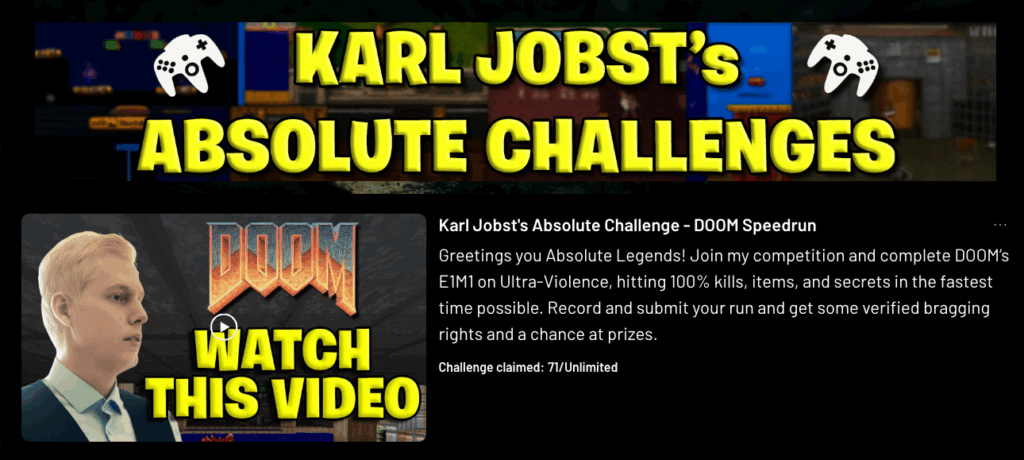
Traditional YouTube ad reads see the majority of viewers hitting the skip button. Yet when gaming YouTuber Karl Jobst announced a “Doom” speedrunning competition sponsored by metal poster company Displate, something unexpected happened – viewers stayed engaged through the entire ad segment, with 44% fewer people skipping the sponsor message.
This shift in audience behavior stems from a fundamental reimagining of creator-brand partnerships orchestrated by Twin Galaxies Challenges, a platform spearheaded by Zachary Rozga, founder and CEO of Thece and senior executive at Twin Galaxies.
“I recognized that in the attention economy, not all ad impressions or campaigns are equal,” Zachary explains. “A lot of display advertising has become empty calories. You can feed your audience with impressions, but they don’t move the needle or build a healthy relationship.”
Twin Galaxies Challenges addresses this problem by transforming passive viewers into active participants through customized competitions. The platform’s partnership with Karl Jobst and Displate demonstrates how this approach creates meaningful engagement for brands, creators, and audiences alike.
Karl Jobst, a YouTube creator with more than 1.05 million subscribers, is known for his thorough investigative content in gaming. “He makes well-researched, thoughtful videos and always brings receipts. He often looks for cheating,” Zachary notes. This reputation made him an ideal partner for Twin Galaxies, which, according to Zachary, has developed a verification system he says achieves 99% accuracy over its 40-year history.
For the competition, Jobst challenged his audience to complete “Doom’s” first level while collecting all special items, which was a novel task that hadn’t been attempted in the speedrunning community before. This move was intentional and strategic. “It was important to him to do a new challenge nobody had ever done, so that everyone, including top ‘Doom’ speedrunners, would participate, which they did,” Zachary explains.
A Three-Week Brand Experience
The competition ran for three weeks, transforming what would typically be a brief ad mention into an extended engagement campaign. “It creates a campaign that isn’t just a 30-second ad read,” Zachary says. “It turns into a three-week engagement with fans and community. Dialogue happens on Discord, in comments, on social posts. It lives and breathes over the whole period.”
For Displate, a company that creates metal posters, including a “Doom”-themed line, the partnership delivered tangible results. Beyond the improved ad viewability metrics, Zachary says the campaign achieved a 1.5x return on investment. This performance significantly outpaced traditional sponsored content, not just for Displate, but also compared to Jobst’s previous brand partnerships.
“Purely from an advertiser viewability standpoint, it astronomically outperformed,” Zachary says. “We compared it to five other ad reads he’d done for four other products, and it substantially outperformed them all.”
According to Zachary, the campaign’s natural integration was key to its success. Rather than awkwardly pivoting from content to commercial message, Jobst was able to introduce the challenge as something exciting for his community first, then acknowledge Displate’s role in making it possible. “Instead of content, content, then ad break, it was, ‘I’m launching a competition. Oh, by the way, it’s powered by my sponsor,'” Zachary explains.
The Competition Dynamics
The three-week competition timeline revealed specific participant behaviors that contributed to sustained engagement. Zachary observed a consistent pattern across their challenges: “You get an initial burst of people on the leaderboard, then it levels out, and then you get a burst at the end.”
This final surge occurs because participants strategically time their submissions to maximize their chances of winning. “If you have a run that would beat everybody, you don’t want to post too early because it might encourage others to beat you,” Zachary says. This competitive dynamic drove ongoing interest throughout the campaign period, with participants repeatedly returning to check standings and refine their attempts.
The competition also generated rich content for Jobst’s channel, as participants developed and shared various strategies to complete the challenge. “The strategies changed over time,” Zachary shares. “They started with one way, then copied each other, then someone came up with a slightly faster strategy, and others copied that.” This evolution culminated in the winning entry, which used “a new approach nobody predicted at the start.”
What’s particularly valuable about this model, Zachary adds, is how it creates multiple levels of engagement beyond those who submit entries. “The audience of a competition is much larger than the people who submit,” he points out. “Many just watch videos or judge entries.”
Trust, Verification, and Community Building
Twin Galaxies’ legacy in the gaming world provides a crucial foundation of trust for these challenges. The platform’s rigorous verification process ensures competition integrity, which is particularly important to Jobst, whose content often focuses on exposing cheating in gaming.
“Twin Galaxies has built this system over decades using human input to verify true submissions,” Zachary explains. “It’s a process that evolved over a long time and gets to the truth.”
This foundation of trust enables the platform to function as a social network with competition as its central organizing principle. “Every submission can be commented on, liked, and voted on. Voting is the verification. Every submission can be shared,” Zachary says.
The community aspect is particularly powerful for deeper connections with both the creator and sponsoring brand. Throughout the “Doom” challenge, Jobst’s Discord channel was filled with discussions about strategy, speculation about unrevealed scores, and anticipation for the final results. Zachary reveals that these conversations extended the campaign’s impact well beyond the initial announcement and recap videos.
From Interruption to Enablement
Perhaps most significant is how this approach changes the relationship between creators, sponsors, and audiences. Rather than interrupting content with a commercial message, the sponsor becomes an enabler of content that audiences actively want.
“It gives the creator a clean, organic way to talk about their advertiser,” Zachary notes. “It’s not about forcing in an ad read that feels cringe.”
This positioning transforms how viewers perceive the sponsor. Instead of being an intrusion, the brand becomes a facilitator of community engagement. This is particularly valuable for direct-to-consumer companies like Displate that rely on conversion-driven advertising.
“From a pure return on ad spend, it wasn’t a campaign in the red,” Zachary states. “They made a huge brand impression and sold product. Anytime you can get brand lift and move product, it’s a win.”
The multiple touchpoints throughout the campaign provide opportunities for brand integration at every stage. Zachary explains that “there are multiple calls to action. There’s the launch, the integrated ad read, the link in bio, the competition landing page with prizes and product images, and a direct link to Displate.”
The Future of Creator-Led Competition
Following the Jobst-Displate campaign, Twin Galaxies is expanding its creator partnerships. For brands considering a creator-led strategy, Zachary’s advice is straightforward: “Take the leap. You’ll get a strong impact. Whether you want brand exposure or DTC [Direct To Consumer] sales, it’s an authentic way to show gamers you care.”
The “Doom” challenge demonstrates how active participation creates stronger connections than passive consumption. “It’s about stickiness,” Zachary emphasizes. “Not millions of people, but thousands dedicating weeks of their lives to something you made possible. Your brand message is in their head.”
By focusing on competition as the organizing principle for social interaction, Twin Galaxies has created a model that delivers engagement in an increasingly distracted world. As Zachary concludes, “We’re seeing millions of hours spent on these three-week campaigns. It’s not billions of people, but a dedicated fan base. And you can do it again.”
Subscribe to Our Newsletter
Check Out Our Podcast