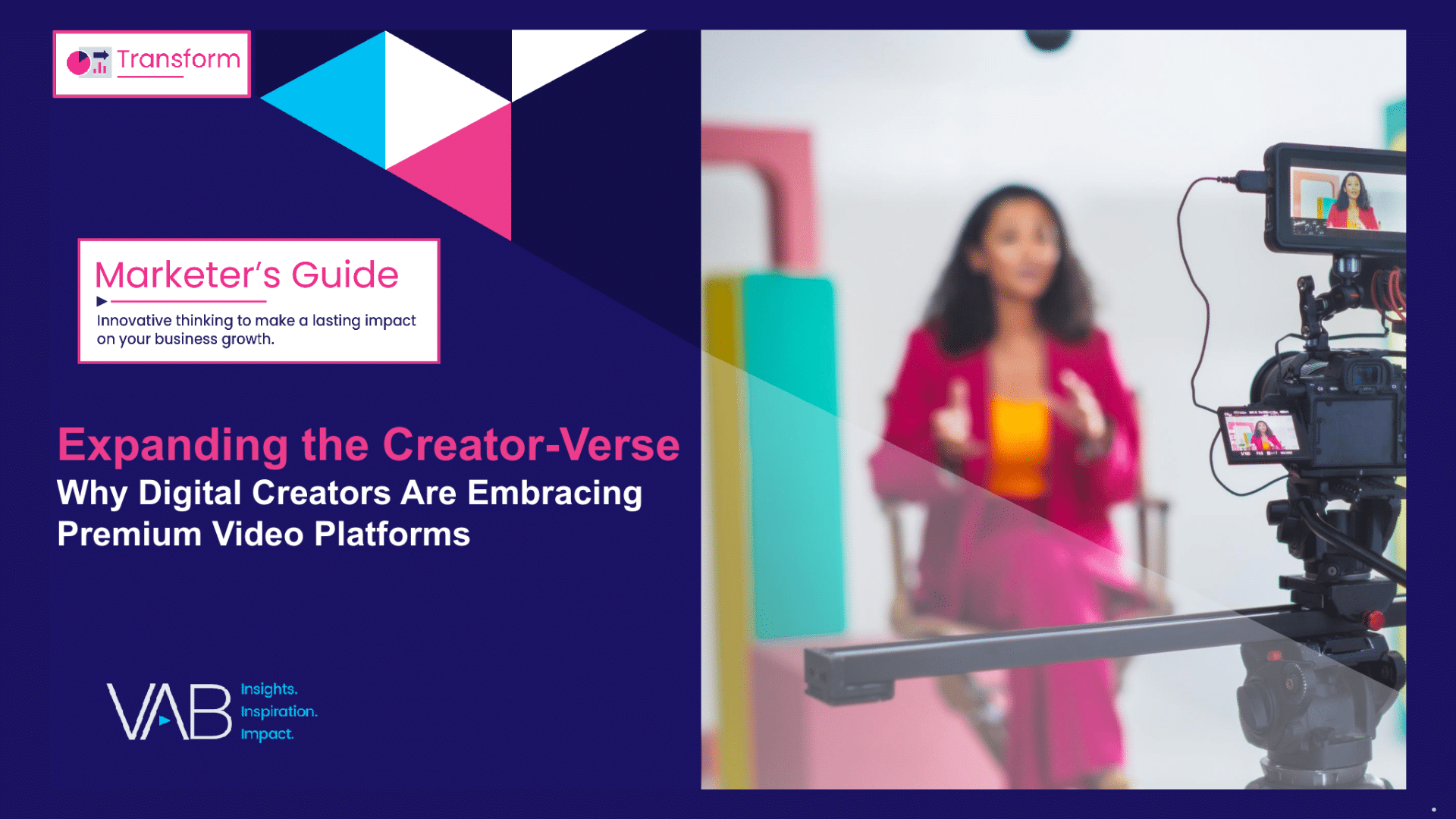
Digital creator content now accounts for 26% of Americans’ daily video viewing across devices, and creators appearing on TV or streaming platforms make followers four times more likely to search for advertised brands and 2.4 times more likely to purchase, according to a new report from the Video Advertising Bureau (VAB).
The report, “Expanding the Creator-Verse: Why Digital Creators Are Embracing Premium Video Platforms,” combines VAB’s own custom survey, fielded with Hub Entertainment Research in June 2026 among 1,600 consumers ages 16 to 74, with third-party data from eMarketer, CreatorIQ, Linqia, Influencer Marketing Factory, Tubi and Media Dynamics.
Creators Close In on Premium Video’s Share of Attention
Citing Media Dynamics data from July 2026, the report finds that of the 6.7 hours Americans spend daily with TV and video content, 26% goes to creators, compared with 35% for linear TV and 33% for streaming platforms. Combined, linear and streaming still account for 68% of daily viewing, which VAB frames as “Premium Video Platforms.”
More than half of people 16 and older (55%) actively follow at least one digital creator, per VAB’s custom survey. That figure rises to 84% among 16-to-24-year-olds and 83% among 25-to-34-year-olds, before dropping to 54% for 35-to-54-year-olds and 23% for those 55 to 74.
Consumer perception of creators splits by age. Across all respondents, 54% describe creators primarily as entertainers, 34% as celebrities, and 29% as media brands or entrepreneurs. Younger audiences are more likely to see creators in those latter categories: 37% of 16-to-24-year-olds call creators media brands, versus 20% of those 55 to 74, who are more likely to describe them as entertainers (46%), entrepreneurs (30%), or product recommenders (29%).
Revenue Is Projected to Nearly Triple in Six Years
eMarketer’s February 2026 forecast, cited in the report, puts U.S. social media creator revenue at $21.1 billion in 2026, up from $10.0 billion in 2022, with the figure projected to reach $26.8 billion by 2028.
Separately, CreatorIQ’s “The State of Creator Marketing 2024-2025” found that among 39 of the top Fortune 100 brands, creator content generated 12 times the impressions, 17 times the engagement, and 20 times the earned media value of those brands’ owned social channels.
Brands Are Increasing Budgets but Struggling With ROI
A Linqia survey of more than 200 enterprise marketers found 59% of brands plan to increase influencer marketing investment in 2026 compared with the prior year, and 62% of companies now invest more than $500,000 annually in the category. Thirteen percent invest more than $10 million.
Despite the spending increase, marketers report persistent friction: 71% cite determining ROI as a top challenge, 50% cite the time required to run programs, and 48% cite content quality, according to the same Linqia survey.
Creators report their own pressures. Influencer Marketing Factory’s “2026 Creator Economy Report” found the top challenges creators face are time management (15%), inconsistent income (14%), and burnout (14%). Separately, 45% of creators told the same survey they now prioritize stability and consistency with brand partners over one-off campaign work.
Creator Appearances Lift Every Stage of the Marketing Funnel
VAB’s custom survey asked respondents how a favorite creator’s appearance on a TV or streaming show would affect their behavior toward brands featured in that content. Respondents who follow creators were three times more likely to pay attention to an advertised brand, 2.8 times more likely to consider it, four times more likely to search for it online, 2.4 times more likely to purchase it, and 2.2 times more likely to recommend it to a friend.
Separately, Tubi’s “The Stream 2026” survey of 2,500 streamers, conducted by the Harris Poll, found 63% say watching creator content feels no different than watching a TV show, and 56% consider creators celebrities on par with Hollywood talent. Seventy-six percent said they want more original content from independent or smaller creators, up 6 percentage points year over year, and 73% said watching smaller creators feels like directly supporting them, up 10 points.
The report also cites a wave of media companies building creator-facing infrastructure in 2026, including FOX Creator Studios, NBCUniversal’s Rock Studios, Roku’s Creators destination and PubMatic’s Creator Marketplace, alongside creator crossovers such as “The Pat McAfee Show” simulcasting on ESPN, Alix Earle appearing on “Dancing With the Stars” and “Beast Games” streaming on Amazon.
Dragomir is a Serbian freelance blog writer and translator. He is passionate about covering insightful stories and exploring topics such as influencer marketing, the creator economy, technology, business, and cyber fraud.












Digital creator content now accounts for 26% of Americans’ daily video viewing across devices, and creators appearing on TV or streaming platforms make followers four times more likely to search for advertised brands and 2.4 times more likely to purchase, according to a new report from the Video Advertising Bureau (VAB).
The report, “Expanding the Creator-Verse: Why Digital Creators Are Embracing Premium Video Platforms,” combines VAB’s own custom survey, fielded with Hub Entertainment Research in June 2026 among 1,600 consumers ages 16 to 74, with third-party data from eMarketer, CreatorIQ, Linqia, Influencer Marketing Factory, Tubi and Media Dynamics.
Creators Close In on Premium Video’s Share of Attention
Citing Media Dynamics data from July 2026, the report finds that of the 6.7 hours Americans spend daily with TV and video content, 26% goes to creators, compared with 35% for linear TV and 33% for streaming platforms. Combined, linear and streaming still account for 68% of daily viewing, which VAB frames as “Premium Video Platforms.”
More than half of people 16 and older (55%) actively follow at least one digital creator, per VAB’s custom survey. That figure rises to 84% among 16-to-24-year-olds and 83% among 25-to-34-year-olds, before dropping to 54% for 35-to-54-year-olds and 23% for those 55 to 74.
Consumer perception of creators splits by age. Across all respondents, 54% describe creators primarily as entertainers, 34% as celebrities, and 29% as media brands or entrepreneurs. Younger audiences are more likely to see creators in those latter categories: 37% of 16-to-24-year-olds call creators media brands, versus 20% of those 55 to 74, who are more likely to describe them as entertainers (46%), entrepreneurs (30%), or product recommenders (29%).
Revenue Is Projected to Nearly Triple in Six Years
eMarketer’s February 2026 forecast, cited in the report, puts U.S. social media creator revenue at $21.1 billion in 2026, up from $10.0 billion in 2022, with the figure projected to reach $26.8 billion by 2028.
Separately, CreatorIQ’s “The State of Creator Marketing 2024-2025” found that among 39 of the top Fortune 100 brands, creator content generated 12 times the impressions, 17 times the engagement, and 20 times the earned media value of those brands’ owned social channels.
Brands Are Increasing Budgets but Struggling With ROI
A Linqia survey of more than 200 enterprise marketers found 59% of brands plan to increase influencer marketing investment in 2026 compared with the prior year, and 62% of companies now invest more than $500,000 annually in the category. Thirteen percent invest more than $10 million.
Despite the spending increase, marketers report persistent friction: 71% cite determining ROI as a top challenge, 50% cite the time required to run programs, and 48% cite content quality, according to the same Linqia survey.
Creators report their own pressures. Influencer Marketing Factory’s “2026 Creator Economy Report” found the top challenges creators face are time management (15%), inconsistent income (14%), and burnout (14%). Separately, 45% of creators told the same survey they now prioritize stability and consistency with brand partners over one-off campaign work.
Creator Appearances Lift Every Stage of the Marketing Funnel
VAB’s custom survey asked respondents how a favorite creator’s appearance on a TV or streaming show would affect their behavior toward brands featured in that content. Respondents who follow creators were three times more likely to pay attention to an advertised brand, 2.8 times more likely to consider it, four times more likely to search for it online, 2.4 times more likely to purchase it, and 2.2 times more likely to recommend it to a friend.
Separately, Tubi’s “The Stream 2026” survey of 2,500 streamers, conducted by the Harris Poll, found 63% say watching creator content feels no different than watching a TV show, and 56% consider creators celebrities on par with Hollywood talent. Seventy-six percent said they want more original content from independent or smaller creators, up 6 percentage points year over year, and 73% said watching smaller creators feels like directly supporting them, up 10 points.
The report also cites a wave of media companies building creator-facing infrastructure in 2026, including FOX Creator Studios, NBCUniversal’s Rock Studios, Roku’s Creators destination and PubMatic’s Creator Marketplace, alongside creator crossovers such as “The Pat McAfee Show” simulcasting on ESPN, Alix Earle appearing on “Dancing With the Stars” and “Beast Games” streaming on Amazon.
Image source: VAB
Get the full report here
Subscribe to Our Newsletter
Check Out Our Podcast