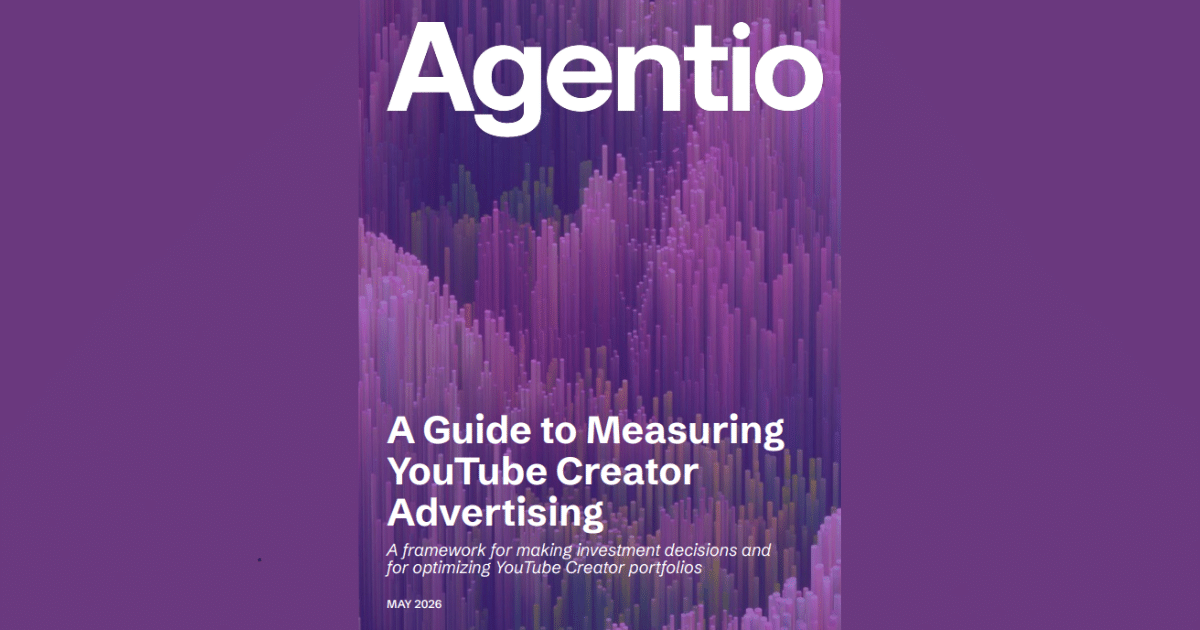
Brands measuring YouTube creator advertising with traditional attribution tools are systematically undercounting conversions from the channel, and four out of ten top-performing creators would not be renewed under standard attribution models, according to a new guide published in May 2026 by Agentio, a creator advertising platform.
The report, titled “A Guide to Measuring YouTube Creator Advertising,” draws on data from 50 enterprise brands spending between $2 million and $10 million annually on creator partnerships. It argues that the tools most commonly used to evaluate creator performance (discount codes, UTM parameters, and pixels) were not designed for YouTube and produce a structurally incomplete picture of the channel’s contribution.
The Attribution Gap
The core problem, according to Agentio, is that YouTube does not allow pixels to fire on a video view. On platforms such as Meta, a user is cookied when shown an ad, enabling brands to track that person’s path to purchase even without a click. YouTube provides no equivalent passive tracking mechanism.
“A viewer must actively click a link in the description or scan a QR code – and only then can any tracking occur,” the report states. “Until that moment, the viewer is completely invisible to every attribution tool you have.”
Most YouTube viewers never click. Instead, they watch, absorb the message, and convert later through organic search, direct URL entry, or a third-party marketplace. When that purchase is made, last-touch attribution credits search or organic traffic rather than the creator who drove the awareness.
The report also identifies limitations specific to each common data capture tool. Discount codes capture only viewers who remembered and applied a creator-specific promo code at checkout, and can leak across audiences, making creator-to-creator comparisons unreliable. UTMs miss any viewer who entered through an untagged path. Pixels track only those who clicked through at some point. Attribution methodologies (first-touch, last-touch, and multi-touch) all sit on top of this click-gated data and therefore inherit the same blind spots.
A Two-Question Framework
Agentio’s central recommendation is that brands separate two distinct questions that most measurement setups conflate: whether the YouTube creator channel deserves more budget, and which specific creators within that channel to renew.
“These questions require different tools, operate at different levels of granularity, and should never be conflated,” the report states.
For budget allocation, Agentio recommends a properly configured Media Mix Model (MMM), which estimates channel-level incrementality by correlating marketing inputs with business outcomes over time rather than tracking individual users. Across the 50 brands in its dataset, Agentio found that MMM-measured creator performance is 1.2x to 5x higher than what traditional last-touch or promo code attribution reports.
The report identifies three configuration requirements specific to YouTube creator integrations. First, the channel should represent at least 5% of a brand’s total marketing budget for the model to isolate its effect, citing measurement firm Haus. Second, MMMs should not be calibrated using geo-test experiments, since creator audiences cannot be precisely geo-targeted. Third, because creator deals involve a flat fee paid upfront while viewership accumulates over months, with 40% of views occurring after the first 30 days, brands should feed the model either spend amortized over 90 days or actual view accumulation data rather than point-of-purchase spend figures.
Creator-Level Rankings Require a Different Approach
Because MMMs operate at the aggregate channel level, they generally cannot identify which individual creators are responsible for performance. For that decision, Agentio recommends combining two signals: pixels and Post-Purchase Surveys (PPS).
Pixels capture the subset of viewers who clicked through and converted. While that represents a small fraction of total orders, the report argues the fraction is statistically consistent across creators, making relative rankings meaningful even if absolute counts are understated.
Post-Purchase Surveys ask customers directly how they heard about the brand. With a response rate of approximately 30%, Agentio describes PPS results as statistically meaningful. Across its brand dataset, 73% of PPS-attributed responses represent orders that were invisible to last-touch attribution or pixels.
Combining and deduplicating the two signals is necessary, according to the report. Using either alone produces materially different renewal lists. In anonymized campaign data from one Agentio client evaluating 20 creators, up to four of the top ten performers would have been cut if the brand had relied solely on pixels or solely on PPS.
Recommended Steps by Current Setup
For brands not yet running an MMM, Agentio recommends deploying pixels and a Post-Purchase Survey immediately, amortizing creator spend over 90 days, and applying a conservative 1.5x to 3x multiplier to pixel ROAS for internal reporting. The report describes this approach as a directional bridge rather than a permanent measurement solution.
For brands with multi-touch attribution in place but no MMM, the report cautions against using MTA outputs for budget allocation decisions, since MTA models draw from the same click-gated data as pixels. For brands with an MMM already running, the report advises confirming that the model is not calibrated using geo-testing and, if necessary, switching to synthetic control modeling.
Image source: Agentio The full report is available here
Jonathan is a South African content creator, photographer and videographer with 25 years of experience in journalism and print media design. He is interested in new developments in AI content creation and covers a broad spectrum of topics within the creator economy.









Brands measuring YouTube creator advertising with traditional attribution tools are systematically undercounting conversions from the channel, and four out of ten top-performing creators would not be renewed under standard attribution models, according to a new guide published in May 2026 by Agentio, a creator advertising platform.
The report, titled “A Guide to Measuring YouTube Creator Advertising,” draws on data from 50 enterprise brands spending between $2 million and $10 million annually on creator partnerships. It argues that the tools most commonly used to evaluate creator performance (discount codes, UTM parameters, and pixels) were not designed for YouTube and produce a structurally incomplete picture of the channel’s contribution.
The Attribution Gap
The core problem, according to Agentio, is that YouTube does not allow pixels to fire on a video view. On platforms such as Meta, a user is cookied when shown an ad, enabling brands to track that person’s path to purchase even without a click. YouTube provides no equivalent passive tracking mechanism.
“A viewer must actively click a link in the description or scan a QR code – and only then can any tracking occur,” the report states. “Until that moment, the viewer is completely invisible to every attribution tool you have.”
Most YouTube viewers never click. Instead, they watch, absorb the message, and convert later through organic search, direct URL entry, or a third-party marketplace. When that purchase is made, last-touch attribution credits search or organic traffic rather than the creator who drove the awareness.
The report also identifies limitations specific to each common data capture tool. Discount codes capture only viewers who remembered and applied a creator-specific promo code at checkout, and can leak across audiences, making creator-to-creator comparisons unreliable. UTMs miss any viewer who entered through an untagged path. Pixels track only those who clicked through at some point. Attribution methodologies (first-touch, last-touch, and multi-touch) all sit on top of this click-gated data and therefore inherit the same blind spots.
A Two-Question Framework
Agentio’s central recommendation is that brands separate two distinct questions that most measurement setups conflate: whether the YouTube creator channel deserves more budget, and which specific creators within that channel to renew.
“These questions require different tools, operate at different levels of granularity, and should never be conflated,” the report states.
For budget allocation, Agentio recommends a properly configured Media Mix Model (MMM), which estimates channel-level incrementality by correlating marketing inputs with business outcomes over time rather than tracking individual users. Across the 50 brands in its dataset, Agentio found that MMM-measured creator performance is 1.2x to 5x higher than what traditional last-touch or promo code attribution reports.
The report identifies three configuration requirements specific to YouTube creator integrations. First, the channel should represent at least 5% of a brand’s total marketing budget for the model to isolate its effect, citing measurement firm Haus. Second, MMMs should not be calibrated using geo-test experiments, since creator audiences cannot be precisely geo-targeted. Third, because creator deals involve a flat fee paid upfront while viewership accumulates over months, with 40% of views occurring after the first 30 days, brands should feed the model either spend amortized over 90 days or actual view accumulation data rather than point-of-purchase spend figures.
Creator-Level Rankings Require a Different Approach
Because MMMs operate at the aggregate channel level, they generally cannot identify which individual creators are responsible for performance. For that decision, Agentio recommends combining two signals: pixels and Post-Purchase Surveys (PPS).
Pixels capture the subset of viewers who clicked through and converted. While that represents a small fraction of total orders, the report argues the fraction is statistically consistent across creators, making relative rankings meaningful even if absolute counts are understated.
Post-Purchase Surveys ask customers directly how they heard about the brand. With a response rate of approximately 30%, Agentio describes PPS results as statistically meaningful. Across its brand dataset, 73% of PPS-attributed responses represent orders that were invisible to last-touch attribution or pixels.
Combining and deduplicating the two signals is necessary, according to the report. Using either alone produces materially different renewal lists. In anonymized campaign data from one Agentio client evaluating 20 creators, up to four of the top ten performers would have been cut if the brand had relied solely on pixels or solely on PPS.
Recommended Steps by Current Setup
For brands not yet running an MMM, Agentio recommends deploying pixels and a Post-Purchase Survey immediately, amortizing creator spend over 90 days, and applying a conservative 1.5x to 3x multiplier to pixel ROAS for internal reporting. The report describes this approach as a directional bridge rather than a permanent measurement solution.
For brands with multi-touch attribution in place but no MMM, the report cautions against using MTA outputs for budget allocation decisions, since MTA models draw from the same click-gated data as pixels. For brands with an MMM already running, the report advises confirming that the model is not calibrated using geo-testing and, if necessary, switching to synthetic control modeling.
Image source: Agentio
The full report is available here
Subscribe to Our Newsletter
Check Out Our Podcast