






Tech
Brand Marketers Can’t See Where Their Influencer Budgets Go. And They’re Running Out Of Patience

A new ANA study finds that a majority of marketers lack full visibility into how Influencer Marketing budgets are spent, even as more than half say they intend to change their compensation approach within the year.
The Transparency Problem Is Bigger Than It Appears
When the Association of National Advertisers (ANA) surveyed 84 client-side marketers on influencer agency compensation late last year, the headline finding was striking: only half say they have full visibility into what their agencies actually pay creators and influencers on their behalf.
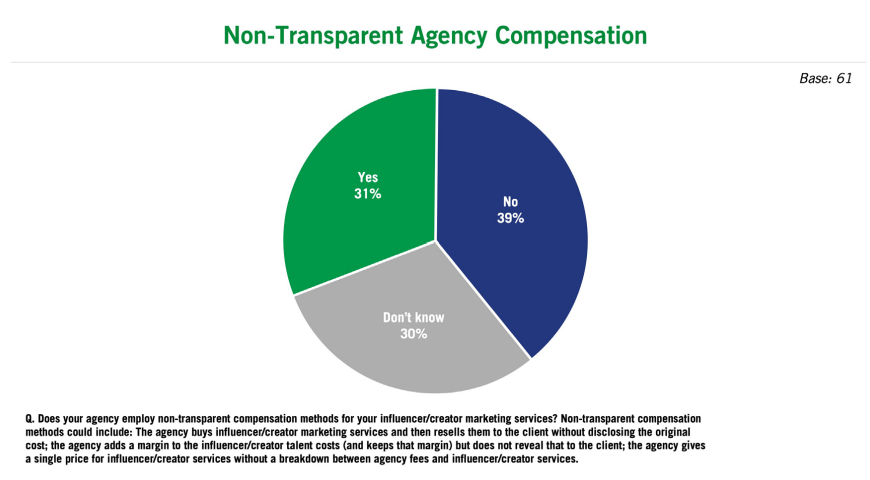
But the deeper problem may be larger than that number suggests. When the ANA asked respondents directly whether their agency employs non-transparent compensation methods, 31% said yes. Another 30% said they did not know. The ANA’s assessment is pointed: those who don’t know likely have agencies that are operating non-transparently. Combined, that means as many as 61% of marketers surveyed may not have a clear picture of how their influencer budgets are being allocated.
The mechanics of the opacity vary. Some agencies bundle talent and agency fees into a single line item. Others provide only the total amount paid across all creators in a campaign, without breaking down individual rates. In some cases, agencies declined to disclose their fee structures entirely when clients asked.
Respondents described their situations in direct terms. “The agency gives us a single price for working with influencers, and we don’t know how much of that is the agency fee,” one wrote. Another reported: “We didn’t have ANY visibility into specific contracts with our talent – just a breakdown of the total talent budget. We asked to see the contracts several times, and the agency said ‘no.’ We are now changing agencies.”
The ANA draws a parallel to principal media: the practice in which agencies buy media inventory with their own funds and resell it to clients without disclosing the original purchase price or their markup. The organization has scrutinized principal media in prior reports dating to 2016. Its position in this new report is that Influencer Marketing has developed a structurally similar dynamic, in which clients bear the cost, but lack the information to evaluate whether that cost is fair.
Satisfaction Numbers Mask Underlying Pressure
On the surface, marketers’ satisfaction with influencer agency compensation looks reasonably solid. Twenty-five percent of respondents describe themselves as very satisfied with their current agency compensation agreements, and another 48% say they are somewhat satisfied, leaving 27% dissatisfied.
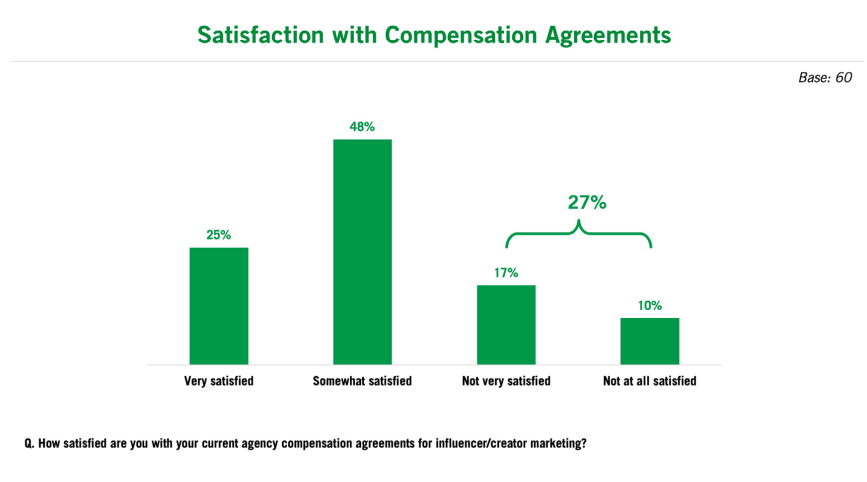
But those numbers sit in tension with a different finding: 55% of respondents say they are likely to change their current compensation approach within the next 12 months. That means a meaningful portion of marketers who describe themselves as somewhat satisfied are still planning to make a change, and their open-ended responses point to why.
Transparency is the dominant theme. “Not happy with current transparency,” one respondent wrote plainly. Others cited the absence of industry benchmarks as a compounding problem: without standard reference points, even marketers who feel their pricing is fair have limited ability to verify it. “There aren’t enough benchmarks to know if this is good or bad,” one respondent noted.
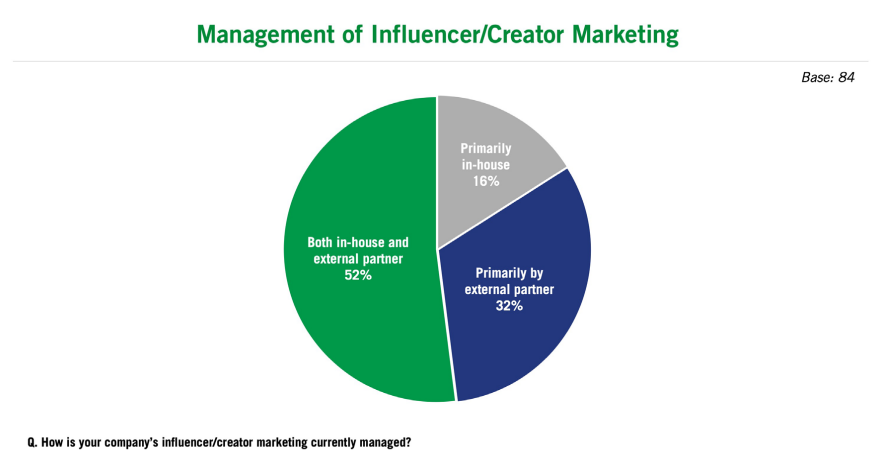
A second driver of planned change is the move toward in-house management. Currently, only 16% of respondents manage Influencer Marketing primarily in-house, but that figure appears to be growing. Among those already operating in-house, the top-cited benefits are better brand knowledge, greater control, and cost efficiencies. Qualitative interviews surfaced a benefit the survey itself did not anticipate: direct relationships with influencers. Marketers who manage creators directly report better rate negotiations, fewer rounds of content edits, faster timelines, and stronger long-term partnerships.
The administrative costs of in-housing are real. Respondents consistently described the contracting, payment, and project management work as labor-intensive, but for some, those costs are proving worth it. One respondent described redirecting a $42,000 program budget entirely to talent and allowlisting after an agency quoted $30,000 in fees for the same work, ultimately delivering more content in less time.
What Marketers Are Doing About It
The ANA’s guidance to marketers is consistent throughout the report: require transparency contractually before the relationship begins.
Respondents who report full visibility into agency fees and talent costs share a common factor: they asked for it upfront and made it a condition of the partnership. “Full transparency is something we asked for and negotiated,” one interviewee said.
For brand marketers evaluating their current agency arrangements, the report’s central message is that the information asymmetry many are experiencing is not inevitable. It is negotiable.
Image source: Association of National Advertisers
The full report is available here
Checkout Our Latest Podcast