









Technology
One Peak’s Conar Fair: Build for Watch Time, Repeat One Format, Keep the Content Human

In 2020, a behind-the-scenes clip from creator education platform One Peak Creative posted to a brand-new TikTok account drew a million views with no followers behind it. A spec ad posted to Instagram around the same time, which Ryan Reynolds shared, reached about a quarter of that. Co-founder and CEO Conar Fair read the result as proof that short-form algorithms reward watch time, and he has since built a business around teaching people to earn it with formats they can repeat.
That method now runs through Format Finder, an app that turns proven formats into scripted, edited videos. It was developed by the co-founders of One Peak Creative, Conar Fair, Megan Jackson, and Glen Jackson, who founded the company in 2019 in Kelowna, British Columbia.
“If you have an internet connection and a cell phone, you can go out and create really impactful short-form content that can reach millions of people,” Conar says.
He sorts those would-be creators into two groups: small business owners with a monetizable skill, product, or service who want more predictable revenue, and ordinary people who want to join the Creator Economy. He calls the second the much bigger market, because he treats short-form video as a basic skill. “I believe it’s comparable to what writing and typing was when we were growing up in school,” he says.
One Peak taught that skill before it built software for it. The company scaled its TikTok and Reels Creator Course to 170,000 students over two and a half to three years, according to Conar, and the members who succeeded shared the same fundamentals. Format Finder encodes them, starting with one metric.
Watch Time Decides Which Videos Spread
That metric came out of a crisis. When COVID-19 restrictions erased around $300,000 of booked agency work in 2020, by Conar’s account, the founders locked themselves in a house for 30 days and released a new spec ad on Instagram every night. They called it “Adsolation,” and its Aviation American Gin ad drew comments and shares from Reynolds and Blake Lively.
The TikTok results set the thesis. “Honest Ads,” a later account, posted about eight videos, each drawing hundreds of thousands or millions of views, and a Tesla spoof reached about 7 million. Conar concluded the algorithm was merit-based. “The only metric that mattered was watch time, getting people to watch to the very end of your video,” he says.
Holding viewers to the end takes a hook, a story or value, and a payoff, and Conar says the payoff has to land in the last three seconds. “The hook has to create an insane amount of tension and curiosity that is only resolved in the payoff,” he says.
That rule explains a single video. The students who succeeded repeatedly, Conar found, did something more specific.
Successful Creators Repeat One Format
Those students found one way to deliver the payoff and kept using it. The first case study was Megan’s father, Gerry, who was weighing a winter trucking job to fund his retirement. In his debut video, he offers to caddy for Conar and promises lunch if the golfer makes par. It passed a million views within 24 hours and approached 3 million within days, according to Conar.
Gerry has used that challenge format for almost three years, building roughly 400,000 followers across TikTok and Instagram and landing six-figure brand deals. “He has created an entire career off of this one repeatable video idea,” Conar says. He points to Alix Earle’s GRWM videos and Caleb Simpson asking strangers what they pay in rent as the same pattern.
One Peak sorts viral videos into five categories defined by the payoff. A challenge resolves on a win or loss, education answers the question the hook raised, storytelling resolves a conflict, “wait for it” videos such as pranks deliver a reaction, and skits deliver emotion. Conar compares them to book genres with subgenres.
The harder call is separating a format from a trend. A format, Conar says, has to work in any niche over time. “Creators are out there inventing new formats literally every single day,” he says. One recent addition, which the team calls “unsolicited advice,” shows a man with developed triceps explaining his routine to strangers who don’t work out. Each candidate is tested across niches before entering the app’s training library.

Photo: Conar Fair, Megan Jackson, and Glen Jackson
Format Finder Builds the Video Around Retention
Once a format enters that library, Format Finder can offer it to any user. Onboarding starts with a quiz about goals and a this-or-that hook game that shapes a creator’s profile, and agencies can add a profile per client. The “Brainstorm” tab generates best-fit formats with written hooks, screened by what the company calls the “Curiosity” test. “If this makes you curious, it’ll make your audience curious,” Conar says.
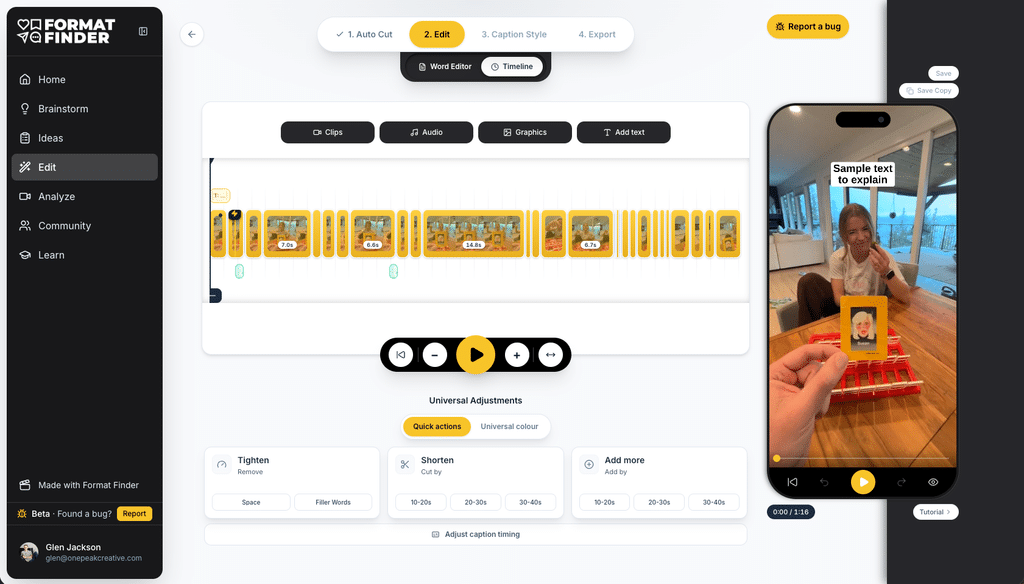
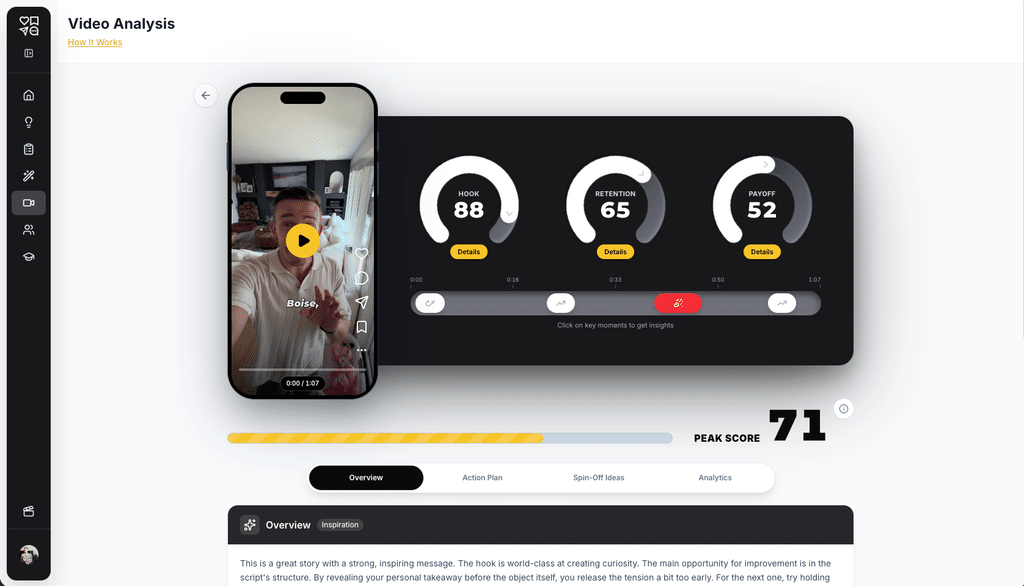
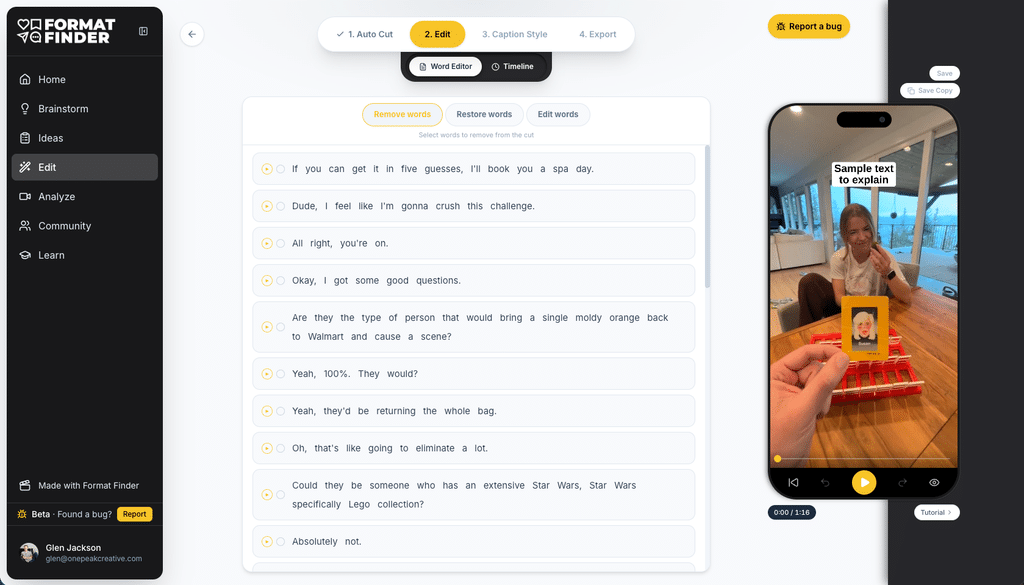
A saved idea becomes a script and shot list in one click. Users film, drag the clips into the editor, and the app cuts a first draft from the visuals and transcript for maximum retention. An analyzer then flags lulls and returns a “Peak Score” from 0 to 100, where anything above 80 is typically a well-constructed video, by Conar’s account. Each step applies the watch-time rule.
The workflow still has seams. Users have to leave the app to record, Conar acknowledges, and the Android version is not ready yet. The team is building an in-app teleprompter that gives live feedback on stumbles and framing. “Then you’re not wasting time on the edit on footage that could have been better,” he says.
Repetition Predicts Who Succeeds and Stays
The teleprompter serves the goal of daily repetitions. Conar wants a format ready to film every day, with streaks and prizes that reward creating as well as views. “The creator who gets the most out of the app is actually the creator who uses it the most,” he says.
One customer Conar cites shows the payoff. A construction worker in his 50s who restores baseball gloves on the side joined to grow that business into his retirement. In his first week, a video reached 60,000 views, more than 10 times his previous best, and brought calls from customers as far away as Australia.
Retention follows the same pattern. Users who complete the full cycle of generating an idea, scripting, editing, and analyzing stay “way longer” on average than those who try a single feature, according to Conar. He calls that partly the company’s failing. “It’s partially on us for not doing a good enough job educating, because things have just been growing so quickly,” he says.
Human Voice Matters More in AI-Filled Feeds
The glove maker’s result came from getting comfortable on camera, in Conar’s view, and that personal element is what separates creators using the same formats. “The format is just the structure,” he says. “The actual voice and the verbiage that you’re using, that’s what makes it unique to you.”
He gives large brand teams the same advice. Many tell One Peak they operate in a serious niche, but the people succeeding show real emotion, including their failures, Conar argues. “It’s all human to human,” he says. He calls this hardest for companies protecting a brand image, and cites an interview in which Instagram head Adam Mosseri said users increasingly complain about AI-generated content.
Conar still wants creators using AI. He separates AI-generated content from AI-assisted content and says every creator and brand should learn the latter. In his example, Higgsfield’s models could let a creator stage a World War II story whose sets would cost hundreds of thousands of dollars, provided the creator stays in the story. “It’s really trying to differentiate what is expanding your own voice versus what is subtracting from who you are,” he says.
Conar Treats Short-Form Skill as a Hedge Against Change
The Format Finder app itself keeps changing. It started as an idea-generation and scripting tool and has grown well beyond that in six months, Conar says, with a one-click carousel builder now also in the pipeline. He plans a workshop to catch users up.
His argument is that reach on short-form platforms is learnable. Watch time sets the rule, a repeatable format supplies the structure, and the creator’s voice keeps the result from blending into an AI-filled feed. Conar ties that to a market where “we all just have to get extremely good at adaptation.”
“Learn content creation,” he says. “I think it’s the highest, most impactful thing that you can do to future-proof yourself.”
Subscribe to Our Newsletter
Check Out Our Podcast