







Influencer
How Jason Jin Turned an Empty Audition Calendar Into an Agency-Repped Flower Business

Before Jason Jin built a floral brand that pulls millions of views, he was an actor with an empty audition calendar and nothing to do. So he reached out to his aunt, who owned a flower shop, and asked if she needed help. That question became the opening scene of Flower Academia.
Jason is a Los Angeles-based actor and floral designer who posts across TikTok, Instagram, YouTube, and Facebook, with a total following of over 2 million. His on-camera resume predates the flowers, including a role in Netflix’s “BEEF” season two, along with commercials and print work through his talent agency, CESD.
“I have a channel called Flower Academia. It’s chill. I have fun making flower arrangements. Sometimes I like to teach the tips and tricks of floral arranging or designs. Sometimes I just like to express art through flowers. That’s the primary goal, though: just to have fun with it,” he says.
Behind that description sits a business he is still building in public: brand partnerships routed through his agency, informal apprenticeships with other florist creators, and a floral design book on its way toward a publisher.
Improvising at the Flower Market
Unlike creators who script every short-form video in advance, Jason skips that step. “We don’t have much time, so I just kind of improvise,” he says.
His market ritual is consistent. “First, I just take a lap. I just look at the flowers, the colors, the quality, the price. That’s a big thing in the flower industry because it can get pricey. It’s an expensive hobby,” he says, adding that small price differences compound: “Even if it’s a two-dollar difference for the amount of flowers that I buy, at the end of the year that $2 can be a big difference.”
Inspiration for an arrangement, he says, can come from anywhere: a World Cup loss, his girlfriend’s outfit, an off-Broadway play called “Masquerade” he saw with her on their first anniversary. “I’m not a Broadway guy,” he admits, but the show broke that pattern. “This one was amazing. You could see the actors’ emotions, even the sweat dripping. It was so intimate,” he says of a performance among his most referenced creative touchstones.
Turning Brand Budgets Into an Excuse to Splurge
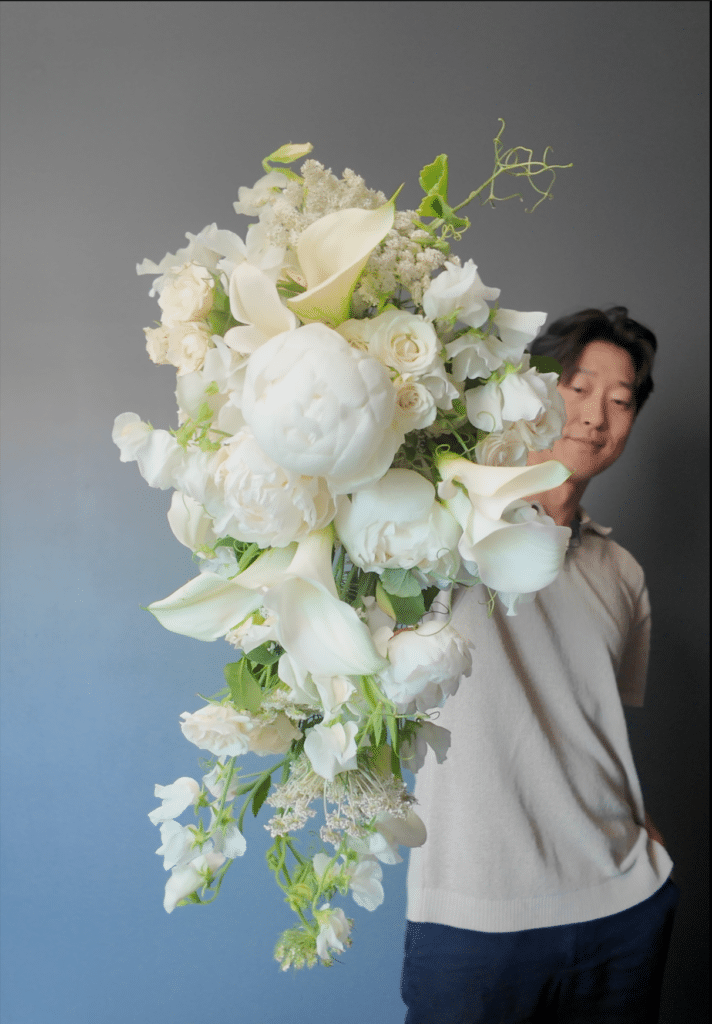
Brand partners generally arrive with a loose creative brief rather than a script, often built around a seasonal moment or the brand’s own colors. A Dunkin’ Donuts collaboration timed to Valentine’s Day turned heart-shaped donuts into a heart-shaped bouquet. A Stanley Quencher partnership had him building an arrangement inside one of the brand’s oversized cups for his niece.
For Jason, a bigger deal budget mostly means a chance to buy flowers he would not otherwise justify. “That’s my excuse to splurge on flowers,” he says. “I go to the fine dining section, the Michelin flowers. I’d be like, how much for five stems? Give me three bunches, no problem. I get really excited when an opportunity comes by like that.”
Jason credits his current run of brand deals to CESD, the agency that represents him, and to his agent, Eddie Pietzak, whom he reached first through a voiceover contact. The value of representation, in his telling, is a division of labor. “My agent does all the hard work when it comes to negotiations or hunting for the brand, or just getting me on the right projects. I get to just really enjoy it and be creative,” he says.
Learning From Rivals Instead of Competing With Them
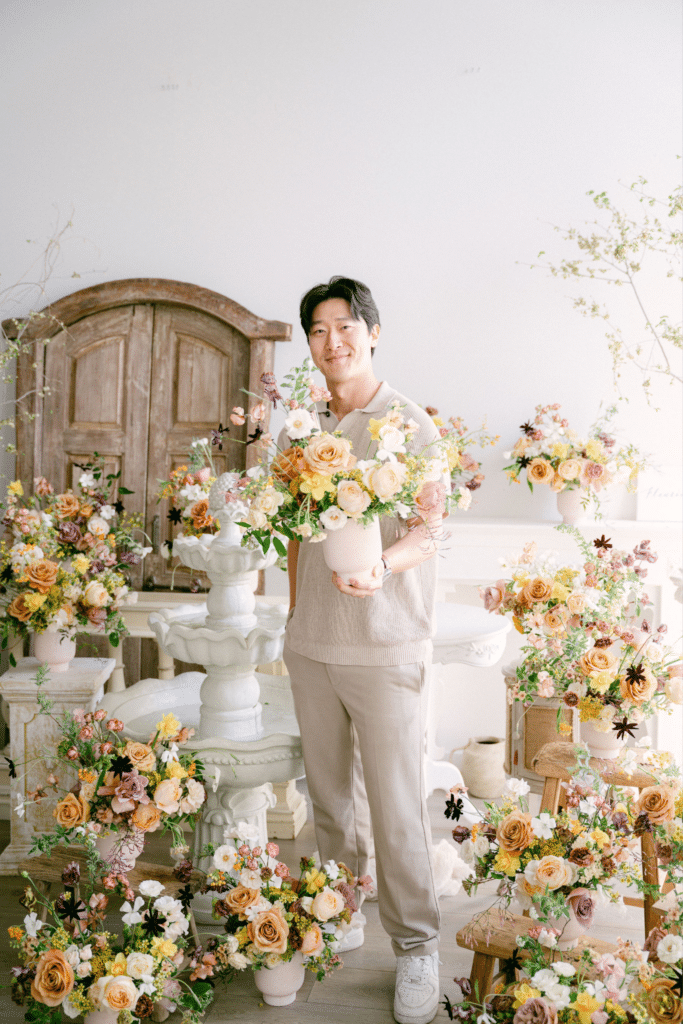
Cross-promotion with other florist creators, Jason says, is not a meaningful revenue driver. It functions more like informal apprenticeship. “Sometimes, I do it with the intention of promoting small business. Sometimes I do it hoping that I can learn something too,” he says, pointing to time spent shadowing a friend who runs event-focused floral work.
He argues that his own visibility has outpaced the wider industry’s, and that better-known florists elsewhere remain overlooked by his audience. “Everyone thinks I’m this really good designer, but to be honest, these people just don’t know the talent out there because they’ve never been exposed to it,” he says, naming designers in Japan, Korea, and across Europe he would like to feature.
A Book Written From Concrete, Not a Flower Field
Jason is also working on a floral design book, a project that came to him through his agent. Structured around a year of arrangements from winter through fall, it is meant to strip out the genre’s usual reverence. “Here’s the flowers, here’s the recipe, and here’s a little bit of technique,” he says.
Finding that voice took several attempts. “I’ve probably written about six different intros,” he says, describing early drafts as too polished for his taste.
The version he has settled on leans into his own background instead. “I’m not a flower from a flower field. If I am a flower, I grew from concrete in the streets of Vegas. I’m just a normal dude that’s trying to normalize people making flower arrangements as a form of art, as self-therapy, or just as a gift,” he says. There is no release date yet.
His five-year plan treats Flower Academia and acting as parallel tracks, not a handoff. He wants workshops in different cities and countries, a second volume of the book, and eventually a shop that doubles as a filming location. “Whether I’m rich, wealthy, or poor, I’m still gonna do it. It’s just part of my nature. It’s who I am,” he says. “I act, and I make flowers.”
Subscribe to Our Newsletter
Check Out Our Podcast