




Agency
12,000 Sq Ft, 16 Studios, Crocs & Chemical Guys: Inside Outlandish’s TikTok Shop Live Streaming Empire


William August spent a decade witnessing firsthand how social commerce developed in China before most Western marketers had even heard of the concept. As a fluent Mandarin-speaking content creator who became one of the most popular Western influencers on Chinese platforms between 2011 and 2021, William observed a key shift in how social media platforms connected content to commerce.
“The attribution model really wasn’t there,” he explains. “I did a lot of ads when I was a creator, but there’s just no way they would have known how many people, after watching my video, went and purchased a product.”
In 2018, William founded Outlandish, a performance-focused agency initially representing Western influencers in China. The company has since expanded to bridge the gap between content creation and sales generation. “At the end of the day, our job is to make more money for our clients,” says William.
What gave the creator-turned-entrepreneur this insight was witnessing how China’s version of TikTok, Douyin, changed the creator ecosystem. “I saw how that started to change the whole industry,” William explains. “These smaller creators that jumped on board very quickly became bigger creators than even a creator like myself, who actually can’t convert very well because people don’t watch me to buy things, they watch me to be entertained.”
The opportunity to expand this insight globally arrived in 2021 when TikTok Shop prepared to launch outside China. “I was contacted by a friend who worked at the UK TikTok. He asked me, ‘TikTok Shop was about to launch. Would you be interested in becoming one of the first agencies outside of China?’”
William became one of the first agency partners for TikTok Shop’s UK launch, developing methods for effective livestream shopping during the platform’s alpha phase

A Complete Solution for the Creator Economy
Today, headquartered in Los Angeles with operations across eight global markets, including London, Madrid, Mexico, Brazil, and Japan, Outlandish provides solutions to the challenges facing both sides of the creator economy marketplace. The company’s modus operandi centers on three key gaps William identified in the ecosystem.
First, they address the infrastructure needs through their new live shop concept—a 12,000 square foot retail space in Santa Monica with 16 livestream booths that produces over 2,000 hours of content monthly and employs over 50 people.

“In the UK, it didn’t make any sense for me that we’re livestreaming out of warehouses and office space. We should be livestreaming out of retail space,” William explains. “At the same time, high streets, retail streets are dying. They’re struggling because people are buying online. Why not integrate the online with the offline?”

This vision led to a partnership with Dodo Group to create environments where brands can livestream from professional setups while maintaining a physical retail presence. “People do not realize an impression is a person looking at you. Like a literal person just looked at your product and you did not display it correctly,” William emphasizes. He recounts visiting a large company that spent “a million dollars on designing their office” while livestreaming from “a closet where it’s literally some shelves and just a phone.”
The second component of Outlandish’s value proposition is addressing knowledge needs through training and optimization.
When entering the U.S. market in late 2022, Outlandish concentrated first on education. “We trained over a thousand businesses in the first couple of years,” William explains. “Many businesses, once they saw a lot of results, were looking to outsource it because it’s very tiring. So once they saw a higher level of hourly GMV, they went back to us who trained them and said, ‘Hey, can you take over the rest of the live streams because it’s too much work.'”
The third element of Outlandish’s approach is performance-based marketing. “We’re very performance driven. We’re not like an influencer agency,” William emphasizes. “Our model is that we take a commission on the sales. So if they’re not making good revenue in three months, we will fire the client because we don’t want to waste time with clients that can’t sell.”

Proving the Model
To demonstrate their approach in action, Outlandish created their own product line—Dodo Chocolates. Starting with 20,000 units of Dubai pistachio chocolate, they handled everything in-house: branding, fulfillment, customer service, and marketing.
“We took that brand from absolute zero, not even branded, unheard of, to the number one spot in the food and beverage category within three months. Within six months, it made $7 million on TikTok Shop alone,” William states, adding that this success has translated to offline retail opportunities, with Dodo Chocolates now available in Bristol Farms.

For established brands, Outlandish brings similar results. While William can’t share exact figures for clients like Crocs, he notes that Outlandish has helped them “from scratch to the top of the category in two or three months” through affiliate management and celebrity livestreams featuring personalities like Jason Derulo and Hannah Berner.


Another client, premium detailing brand Chemical Guys, discovered that “95% of their purchases on TikTok Shop are new buyers. They’ve never even bought from there on any other platforms.”
Cross-Cultural Insights and Market Differences
Outlandish’s business is powered by William’s understanding of how social commerce works differently across global markets.
“TikTok in China is already a shopping app. People will open it to go shopping,” William explains. “The live streams there are higher converting with lower views, whereas in the U.S., it’s a much newer market. So the transition from entertainment to shopping is not completely there yet.”
This insight informs how Outlandish approaches each market. In China, livestreams can be more directly focused on products. In the U.S., streams need more entertainment and community-building elements to engage viewers who aren’t primarily looking to make purchases.
William has also observed notable regional differences in creator adoption. “The biggest surprise to me, at least in the U.S. market, is how creative and quick the affiliates are. I didn’t see this in any other market where they were just so quick to pick up and see this as a side business. And I think it really shows how entrepreneurial the U.S. market is.”
Even within Latin America, William notes clear differences: “Mexico and Brazil are actually very different markets. Even though they’re both in Latin America, Mexico doesn’t have shopping. It failed there. In Brazil, it is very successful, and they do live streams.”
Practical Insights
Through their work across markets, William has developed valuable guidance for both creators and brands.
For the former, William emphasizes the importance of action over analysis. “They think too much and they don’t do enough. TikTok Shop is about doing. If you don’t catch this wave, you’re going to miss it. And this isn’t just a trend. This is the future of social media.”
He also highlights how the creator economy is shifting toward performance-based compensation. “Brands will care about how much you sell, not just about how many views you get. If you’re mid-tier and you’re getting like 10,000 views a video and you stop producing results, you don’t make any GMV, you’re just going to go right to the bottom of the funnel, and no one’s going to sponsor you.”
For brands, William stresses that TikTok Shop offers more than just sales—it’s a brand-building platform. “Everyone sees TikTok Shop as an e-commerce platform, which it is. Sales are important, but the views you get from selling and the spillover effect you gain from being on the platform are incredible. It’s not just an e-commerce platform, but a social media platform as well.”
He advises brands to eliminate friction points in the purchase process, particularly shipping fees. “Add shipping fees in the beginning because your margin’s important. But TikTok is a discovery platform. Users click on the product and there’s a $6 shipping fee, which causes them not to purchase.”
The Future of Shopping
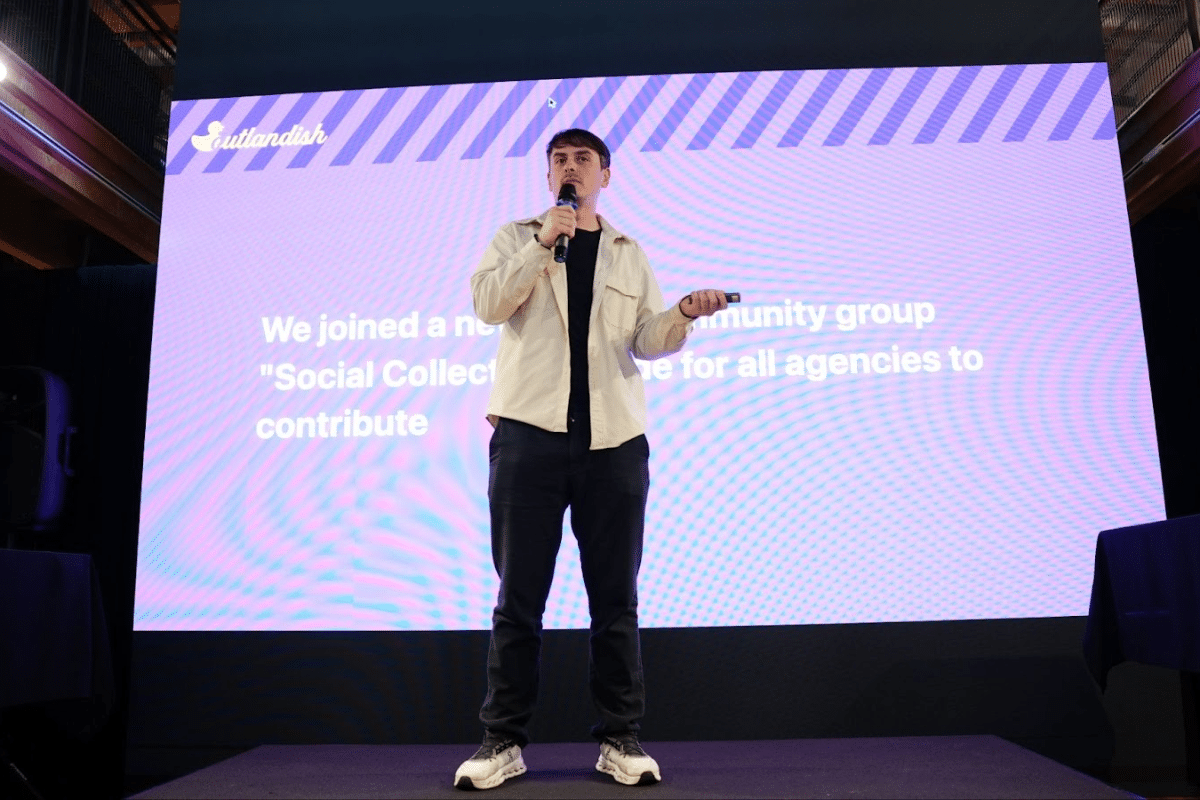
William has plans to grow Outlandish’s impact on the creator economy. “I want Outlandish to be the infrastructure for the future of shopping,” he says. This vision includes expanding their physical presence, opening in Las Vegas by the end of 2025, followed by five additional locations in 2026.
The company is developing new technology offerings as well, including Creator Samples, their SaaS platform for managing creator relationships and measuring performance. Community-building remains central to Outlandish’s strategy, with regular events planned throughout the year.
For Black Friday, William aims to make a statement about the future of retail. “I want to break some records on Black Friday. I want to do like a hundred live streams at the same time on Black Friday down 3rd Street Promenade.”
As William concludes, “I want to have these live shops not just in the U.S. but globally. I want to have a centralized location for creators to come to for the creator economy, matchmaking events, and all the tools necessary to build it.”
Subscribe to Our Newsletter
Check Out Our Podcast