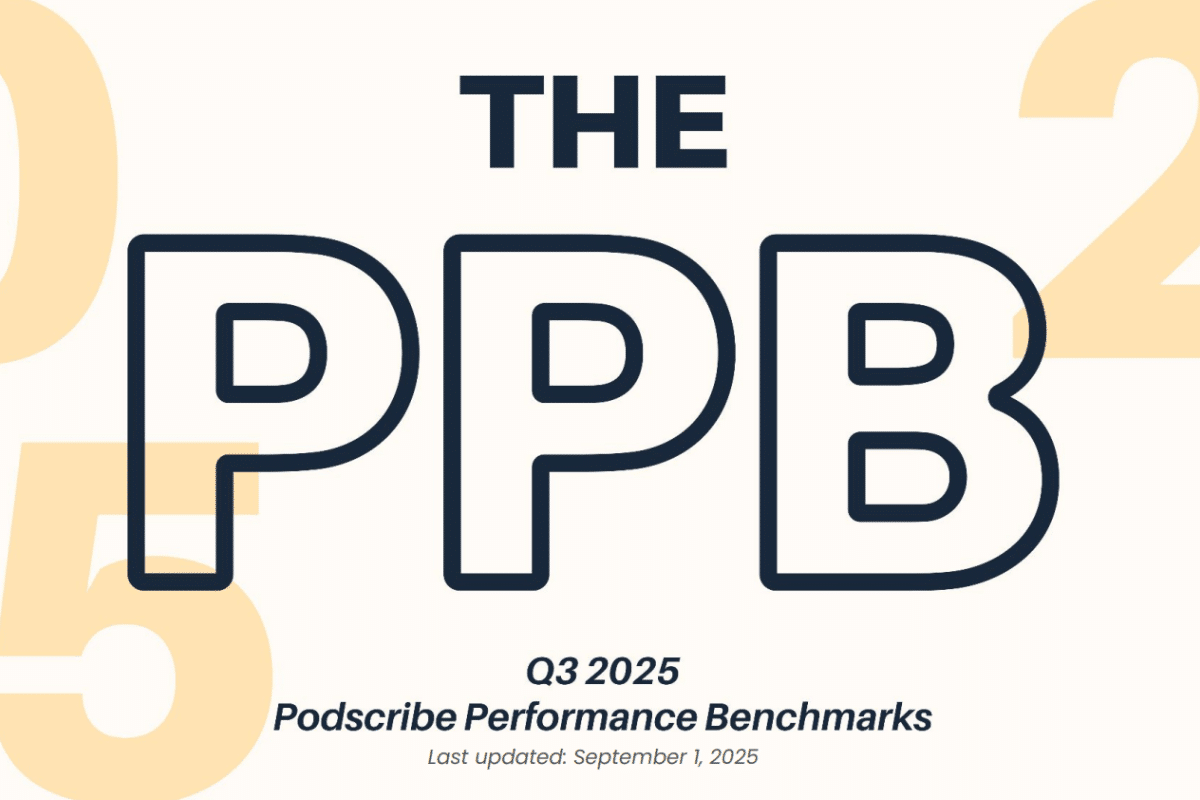
As podcast advertising grows into a major market, Podscribe‘s “Q3 2025 Performance Benchmarks” report offers important insights that reshape how advertisers approach the medium. Drawing from analysis of 66,000+ campaigns, 500+ advertisers, and 17 billion impressions, the report highlights notable changes in measurement approaches, buying strategies, and performance metrics that affect both creators and advertisers.
The Attribution Blind Spot
The most consequential finding from Podscribe’s analysis concerns the widespread attribution gap in podcast advertising. “Our data shows that advertisers could miss up to ~80% of actual engagement without pixel-based attribution,” the report states. This measurement shortfall represents billions in potentially unattributed conversions.
Traditional measurement approaches underreport campaign impact. According to the findings, “Promo codes and vanity URLs capture only about 21% of the total conversions attributed to podcast ads.” Even post-purchase surveys fare poorly, with pixel attribution capturing approximately six times more conversions than survey-based methods.
This attribution challenge is further complicated by changes to the technical infrastructure. With 90% of advertisers now sending IPv6 traffic while only ~26% of top publishers support IPv6, many valid conversions go unrecognized. “Without IPv6 support, a valid conversion like this wouldn’t be counted,” the report notes, highlighting how technical misalignment creates additional measurement gaps.
The Shift to Audience-Based Buying
Podcast advertising is moving away from its historical reliance on show-specific sponsorships. The share of non-show specific buy impressions has increased steadily from just 13% in September 2024 to 32% in June 2025, marking what the report describes as “a ~2.5x increase in just 10 months.”
This change follows patterns seen previously in digital display advertising, representing a key development in how podcast advertising is transacted. Though show-specific buys still deliver higher visitor rates (0.31% versus 0.20%) and purchase rates (0.022% versus 0.011%), audience-based approaches are gaining favor for their efficiency. Non-show specific buys offer better ROAS (1.17 versus 0.92) and lower CPAs ($85 versus $93), driving their adoption despite lower engagement rates.
The report also identifies growth in YouTube simulcasting, with the share of episodic campaigns using simulcast increasing from 58% to 75% over the analyzed period. However, early data suggests audio-only campaigns outperform simulcast efforts, with YouTube simulcast campaigns showing approximately 34% lower conversion rates.
Audio Channel Complementarity
The Podscribe data reveals clear audience differences between podcast and streaming audio channels. “Most advertisers see about an 80%+ uniqueness between podcasting and streaming audio audiences,” the report indicates, challenging assumptions that these channels reach similar listeners.
Combined, these audio formats can reach up to 85% of U.S. listeners – a reach comparable to traditional broadcast media. However, the report finds that “Currently, advertisers are reaching about one-third of the podcast audience,” suggesting considerable room for growth. Reaching all podcast listeners would require more than two billion impressions per month, more than most current campaigns deliver.
The channels differ notably in performance metrics. “Podcast ads deliver higher incrementality (32%) than streaming audio ads (14%),” the report states. This incrementality advantage holds even for brands operating across both channels, with podcasting maintaining a 21% incrementality advantage for cross-channel advertisers.
The Device Performance Divide
Notable performance variations exist across devices and applications, according to Podscribe’s analysis. iPhone users convert 30% better than Android users, with visitor rates of 0.32% versus 0.25% and conversion rates of 0.017% versus 0.013%, respectively.
Platform choice affects these differences. Apple Podcasts on iPhone shows the highest performance metrics, with a visitor rate of 0.31% and a conversion rate of 0.022%. Meanwhile, Spotify on Android shows consistently weaker performance across all metrics, establishing clear patterns in platform effectiveness.
This performance variation also extends to geographic markets. The report highlights wide differences across top U.S. DMAs, with Chicago showing strong metrics (visitor rate of 0.31%, purchase rate of 0.024%), while other major cities such as New York, Los Angeles, Washington, D.C., and Seattle show distinct performance patterns. At the state level, California, Texas, New York, Florida, and Illinois emerge as the largest contributors, each showing unique cost and purchase dynamics.
The Brand Size Advantage
Perhaps most notable for emerging creators and smaller advertisers is the inverse relationship between brand size and podcast advertising impact.
The Podscribe data indicates that smaller brands tend to see higher incremental lift from podcasting compared with larger advertisers. This suggests that newer or emerging brands may benefit disproportionately from podcast ad campaigns, while larger brands see lower incremental lift due to their broader, more diversified channel mix.
This pattern suggests podcast advertising offers greater value to emerging brands and businesses. “Podcast listeners are harder to reach elsewhere, making each ad exposure more valuable,” the report explains, contrasting this with streaming audiences that “can be found more easily across different channels, reducing the unique impact of streaming ads.”
The Direction of Podcast Advertising
As podcast advertising continues to develop, several additional findings from the report merit attention from creators and marketers alike.
Host-read ads continue to outperform producer-read ads across all metrics and show greater resilience to higher ad loads. The optimal frequency within a single campaign appears to be up to three exposures, with diminishing returns beyond that point, while channel-level frequency extends effectively to five exposures monthly.
The data also demonstrates that content genre affects performance. Business shows lead in purchase rate (0.061%) and rank second in visitor rate (0.47%), while technology shows drive the highest visitor rate (0.51%) and rank fourth in purchase rate (0.049%). Fiction has emerged as the most cost-effective genre, with the lowest cost per acquisition at ~$64.
As Podscribe’s benchmarks indicate, podcast advertising is developing into a more refined market that increasingly resembles other digital channels in its measurement capabilities and targeting options.
Nii A. Ahene is the founder and managing director of Net Influencer, a website dedicated to offering insights into the influencer marketing industry. Together with its newsletter, Influencer Weekly, Net Influencer provides news, commentary, and analysis of the events shaping the creator and influencer marketing space. Through interviews with startups, influencers, brands, and platforms, Nii and his team explore how influencer marketing is being effectively used to benefit businesses and personal brands alike.
















As podcast advertising grows into a major market, Podscribe‘s “Q3 2025 Performance Benchmarks” report offers important insights that reshape how advertisers approach the medium. Drawing from analysis of 66,000+ campaigns, 500+ advertisers, and 17 billion impressions, the report highlights notable changes in measurement approaches, buying strategies, and performance metrics that affect both creators and advertisers.
The Attribution Blind Spot
The most consequential finding from Podscribe’s analysis concerns the widespread attribution gap in podcast advertising. “Our data shows that advertisers could miss up to ~80% of actual engagement without pixel-based attribution,” the report states. This measurement shortfall represents billions in potentially unattributed conversions.
Traditional measurement approaches underreport campaign impact. According to the findings, “Promo codes and vanity URLs capture only about 21% of the total conversions attributed to podcast ads.” Even post-purchase surveys fare poorly, with pixel attribution capturing approximately six times more conversions than survey-based methods.
This attribution challenge is further complicated by changes to the technical infrastructure. With 90% of advertisers now sending IPv6 traffic while only ~26% of top publishers support IPv6, many valid conversions go unrecognized. “Without IPv6 support, a valid conversion like this wouldn’t be counted,” the report notes, highlighting how technical misalignment creates additional measurement gaps.
The Shift to Audience-Based Buying
Podcast advertising is moving away from its historical reliance on show-specific sponsorships. The share of non-show specific buy impressions has increased steadily from just 13% in September 2024 to 32% in June 2025, marking what the report describes as “a ~2.5x increase in just 10 months.”
This change follows patterns seen previously in digital display advertising, representing a key development in how podcast advertising is transacted. Though show-specific buys still deliver higher visitor rates (0.31% versus 0.20%) and purchase rates (0.022% versus 0.011%), audience-based approaches are gaining favor for their efficiency. Non-show specific buys offer better ROAS (1.17 versus 0.92) and lower CPAs ($85 versus $93), driving their adoption despite lower engagement rates.
The report also identifies growth in YouTube simulcasting, with the share of episodic campaigns using simulcast increasing from 58% to 75% over the analyzed period. However, early data suggests audio-only campaigns outperform simulcast efforts, with YouTube simulcast campaigns showing approximately 34% lower conversion rates.
Audio Channel Complementarity
The Podscribe data reveals clear audience differences between podcast and streaming audio channels. “Most advertisers see about an 80%+ uniqueness between podcasting and streaming audio audiences,” the report indicates, challenging assumptions that these channels reach similar listeners.
Combined, these audio formats can reach up to 85% of U.S. listeners – a reach comparable to traditional broadcast media. However, the report finds that “Currently, advertisers are reaching about one-third of the podcast audience,” suggesting considerable room for growth. Reaching all podcast listeners would require more than two billion impressions per month, more than most current campaigns deliver.
The channels differ notably in performance metrics. “Podcast ads deliver higher incrementality (32%) than streaming audio ads (14%),” the report states. This incrementality advantage holds even for brands operating across both channels, with podcasting maintaining a 21% incrementality advantage for cross-channel advertisers.
The Device Performance Divide
Notable performance variations exist across devices and applications, according to Podscribe’s analysis. iPhone users convert 30% better than Android users, with visitor rates of 0.32% versus 0.25% and conversion rates of 0.017% versus 0.013%, respectively.
Platform choice affects these differences. Apple Podcasts on iPhone shows the highest performance metrics, with a visitor rate of 0.31% and a conversion rate of 0.022%. Meanwhile, Spotify on Android shows consistently weaker performance across all metrics, establishing clear patterns in platform effectiveness.
This performance variation also extends to geographic markets. The report highlights wide differences across top U.S. DMAs, with Chicago showing strong metrics (visitor rate of 0.31%, purchase rate of 0.024%), while other major cities such as New York, Los Angeles, Washington, D.C., and Seattle show distinct performance patterns. At the state level, California, Texas, New York, Florida, and Illinois emerge as the largest contributors, each showing unique cost and purchase dynamics.
The Brand Size Advantage
Perhaps most notable for emerging creators and smaller advertisers is the inverse relationship between brand size and podcast advertising impact.
The Podscribe data indicates that smaller brands tend to see higher incremental lift from podcasting compared with larger advertisers. This suggests that newer or emerging brands may benefit disproportionately from podcast ad campaigns, while larger brands see lower incremental lift due to their broader, more diversified channel mix.
This pattern suggests podcast advertising offers greater value to emerging brands and businesses. “Podcast listeners are harder to reach elsewhere, making each ad exposure more valuable,” the report explains, contrasting this with streaming audiences that “can be found more easily across different channels, reducing the unique impact of streaming ads.”
The Direction of Podcast Advertising
As podcast advertising continues to develop, several additional findings from the report merit attention from creators and marketers alike.
Host-read ads continue to outperform producer-read ads across all metrics and show greater resilience to higher ad loads. The optimal frequency within a single campaign appears to be up to three exposures, with diminishing returns beyond that point, while channel-level frequency extends effectively to five exposures monthly.
The data also demonstrates that content genre affects performance. Business shows lead in purchase rate (0.061%) and rank second in visitor rate (0.47%), while technology shows drive the highest visitor rate (0.51%) and rank fourth in purchase rate (0.049%). Fiction has emerged as the most cost-effective genre, with the lowest cost per acquisition at ~$64.
As Podscribe’s benchmarks indicate, podcast advertising is developing into a more refined market that increasingly resembles other digital channels in its measurement capabilities and targeting options.
Image credit: Podscribe
Get the full report here
Subscribe to Our Newsletter
Check Out Our Podcast