





Influencer
How ‘Girl Who Eats Art’ Creator Juliet Rofé Built a Business Doing What She Was Told Not to Do

In a friend’s garage, on a freezing afternoon, Juliet Rofé kept her phone plugged into the wall. The notifications from a video she had posted, a ten-foot mosaic portrait of Donald Trump constructed from 10,000 middle fingers, were accumulating faster than the battery could handle.
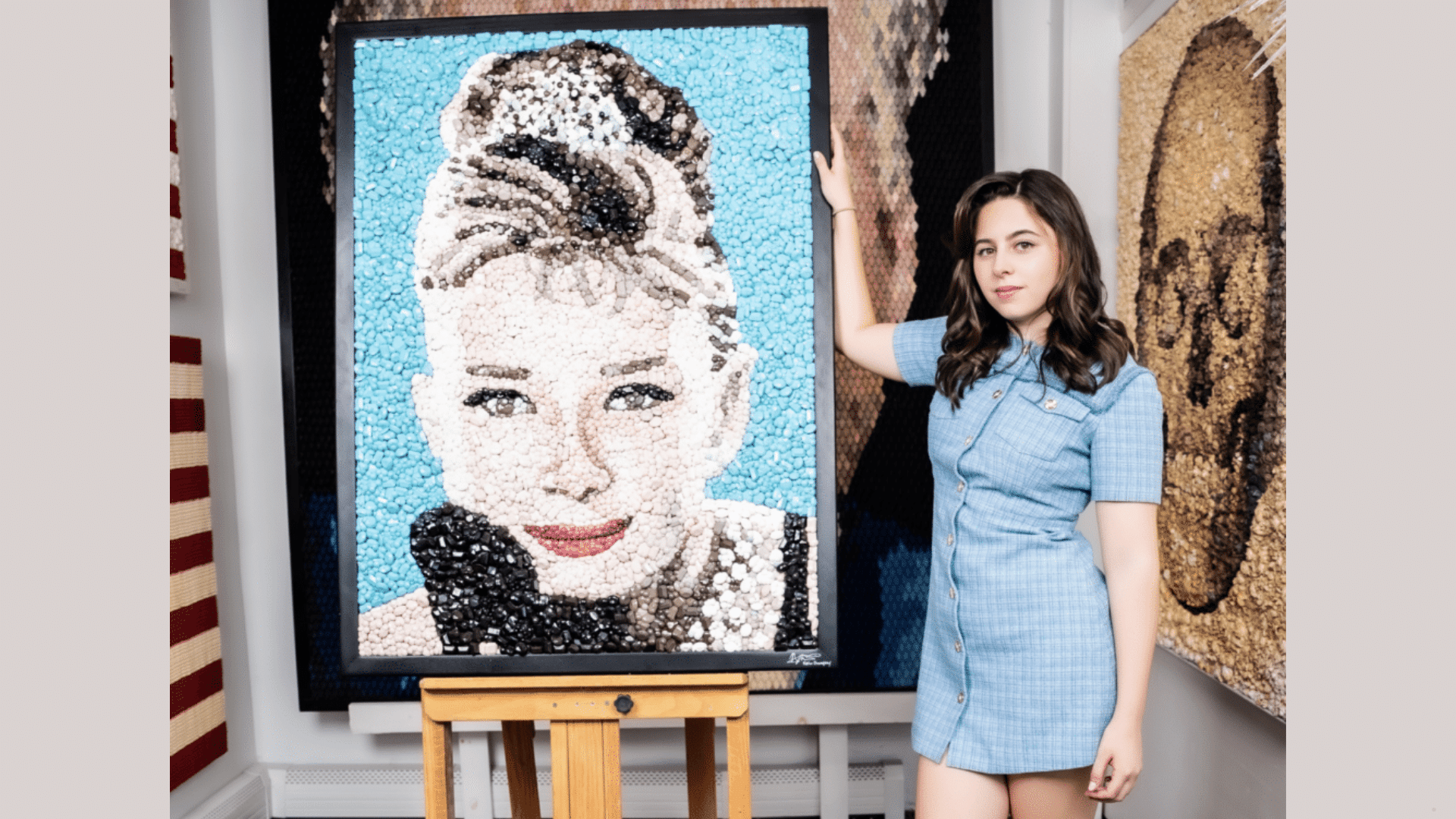
The mosaic was commissioned by Drake and built by a self-taught artist named Kevin Champeny, whose social media Juliet had been managing for less than a year. “Dude, this is it,” she told herself then.
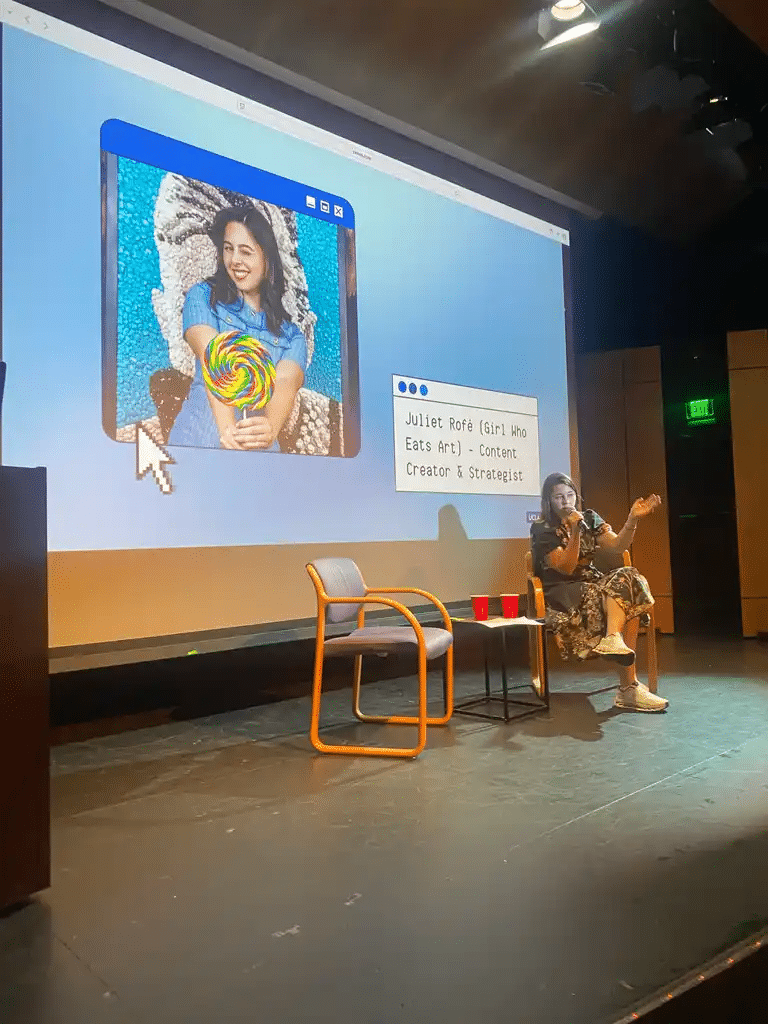
Today, Juliet is the Managing Partner of Kevin Champeny Studio and the creator behind “Girl Who Eats Art,” an account with more than 1.6 million followers across Instagram, TikTok, YouTube, and Facebook. She grew up on Long Island, graduated from Northwestern University in 2025, and relocated to Los Angeles roughly six months ago to a content house shared with 25 animators.
“Content has changed my life in an immeasurable way,” she says.
How a Mosaic Made from Middle Fingers Became a Business
The path to that afternoon in the garage began when Juliet was 14. Her father discovered that his mechanic, Champeny, was producing ten-foot mosaics at home, each built from thousands of individually sculpted objects. He told him that if he ever wanted to pursue art full-time, he should call. Three weeks later, Champeny called.
Two years later, Juliet decided the operation needed a social media manager and volunteered herself. “I post bikini photos all the time,” she reasoned. “I’m sure I can handle an artist; that’s not a big deal.” The account had 10,000 followers when she started. COVID hit in week two of her managing it, giving her time to post at full intensity.
By the time the pandemic eased, the account had grown substantially. Growth came from the scroll-stopping quality of the art: three-dimensional mosaics whose meaning shifted as the camera moved closer, each piece structured so that what a viewer saw at a distance was not what they saw up close. The “Defy This” commission made that dynamic legible at scale. Nobody agreed on what the portrait meant, and the argument did the work. “Since the art sparks such controversial discussions,” she explains, “that’s number one.”
Corporate inquiries arrived from CarMax, Discovery, Amazon and CBS, and more.
A Collector’s Complaint, a YouTube Short and a Separate Career
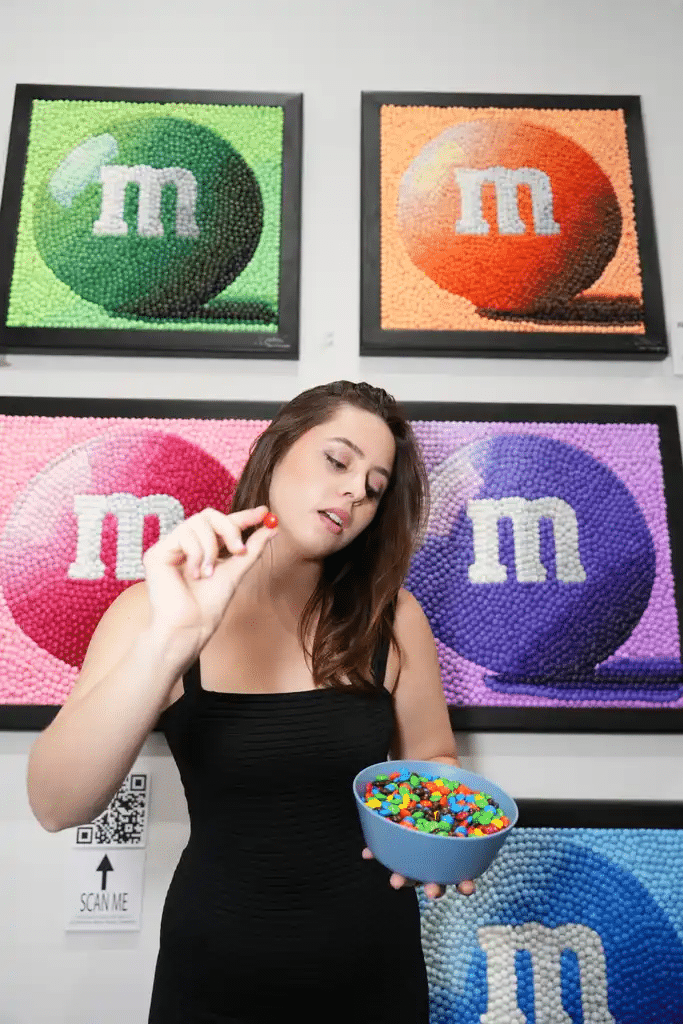
The origin of “Girl Who Eats Art” is quieter than the Trump video but just as consequential. One of Champeny’s collectors raised the concern that Juliet’s presence in some of his videos was creating confusion about who the artist was.
Juliet took the note. She created a new account to post videos where she was featured, ensuring captions attributed the work to Champeny explicitly. A then-boyfriend, himself a YouTuber, suggested she post a YouTube Short of her own. She did, and it accumulated an estimated 67 million views almost immediately.
The format of “Girl Who Eats Art” developed from there. Juliet interacts with Champeny’s work directly rather than documenting it from a distance, taking pieces out, smearing sections and engaging with the work that gallery protocol would normally protect behind rope. “The truest form of art is inspiring emotion in others,” she says.
Why ‘Rejection Therapy’ and Art Destruction Follow the Same Logic
About a month ago, Juliet shifted her Instagram content to a series she calls “Rejection Therapy,” approaching men on the street and asking them on dates. A video she filmed in New York, flirting with a male model she encountered, went viral quickly. Her reading of that moment was precise. “I have the same feeling I had when that Trump video happened with Kevin [Champeny],” she says. “This is going to evolve into its own career.”
The pivot from art content to dating content looks, on the surface, like a departure from a legible niche. Juliet argues it is the same format applied to different material. Both show an audience something the subject is explicitly not supposed to do. Art galleries instruct visitors to keep their distance. Her Rejection Therapy series has her approaching men on the street and asking them on dates. “I am doing what people are told not to do,” she says.
The unexpected variable, Juliet notes, was emotional resonance. Women who had gone through divorces and breakups began reaching out to say the series made them feel less alone, more capable of putting themselves out there. “I never did these videos expecting it would inspire people,” she says. “I just thought, ‘Oh, this is funny.’”
Why She Bets Everything on YouTube
On platform strategy, Juliet champions YouTube, describing its subscriber base as categorically different from followers on other platforms: consistently engaged, invested in the creator specifically, closer in behavior to what she likens to a Twitch audience than a passive scroller.
“When you have a subscriber on YouTube,” she says, “it is the equivalent of having a very serious fan who actually deeply cares about the content you put out.”
TikTok is her experimental platform, where the cost of a video that fails is minimal. “The worst that happens is a video doesn’t get a lot of views,” she notes. Revenue comes from AdSense on YouTube and brand deals on Instagram, the latter measured strictly by off-platform conversion. When she posted content for headphone brand beyerdynamic, a C-suite executive called her agent to ask why searches for the AVENTHO headphones had spiked. That call is what she considers a successful brand deal.
Not everything she does is measured in conversions. When a credit card company placed her image on a billboard because she uses their card, it was not a paid deal. Her grandparents cried. “That’s more worth it to me than anything else that could have occurred,” she says.
The Camera Has Always Been the Point
Juliet’s stated long-term goal is hosting. She recently took a last-minute acting role in content produced by YouTuber Steven Ho, filming on a set she describes as a Hollywood-level production facility with a full crew. She sees that gig as evidence of something real. “In the past, I never would have put that on my resume that I did a YouTuber’s show,” she says. “But now it’s like, oh, that’s super cool.”
The career she has built, across Champeny’s account and her own, rests on the premise of trying the thing before you know whether it will work. “Girl Who Eats Art” grew from a collector’s complaint. “Rejection Therapy” started because she thought it would be funny. She describes the whole chain as kismet, and does not appear troubled by that fact. The failure she is describing is a specific kind: putting yourself on the internet, not once but repeatedly, without knowing which attempt will connect. “What we should instead frame as a negative thing,” she says, “is not trying at all.”
What that requires, in her view, is pushing through a feeling most people mistake for a reason to stop.
“I am scared every day,” she says. “I just push through that fear.”
Subscribe to Our Newsletter
Check Out Our Podcast