Influencer
Content Market Fit Is the New Product Market Fit

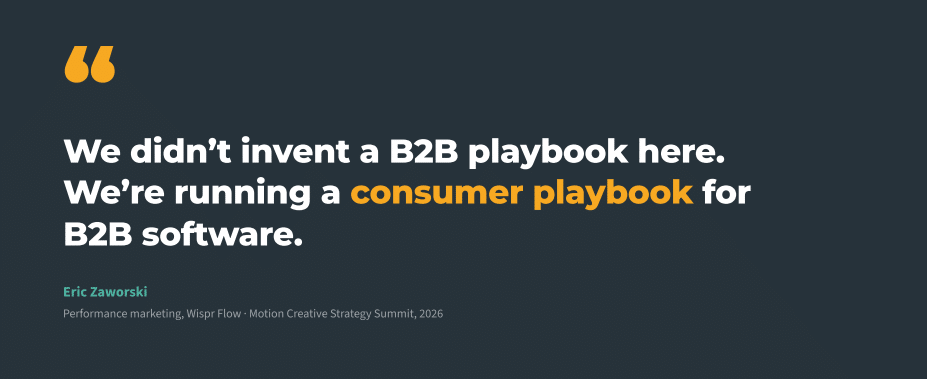
Eric Zaworski, who runs performance marketing at Wispr Flow, told Motion’s Creative Strategy Summit this summer that the company launches 500 ads a month, that three quarters of its best performers in a given month are made by creators. According to Eric, his job is now 80 percent creative operations and 20 percent media buying. “We didn’t invent a B2B playbook here,” he said. “We’re running a consumer playbook for B2B software.” On the same stage, the head of growth at the supplements brand Arrae described hiring the company’s best-performing creator as its head creative strategist, a job that now includes product messaging for the whole brand.
Why would two companies with nothing in common hand their messaging to the person who makes the videos? Because a feed decides what to show by scoring the content, so a fresh account and an account with ten million followers enter that scoring with roughly the same odds, give or take the account’s history and how consistently it has posted on one subject. The ad auctions built on those feeds now work the same way. Platforms will still sell a brand impressions, and they cannot sell the response that decides what those impressions cost.
Something magical happens when content earns a response greater than the impressions paid for it. We call that moment content market fit, and it is the point where content, whether it comes from a brand or a creator, earns its own distribution, so the platform pushes it out to audiences on its own without incremental ad spend. This is the new product market fit. Brands without it spend more to reach the same audiences.
Every impression is either earned or bought, and the difference is a price
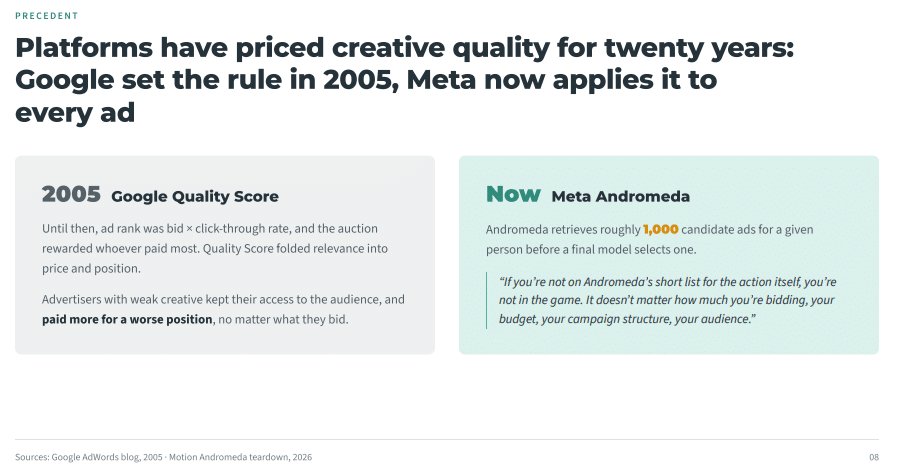
Interestingly enough, the social platforms are not the first to make this part and parcel of the algorithms that surface content. Google did it in 2005 and tightened it over the years that followed. Until then ad rank was bid multiplied by click-through rate and the auction rewarded whoever paid most. Quality Score folded relevance into what an advertiser paid and where it ranked, so an advertiser with weak creative paid more for a worse position no matter what it bid. Those advertisers kept their access to the audience and paid more for it than everyone else.
Meta now applies that rule to creative. Its Andromeda model retrieves roughly a thousand candidate ads for a given person before a final model selects one, and as Motion’s teardown of the system put it, “if you’re not on Andromeda’s short list for the action itself, you’re not in the game. It doesn’t matter how much you’re bidding, your budget, your campaign structure, your audience.” None of this stops a brand with a big enough budget from buying its way to reach. It sets the rate, and the rate is highest for the brands whose content the audience ignores.
Order of operations
Product market fit is a sequencing rule: do not scale your sales team until you know the product works. Content market fit is the same rule moved one step earlier. Do not scale ad spend until you know the messaging resonates organically.
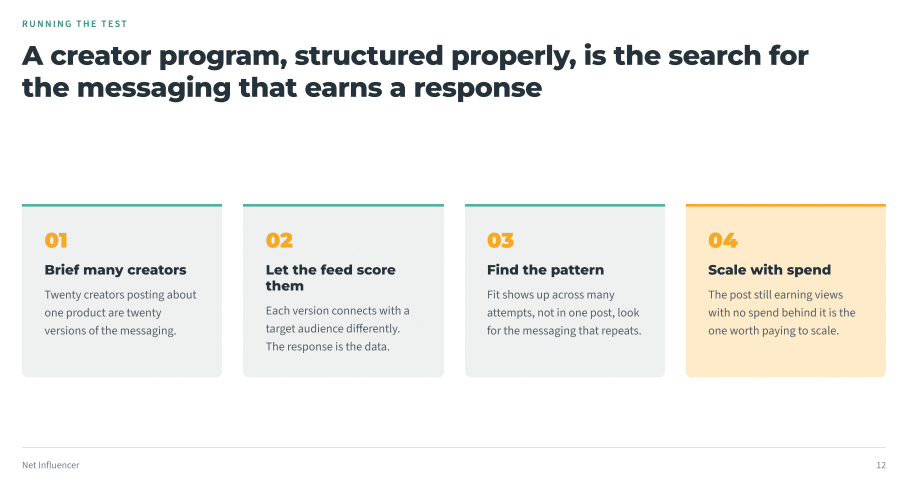
We wrote earlier this year that content built for interest has a brutal half-life, that brands cannot produce enough of it themselves, and that they pay creators to manufacture it. That keeps a brand fed against algorithms that demand constant new material. Structured properly, it also runs the test. Twenty creators posting about one product are twenty different versions of the messaging, each connecting with a target audience differently, and the ones that earn a response tell the brand which messaging is worth scaling and putting ad spend behind.
What this looks like at scale, from the pioneers of creator marketing
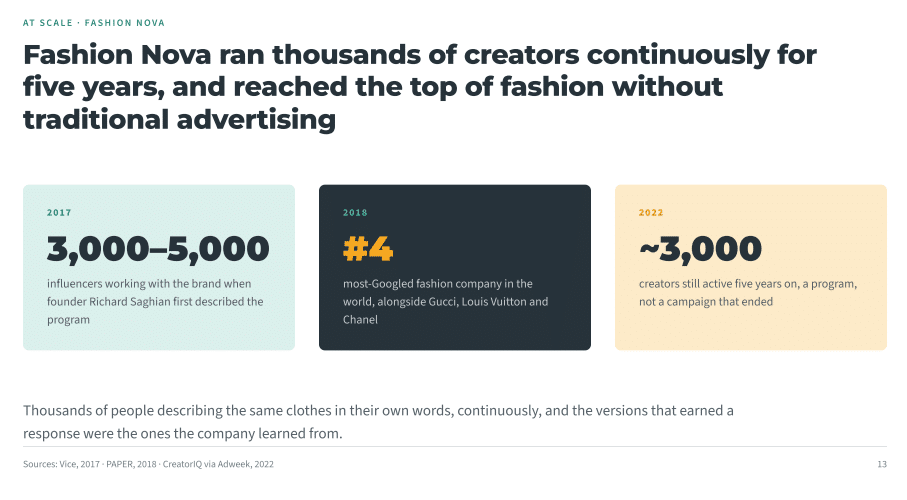
Fashion Nova is the canonical example of a company that understood this reality before the rest of the industry. In his first public interview, in January 2017, founder Richard Saghian told Vice the company worked with 3,000 to 5,000 influencers. The following year PAPER reported that Fashion Nova had become the fourth most Googled fashion company in the world without the aid of traditional advertising, alongside Gucci, Louis Vuitton and Chanel. The program was not a campaign that ended. CreatorIQ measured it still running close to 3,000 active creators in early 2022, five years after Saghian first described it. Thousands of people were describing the same clothes in their own words, continuously, and the versions that earned a response were the ones the company learned from.
Shein’s version started without a program at all. In 2020 the company went viral on hauls posted by young people it was not paying, and by the middle of 2021 the sheinhaul hashtag had passed 2.5 billion views on TikTok Marisa Runyon, who ran content creation at Shein, told Modern Retail that during that stretch “the company didn’t have a dedicated content strategy,” and that she joined in 2022 to build one. Shein then spent $5.0 billion on advertising in 2025, roughly 12 percent of revenue, according to its Hong Kong listing filing. The creators found the messaging first and the media budget followed it.
Content market fit in 2026 and beyond
Most marketers have already watched this happen. A post takes off and nobody can say why. A creator’s video outperforms the studio shoot that cost twenty times as much. A single piece of content keeps getting served weeks after it went up. Those were content market fit, and the reason they felt like luck is that the brand had no word for what it was seeing and no plan for making it happen again.
Content market fit means the creator program is no longer just a reach buy. It becomes an intentional search for the messaging that earns a response, and that search unlocks the ad budget, because the brand now knows what to put money behind. The test is simple. A post that keeps earning views with no spend behind it has fit, and that is the post worth paying to scale.
What gets found is the messaging, and messaging travels further than the post it arrived in. Mark Hardison, who became chief marketing officer of Farmer Boys after 22 years at El Pollo Loco, ran the chain’s largest creator campaign to date this summer and one of the creators in it, a comedian named Scott Frenzel, turned his post about the Chopped Cobb Salad into a jingle. The post performed like organic content, and Hardison says he knew on one viewing, when he caught himself humming it, that he had the message. The summer television campaign was built around the jingle, and the salad sold 20 percent more than before the campaign ran. “You don’t have to use creators to replace your advertising,” he said. “You can use creators to enhance your advertising and paid approach.”
There are two catches. One creator deal does not find fit, because fit is a pattern that shows up across many attempts. Jennifer Wilson, chief marketing officer at Lowe’s, says a one-off partnership delivers a “flash in the pan” spike in impressions, which is why the retailer built a network of 26,000 creators instead. The other catch is time. Joe Pulizzi of The Tilt puts it at “18 to 24 months minimum in most cases” before the work drives significant revenue, which is longer than any annual plan wants to hear.
Given both, enough shots on goal and enough time, a brand of any size can find the messaging that connects with its audience and put its media budget behind something it already knows works. Product market fit told a founder when to stop building and start selling. Content market fit tells a marketer when to start spending.
Subscribe to Our Newsletter
Check Out Our Podcast