







Agency
How CampusLaunch Turns Sororities Into Brand Distribution Networks for Gen Z

CampusLaunch, the New York-based marketing company Jake Motyl founded in 2024, specializes in sorority activations, embedding brands inside the social communities college women already inhabit rather than paying individual creators to hold up a product.
The idea came into focus while Jake was doing campus street interviews as a side hustle at the University of Southern California (USC), where he studied business administration. A video he filmed outside a sorority house outperformed every other interview in his library. When he later watched “RushTok” videos accumulate tens of millions of views, choreographed dances filmed in front of chapter houses, a question formed: why weren’t brands embedding themselves in that cultural moment?
“You have this group of girls that people trust and want to follow on campus,” Jake says. “How are brands not embedding their products into sorority culture?”
He graduated from USC, spent time as a consultant with FTI Consulting, and launched CampusLaunch as a side project that grew into his primary focus. The company serves consumer brands targeting Gen Z women through three service lines: experiential sorority activations, ambassador programs, and creator campaigns using sorority influencers who carry audiences of 100,000 to several million followers.

Community Trust Outperforms the Paid Post
Jake is measured about one of his own LinkedIn taglines, “Sororities > Influencers.” He believes community-rooted marketing outperforms a single paid post from an individual creator, and sorority chapters are among the densest, most trusted communities available to brands on campus.
“People don’t trust influencers as much as they used to,” Jake says. “The way you build trust and the way you market now is [through] communities.”
He believes a sorority chapter carries structural advantages an individual creator does not. Members live together, attend the same events, and exert social influence on each other through proximity. When a brand activates inside that community, the resulting content carries peer endorsement across dozens of organic posts, not just one promoted placement.
Brands in categories with strong sorority affinity see the clearest returns, according to Jake. “You could pay influencers all you want, but the best activations are with the brands that the sororities love because they will want to post about.
The Two-Layer Launch
Every CampusLaunch activation divides into two functions: the “Shock” and the “Flood.”
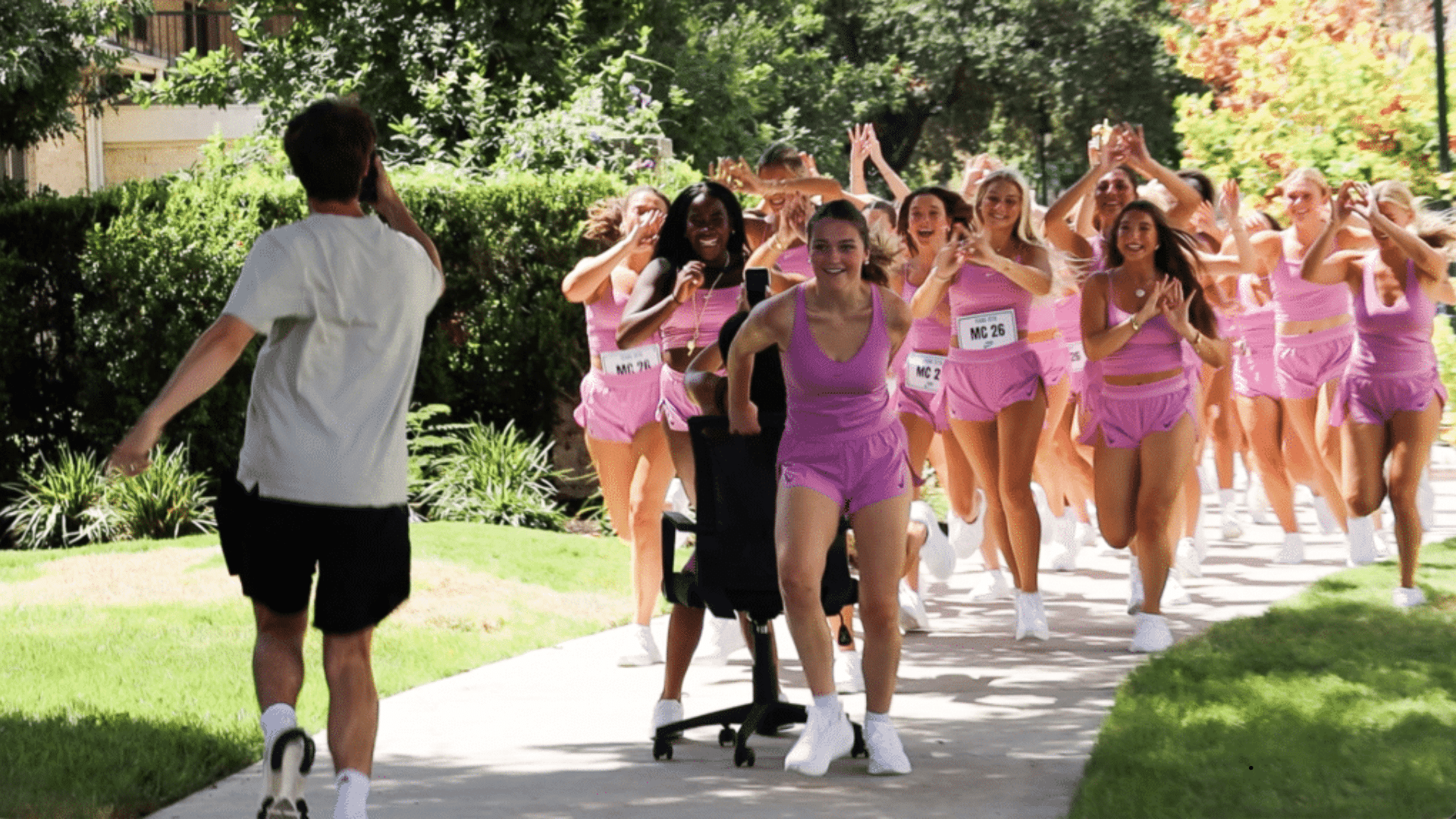
The “Shock” is a single hero video, typically a choreographed dance featuring the full sorority chapter, filmed at the house with the brand at center. Jake targets roughly 15 seconds, long enough to land the concept, short enough to hold attention from the first frame. Sound and choreography are tailored to each activation with the goal of producing a video that can go viral independently.
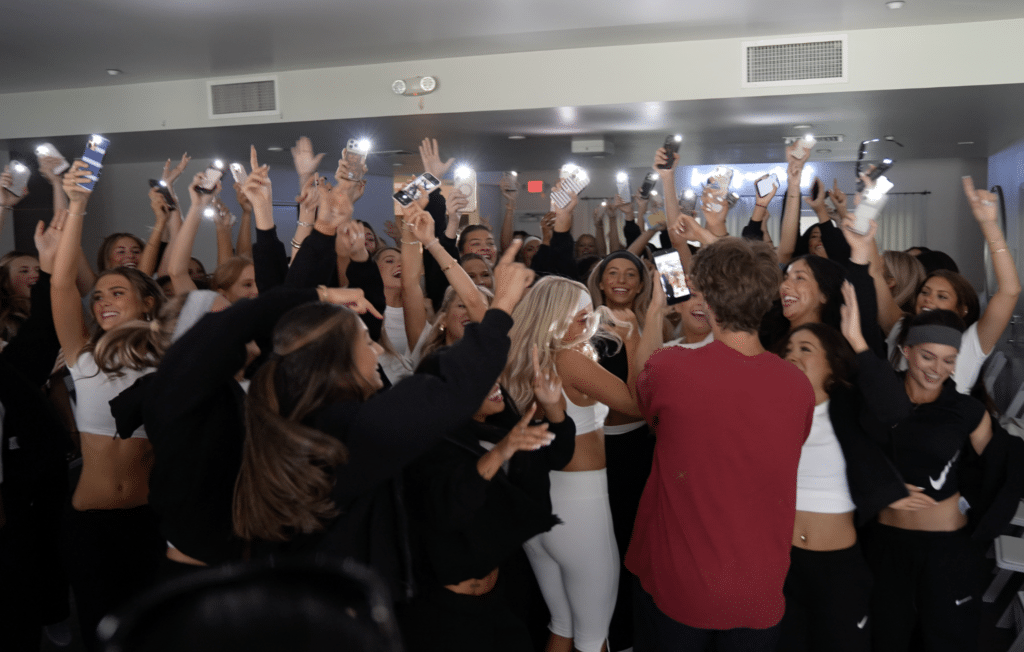
The “Flood” follows immediately. CampusLaunch’s on-site team collects street interviews, taste reactions, and behind-the-scenes footage during the event, while influencers in the network and chapter members post their own content. The objective is to saturate TikTok’s algorithm within a 24- to 48-hour window.
“The viewer sees this massive dance video, they think it’s amazing with the entire chapter, and then they get redirected to all of this content surrounding the event,” Jake explains. “It almost builds like a mini trend where you’re seeing all this content around the activation.”
BODYARMOR at Ole Miss: Flooding the Algorithm
The two-layer model’s first live test came in February 2025, when CampusLaunch activated with BODYARMOR at Ole Miss. Jake drove a pickup truck to the campus himself. The setup included a branded banner, BODYARMOR coolers, and influencers in the house with followings of 300,000 or more. The choreographed video drew around 300,000 views. The most notable result was what surrounded it: over 50 individual posts from chapter members went out around the event in a 24-hour window.
“We literally flooded the TikTok algorithm in that 24-hour period of event-based content,” Jake recalls. “That’s what made the activation successful.”
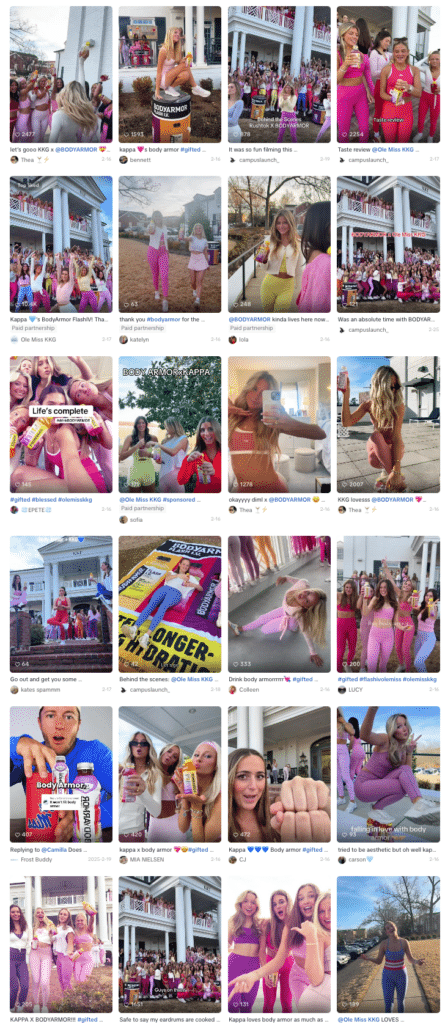
The Ole Miss campaign established the architecture CampusLaunch now uses as a baseline. A guaranteed minimum number of videos comes from the sorority members and the company’s own production team. Jake says a well-executed activation currently averages 44 videos per event, though that figure rises sharply when the brand genuinely fits the chapter’s interests.
Activations, Ambassadors, and the Loop
CampusLaunch’s three service lines are designed to compound rather than operate independently.
An activation is the full production event. Experiential elements include custom inflatables, branded banners, and on-site product displays, with 150 to 200 members participating. An ambassador program is always-on. Selected members or chapter influencers serve as ongoing campus representatives, generating content between events and carrying the brand relationship past a single day. The influencer line handles sorority creators with larger individual followings directly.
Jake’s preferred structure runs from activation to ambassador to activation. A brand enters with an event, the highest-performing participants stay on as ambassadors, and the ambassador network is used to mobilize the sorority when the brand is ready to activate again. “It’s not just them making content,” Jake says. “It’s also them embedding the product within campus.”
One rule runs through all three lines: no scripts. “We never give scripts,” Jake says. “That’s how you make the activation and the ambassador program do worse. It reads as a script.”
Commerce Enters Through the Ambassador Layer
CampusLaunch keeps social commerce mechanics out of its activation content. Discount codes and affiliate links do not appear in event captions. Jake’s reasoning is that embedding transactional elements undercuts the experience quality that drives organic posting in the first place.
“We don’t want to put a discount code in the caption because that just takes away from the authentic experience,” Jake says. “A successful event is the most fun event that the chapter’s ever had.”
When an activation reaches that threshold, he adds, the commercial signal comes through the content itself. Reach and engagement follow from the experience, not from a call-to-action appended to each post. Social commerce and affiliate tools enter through ambassador and influencer programs, where the promotional relationship is already established.
The same underlying logic shapes how Jake thinks about platform risk. If TikTok’s algorithm shifts or the “RushTok” format loses momentum, CampusLaunch’s core asset, a team built with current and former sorority presidents, VPs of recruitment, and members with direct knowledge of what Gen Z women respond to, remains intact. “We’re going to be the first people to see when a trend shifts,” Jake says.
Scaling the Model Without Losing the Touch
CampusLaunch ran 32 activations in the past 30 days, a pace driven in part by “rush” season. Jake is now building programming for new-member events in September and October, targeting chapters that recently added women who joined during “rush” and are looking for their first branded experiences on campus.
The next challenge is access. Jake’s current model is built for larger brands that can absorb custom, high-touch campaign production. Smaller brands are inquiring, and CampusLaunch is working out how to serve them without diluting the tailored approach that generates 50-plus videos per event. “We understand how to put on an amazing event; we understand how to deliver results for these large brands,” Jake says. “Now it’s about scaling with smaller brands.”
His advice to brand marketers thinking about campus activations runs in the same two layers as the method itself. Physical presence has to be worth attending, something students actively want to go to. The content strategy has to make the event visible far beyond the people who were there.
“You need to build an amazing experience,” Jake says. “And you need to build an amazing content engine around that experience.”
Subscribe to Our Newsletter
Check Out Our Podcast