






Technology
CaptionX’s Jake Browne: Automated Clipping Saves Hours, but Release Timing and Volume Decide the Payoff

Turning a three-hour podcast into short clips means someone has to sift through all three hours first. Jake Browne, founder of CaptionX, built software that does the sifting from the transcript. He argues the payoff depends on when creators post, how often, and how much of the story each clip gives away.
That search is the part Jake built CaptionX to remove. In his view, most people starting YouTube channels do it on the side, with limited hours to spare. “Time is actually the most important thing,” Jake says. “How can you reduce as much time involved as possible and get the best result?”
The product began narrower. A software engineer by training, Jake founded the company in April 2024 to add Indonesian captions to Adobe Premiere, which did not support the language out of the box. Demand arrived organically, he says, and CaptionX now sells transcription, translation, captioning and clipping tools to video editors and creators who cut podcasts and live streams into TikToks and YouTube Shorts. It recently added DaVinci Resolve, After Effects, and a Final Cut Pro beta alongside Premiere. Jake, who is based in Perth, says the suite expands every couple of weeks.

Manual Clipping Adds Hours to Every Stream
Jake’s own example shows where the hours go. A creator who live streams five hours a day has to go back through all five. By his estimate, clipping by hand, along with scheduling, uploading, and metadata, takes another two to three hours. With CaptionX, the creator uploads an MP4 and gets a set of clips back.
“It’s cutting out that middle point, which I’m very confident is the most annoying part, which is going through your long-form content and then clipping it,” Jake says. “You’re going to be critical of your work and critical of what clips you get out,” he argues, adding that a tool takes the emotion out of the first pass.
That makes software a cheaper first step than a hire. “Video editors are quite pricey. They know what they’re worth, and that’s actually very good,” Jake says. For clipping alone, he suggests using CaptionX to test which clips perform, then bringing in a part-time editor to refine them as the channel grows. In that sequence, the tool runs the experiment, and the editor arrives once the creator knows what works.
CaptionX Finds Clips in What Gets Said
The experiment depends on what the tool can find. CaptionX scans the transcript for strings of sentences likely to draw engagement and reads the context around them, Jake explains. “You would use it for content where the primary driver is voice,” he says.
That rules some formats out. An eight-hour gaming stream with no talking is not a good fit, and Jake says CaptionX is working on it but is “not there yet.” “You can’t really get viral clips if you’re talking about something that’s really boring,” he says.
That gives the host a lever before recording starts. Jake advises driving the conversation with questions and letting answers run into tangents or friendly disagreement, the moments the tool is built to catch.
Much of the product work has gone into where each clip starts and stops. Avoiding clips that end mid-thought was a must-have for release, Jake says, though edge cases slip through. Early versions targeted clips of 15 to 20 seconds or longer until users fed in 10-second snippets. According to Jake, quality improved once CaptionX loosened the rule.
Hosts Still Make the Final Cut
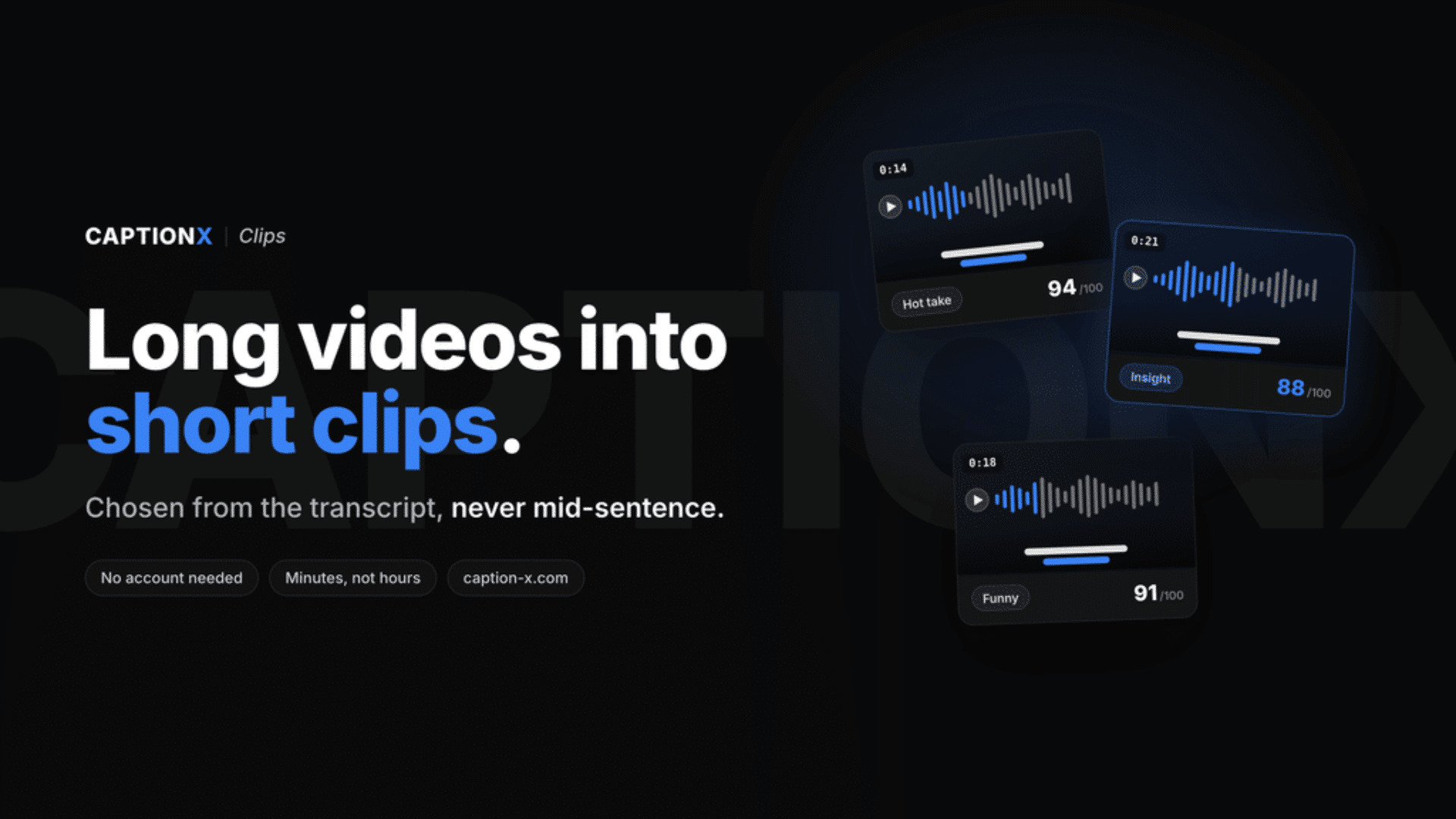
Clean edges do not settle which clips get posted. CaptionX tags each clip with one of seven categories: Story, Insight, Hot take, How-to, Q&A, Funny, and Emotional. Each clip also carries a score out of 100, and opening it shows three of the ratings behind that number (Hook, Payoff, and Stands alone) along with a one-line reason the clip was selected. The scores rank clips only against others cut from the same video, so creators can decide, for example, whether to lead with a hot take or pass on it.
The override, in Jake’s view, comes down to the channel’s vibe. “The clips will push out a whole bunch of stuff that might not be in line with what you want to push on your channel,” he says, citing a channel with a political lean. A factual news show might strip out opinion clips that would suit another channel.
Sponsor reads raise the same question. They sometimes surface in clips, and Jake says users either remove or post them depending on what the sponsor wants, though he floats a future option to exclude sponsored segments automatically. For brands still wary of short-form, he points to YouTube’s app update, which he says makes Shorts a main pillar while subscriptions take a back seat. “If you’re scrolling and then there’s a really serious ad after a really funny video, it’s just completely jarring, and no one’s going to watch it,” he says.
The final check stays manual. CaptionX tells users to always review a clip and make sure they are happy to release it.
Clips Can Sell an Episode Before It Airs
Reviewed clips still need a release slot. Jake says the data favors posting before the full episode is live, because strong shorts send viewers looking for an episode that won’t arrive for 12 hours or a couple of days. “When a lot of people are watching content immediately once it’s released, the algorithm keeps pushing that up,” he says.
The alternative is to trickle clips out after the upload. Jake says the choice depends on the channel’s size and whether its long-form content pulls on its own. Some creators also clip six-month-old episodes to recover views the algorithm ignored, and a single short can bring in a couple hundred thousand views, he notes.
Short-form and long-form audiences only partly overlap in Jake’s reading, with short-form possibly skewing younger. He tells new podcasters in a saturated market to clip from the first episode and post on their audience’s clock. A creator in Australia with viewers in Germany, for example, should not upload at 7 p.m. local time.
Flooding the Feed Costs Views
Posting early does not mean posting constantly. Jake argues that swarming an audience overwhelms viewers even when the content is good, and he points to channels that post four videos a day while their views fall. “I think frequency, consistency and quality are paramount to building a channel,” he says.
Clip-farming accounts get little credit from him, though he allows there may be some payoff. “You’re throwing darts at a board and hoping to hit one,” Jake says, noting that a million-view hit still has to be repeated.
The same caution shapes his view on length. Clips of 10 to 15 seconds that viewers replay signal the algorithm to push them. Longer shorts draw less engagement at volume but do well when people stay. Jake sees room for one- to two-minute clips too, with the caveat that over-delivering overwhelms the audience.
The Clips That Convert Leave the Story Unfinished
Volume and length decide who sees a clip. Sounds Profitable’s “Podcast Atlas” research found that 71% of listeners would follow a host they like into clips, while roughly a third of clip viewers say clips often lead them to watch a full episode or follow the show. Jake’s answer is to treat the clip as a teaser.
CaptionX’s clips are currently built to stand alone, but Jake says the company is moving toward teaser-style clips designed to send viewers to the long-form episode. “That’s actually sort of the goal of short-form in a way,” he says.
Tracking which clips do that happens outside the tool. After posting, Jake points creators to YouTube’s analytics, watch time above all. “If your watch time is starting to fade immediately, that’s clearly non-ideal,” he says. He calls watch time the biggest driver, though YouTube does not say so itself.
The Bet Is on Creators Short on Time
Jake shares that more releases are in the pipeline, and he draws one line around automation. “Any smell of AI in something that’s supposed to be genuine will get found, and it’s actually quite brutal to see,” he says. For that reason, CaptionX starts from recordings of real people talking.
The levers Jake describes, from release timing to clip volume to teaser design, leave the judgment with the creator and hand the searching to software. That split matters most for side-project creators, many of whom, Jake says, never start at all.
“So many people want to be creative, but they just need these tools and these ease-of-use features that make it much simpler to do,” he says.
Subscribe to Our Newsletter
Check Out Our Podcast