


Technology
Social Snowball Turns Its Affiliate Sales Data Into a Marketplace for Performance-Based Creator Deals

Social Snowball can tell a brand how much revenue a creator typically generates per partnership, which order value converts best with that creator’s audience, and how long they take to land a first sale. The affiliate platform, acquired by Dotdigital in June 2025, is now putting that record in front of merchants through a marketplace where creators apply for partnerships that pay across Shopify, TikTok Shop and Meta.
That record exists because founder Noah Tucker built the company around attribution from the start. He launched Social Snowball in Los Angeles in 2019 to run affiliate and referral programs for ecommerce brands, after seeing that founders and operators wanted to pay creators on sales and track the revenue each one drove.
“We choose to focus specifically on how we can make these word-of-mouth channels, these different creator, influencer and customer referral partners, actually drive attributable revenue,” Noah says.
Today Noah calls it an “all-in-one word-of-mouth marketing platform,” covering influencer, affiliate and creator programs as well as customer referrals. The company serves more than 3,000 ecommerce brands, including Grüns, Goli and True Classic. Noah, now Chief Influencer Officer at Dotdigital, ties that focus to demand. “That’s what more and more brands are caring about,” he says.
Until a few weeks ago, Social Snowball sold only to brands and never let an affiliate sign up without a brand’s invitation. The marketplace makes creators the other side of the market. “We need them to come to the table just as much as we need brands to,” says Clint Ross, the company’s VP of Marketing.
TikTok Shop Made Creators a Performance Channel
Bringing brands to that table was harder when Social Snowball launched. Influencer Marketing was long treated as an awareness channel, Noah explains, and conversions were rarely incentivized or measured accurately. “That was not really mainstream, and it was like an uphill battle to convince brands of that,” he says.
TikTok Shop changed the calculation. In Noah’s telling, the platform told brands that creators would be paid only when they drove attributable revenue, which it tracks inside its own app. “They realized, wait, influencers can actually be a performance channel. It doesn’t have to just be something that feeds top of funnel,” Noah says.
The effect is spreading beyond TikTok, he argues. Marketers who pay TikTok creators on commission are starting to ask why a similar-sized Instagram creator gets a flat fee with no revenue tracked.
That shift is the wave Noah says Social Snowball has been riding. It also leaves brands moving to commission deals with a practical problem, which is predicting which creators will actually sell.
Brands Can Now See What a Creator Sells
Most creator marketers solve that problem with social metrics such as engagement rate or reel watch time, says Noah. “I’m not discrediting those because they are good, but they’re not great because the actual job to be done here is to drive revenue,” he says.
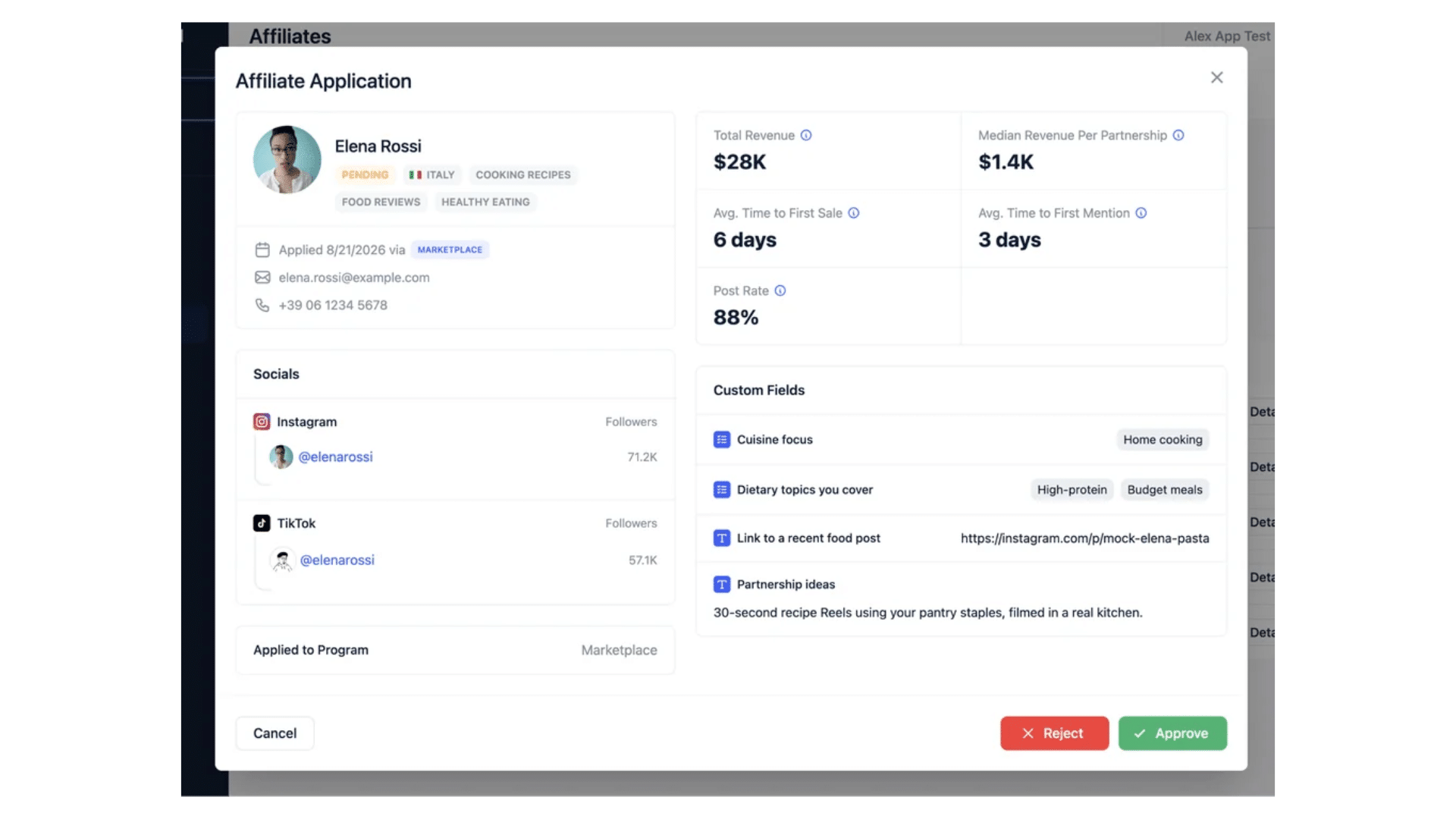
A merchant reviewing an application on Social Snowball’s marketplace sees the numbers those metrics stand in for. They include a creator’s average revenue per accepted partnership, the order value that has converted best with their audience, the time from receiving a gifted product to the first sale, and how long sales continue before tapering off.
According to Noah, the data comes from millions of affiliates who joined Social Snowball over more than six years, all through brand invitations and without any affiliate-facing marketing. Follower counts and engagement rates are “commoditized” in his view, while sales history is not. “The only way to have that data is to be collecting that data and to be on the market for as long as we have,” he says.
For brands, that turns creator selection from an estimate built on reach into a review of past sales. Creators get a version of the same view.
Creators Earn Across Three Channels From One Dashboard
Each brand listing shows creators how much affiliate revenue the brand has generated through Social Snowball, along with its commission, the discount they can share, the gifts on offer, and the content that has performed best for it. “I think affiliates want to know that these products are actually selling and so they’re not wasting their time when they’re creating content,” Noah says.
Noah stresses that all of the data is aggregated and anonymized. “We’re not sharing any brand-specific data ever to anyone. That is something we’ve never done,” he says.
Once accepted, a creator can redeem a gift, enroll in the brand’s Shopify affiliate program, join its TikTok Shop collaboration and, if the brand runs their posts as Meta partnership ads, earn commission on ad spend. Payouts and data for all of it sit in one Social Snowball dashboard. “Instead of creators having to go between three, four different platforms to manage these different types of partnerships, all of it lives under Social Snowball,” Noah says.
For a creator weighing two brands with similar commissions, Noah’s first test is whether their audience will like the products. If that is a tie, he would compare each brand’s affiliate revenue on Social Snowball and its top-performing posts. “This can be a partnership that lasts years instead of weeks,” he says.
Everyday Creators Get In, Coupon Sites Stay Out
The creators Noah expects to fill those long-running partnerships include parents filming between school drop-offs and office workers filming their commute. “This is the everyday person that maybe wants to make a little bit of extra money on the side and is not a full-time creator,” he says. The idea goes back to Social Snowball’s first product, which turned a brand’s own customers into affiliates.
That low bar comes with limits. Social Snowball bars coupon sites and affiliates who run paid traffic without a brand’s knowledge, and Noah says any that slip through are caught and banned quickly. For the early rollout, it also set minimum follower requirements by brand and capped each creator at three applications a day. When Net Influencer browsed the marketplace, most listings set the minimum at 1,000 followers.
Those caps hold back demand as well as abuse. “One of the biggest complaints we’ve gotten from affiliates is, ‘Why can’t I apply to more brands?’” Noah says.
Richer Offers Rank Higher With Creators
Applications came in despite the cap. Creators submitted more than 1,000 applications in the marketplace’s first 10 days, according to the company, during an early-access phase that started with 1,000 creators, has since grown to 3,000, and includes about 80 brands.
Noah says he wakes up to around 10 new emails from affiliates praising the marketplace, which he reads as a signal because affiliates, like consumers, rarely write in except to complain.
For brands, visibility depends on the offer. Social Snowball’s algorithm ranks brands by earning potential for affiliates, so gifts, high commission rates and a TikTok Shop program all lift a listing, according to the company. “The more generous the offer, the more applications they will get,” Noah says. Brands that would rather recruit directly can use creator search, a separate feature that pulls a wider pool of creators through Meta’s API.
The result puts a number on both sides of the match. Brands review creators on the sales they have driven, and creators find brands ranked by what they stand to earn.
Free Access Is the Lever for a Wider Rollout
That match is still small. Noah’s priority heading into 2027 is getting as many brands and affiliates onto the marketplace as possible, releasing access in chunks until the company is confident enough to open it to the rest of its affiliate base. Free access on both sides makes that easier for now. “It’s free right now, but it won’t be free forever,” Noah says, adding that this will probably change sometime in the first quarter.
Dotdigital is meant to speed that expansion. The parent is funding growth investments and removing bottlenecks that would slow a smaller company down.
The performance shift Noah describes is also reaching UGC deals, which he says have moved from a flat fee toward little or no flat fee plus a percentage of ad spend, the same structure the marketplace’s Meta partnership ads program offers creators. “You pay an influencer, and you pray it drives results. Those days are over,” Noah says.
Subscribe to Our Newsletter
Check Out Our Podcast