




Technology
As AI Makes Ad Production Unlimited, Cuttable’s Sam Ayre Says Brands That Learn Fastest Will Win

Sam Ayre, Head of Marketing at AI advertising platform Cuttable, says Meta’s ad system has grown smart enough that the creative now does the targeting. That turns advertising on the platform into a volume problem most marketing teams cannot keep up with. Sam argues that AI can now carry the volume, and the brands that pull ahead will use their own performance data to decide which ad to make next.
Sam watched that volume problem grow from the buyer’s side while leading performance marketing teams at Medibank and running his own ecommerce brand. In his account, the number of assets Meta requires has exploded, and the companies with the deepest resources have been the ones able to keep up.
“What we’re building at Cuttable is trying to close the gap between what everyone else can access and what the world’s best companies can,” Sam says.
He came to Cuttable as its first customer, testing a prototype then called “The Cutting Room” before joining as employee number five. The company sells to mid-market and mature ecommerce brands, typically with physical products on Shopify and, in Sam’s estimate, $15,000 to $100,000 a month in Meta spend. Those brands already own what Cuttable needs: hard drives of shoots and creator content that can be cut into new ads, which is where the name comes from.
That ecommerce focus came after Cuttable launched in July 2025 open to any business, Sam says, and about a dozen service businesses still inquire each day. “Any AI business that’s trying to cater for everyone is really not catering for anyone properly,” he says.
Headquartered in Australia with offices in New York and San Francisco, 44 employees, and more than 450 brand customers, the company relaunched in October alongside an A$20 million Series A led by Airtree Ventures. The new version adds recommendations on which ads to make.

It Takes 42 Ads to Find One Winner
For Sam, recommendations matter because the odds on any single ad are long. “At the moment it takes 42 ads to publish to Meta to find one that moves the business,” he says, likening the winner to a gold nugget a team has to dig for.
The teams that dig fastest publish 100 to 200 or more ads, according to him, and find winners sooner even on lower Meta spend. Cuttable’s own figures point the same way. Across 280,000 ads and more than $320 million in Meta spend, one ad in 11 returned ten times its spend or better, and a small number of ads carried entire accounts.
Rodan & Fields, a skincare and beauty customer with a lean in-house creative team, now moves from concept to launch three times faster, with ideas live in Meta the same day, Sam says. Almost 40% of its Meta spend runs on Cuttable ads. Conserving Beauty produced an entire after-payday sale on the platform at a 10.5x return on ad spend, and work that once took it three weeks now goes live in a few hours.
The cost of not producing at that rate falls on people as well as results. Sam names team burnout first. “Designers didn’t get into design to come up with 15 different variations of an ad,” he says, calling the idea that AI replaces them a misconception. Volume alone does not deliver the lift, though.
Three Creative Types Outperform One House Style
In the same 280,000-ad analysis, brands running three or more types of creative, such as a rough hand-drawn ad, UGC and polished product advertising, saw a 37% uplift in performance over brands running fewer, Sam says. “They need lots of diverse creative that appeals to lots of different audiences,” he adds.
The brand belief Sam singles out as wrong is that every ad must look the same. Brands that insist on a single premium, high-fashion look are usually the ones that see performance drop. “A high fashion brand can do something that doesn’t necessarily look like a high fashion brand and perform really well,” he says.
The resistance often sits inside the client. In companies with separate brand and performance teams, Sam sees a tension he considers natural, with one side wanting consistency and the other pushing for variation. His advice is incremental. “Go 5% outside your comfort zone, go 10%,” he says, warning against jumping straight to AI UGC or a stunt such as someone falling from a plane holding the product.
The increments let performance teams widen their range while brand teams keep protecting the brand. UGC, one of those formats, is also where creators come in.
Creator Ads Still Beat AI-Made Ones
Creator ads still outperform AI ads in the data Cuttable sees, Sam says, despite outliers such as AI claymation and digital twins. “People still are attracted to people,” he says. In his view, AI-generated UGC has not yet fully crossed the uncanny valley.
By the company’s count, creator ads capture 60% more attention and generate 16% higher click-through rates than traditional ads. Follower count has largely stopped mattering over the past three years, Sam argues, as brands put paid spend behind smaller creators. “It doesn’t matter if you have 500 followers or 50 million followers,” he says.
AI’s role sits earlier in the process. Many brands use Cuttable to make AI UGC that tests three or four concepts, then brief five creators on the winning angle, according to Sam.
Creator material makes up about 40% of a typical customer’s ad library, Sam estimates, and brands now negotiate usage for one asset edited five ways, with Cuttable cutting the hooks and angles. Creators either charge an additional fee or fold the edits into the package. Usage periods are built into the platform, so expired assets cannot feed new ads, though Sam says compliance remains the brand’s responsibility.
The five cuts from one shoot multiply a team’s options, and with them the question of which to run next.
Performance Data Now Chooses the Next Ad
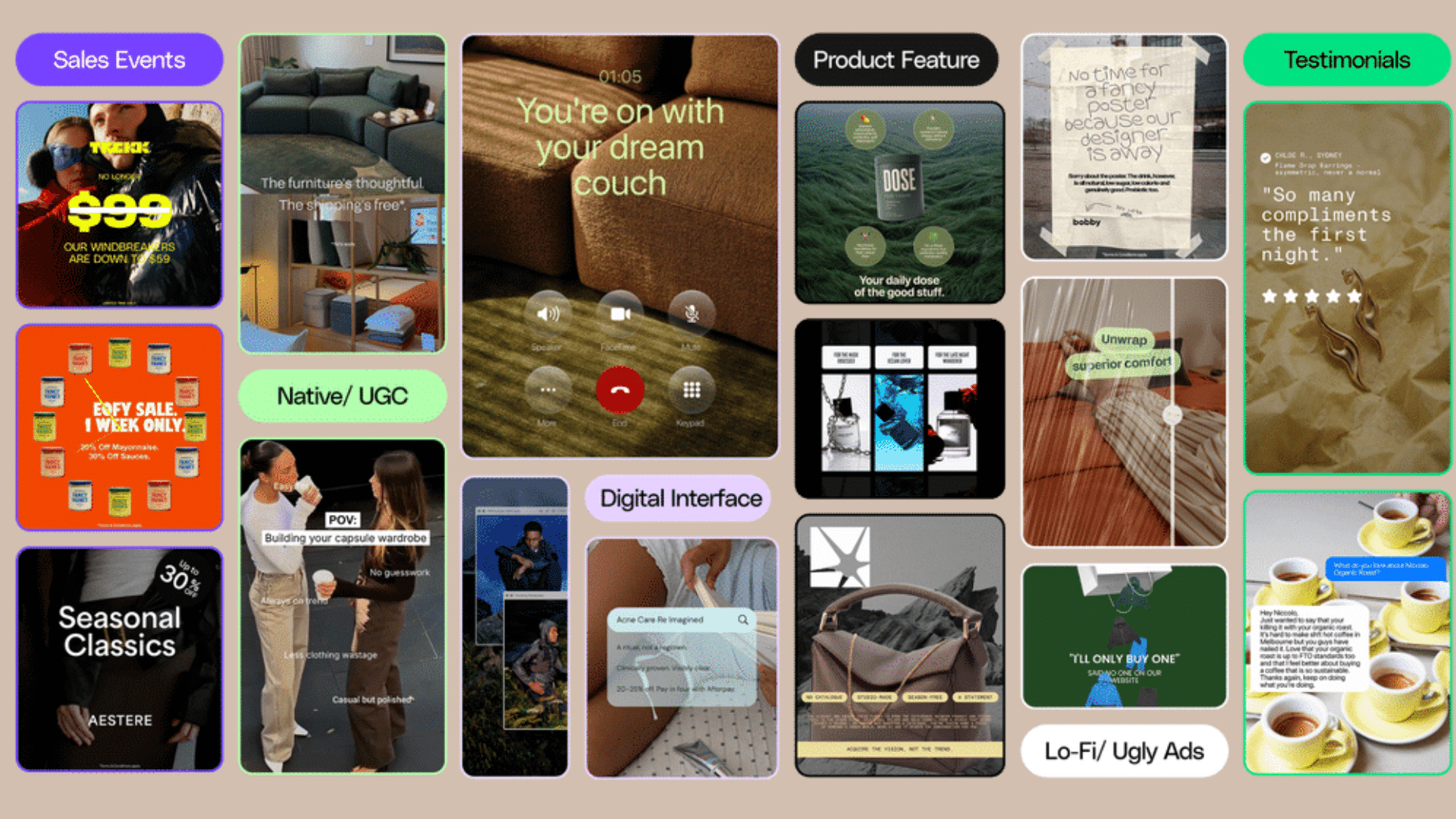
Answering that question is the point of the relaunch. For its first 12 months, Cuttable made ads on request. A marketer prompted for Black Friday assets with 20% off, reviewed the concepts, edited them, and published directly to Meta or TikTok. “The big step is that we are now proactive with recommendations,” Sam says.
The platform now pulls Meta and TikTok performance data alongside a brand’s Shopify and Google Analytics figures, and its Ad Insights tool reads back thumbstop, click-through rate and return on ad spend, according to the company. Brand training from guidelines, customer reviews and past captions makes Cuttable “a living, breathing version of their brand guidelines,” Sam says. When beauty customer Hunter Lab adds a product to Shopify, Cuttable detects it, checks how earlier campaign ads performed and has new ads ready.
“The marketer is the decision maker, and they’re still in full control,” Sam says. Nothing publishes without the marketer’s permission. The recommendations narrow the guesswork, and the call on what runs stays with the team.
The product also stops at creation and publishing. Optimizing spend, along with media buying and planning, is an area Sam says Cuttable may move into later. “At the moment, we really focus on the creation side of things, and we just want to do that really well,” he says.
Brands That Learn Fastest Will Pull Ahead
Sam expects creation itself to stop being scarce within a few years. “Every brand is going to have access to unlimited creative production, but unlimited content doesn’t mean unlimited performance,” he says. His advice heading into 2027 is to pull in data sources such as Triple Whale, Google Analytics, and Motion before building the next batch of ads.
The practices he describes connect through that loop. Volume supplies the tests, variety and creator recuts widen what gets tested, and performance data decides what comes next. For creators, Sam’s advice is to hold attention in the first two seconds and ask brands which personas they are creating for.
Cuttable plans to use the new funding to accelerate its U.S. expansion, a market that already accounts for 40% of its revenue, according to the company. Whether a platform or an agency makes the ad, Sam’s test stays the same. “It’s got to be interesting, and it’s got to be built off real insights and real information,” he says.
Subscribe to Our Newsletter
Check Out Our Podcast