







Strategy
Teachable Bets That Owned Revenue Will Outlast Brand Deals as Creators Scale

A brand deal validates a creator. It does not, Olivia Owens argues, build a business.
As Head of Marketing at Teachable, a platform where human expertise scales into education businesses through online courses, coaching, memberships, and more, Olivia has spent more than four years observing an industry treating sponsored content as a complete revenue strategy rather than a starting point.
“To run a creator business on the back of sponsorships alone is a risk in itself,” she says. “If you’re only relying on brand deals, you’re constantly making a judgment call: is this a brand I really want to work with, or do I need to pay my rent? That puts you in a precarious position.”
That conviction was shaped by her five years at IFundWomen, where she launched and led “IFundWomen of Color,” an initiative designed to close the funding and education shortfall facing women entrepreneurs. Women of color represented 70% of the women on the platform but captured only 30% of funds raised, a disparity Olivia traced to a confidence and education deficit rather than a lack of will. By providing early grant funding and institutional backing to establish credibility for founders, her team increased that share to 51% in the first year. The work reinforced a belief that access to knowledge, and the infrastructure to act on it, is the lever that changes outcomes for underserved operators.
Teachable is that infrastructure applied at scale. The platform’s creator base spans courses helping nurses with continuing education to career professionals with a decade or more of domain expertise looking to monetize what they know.

Brand Deal Income Has a Ceiling
Olivia sees the sponsored post not as a flawed revenue model, but as an incomplete one.
“Brand deal money is a really strong revenue stream, but it can be unpredictable,” she says. As an example, a deal that closes in one quarter may not renew in the next.
The deeper problem is leverage. “The thing that the creator still has to keep in mind is the way they’ve been able to build their audience is based on their authority and the trust they’ve created,” she says. A creator financially dependent on brand revenue eventually loses the ability to be selective. A poorly matched partnership erodes the audience trust that makes future brand deals worth anything at all.
Diversifying resolves the tension by splitting income into two tracks: the larger but irregular sums that brand deals provide, and the predictable, forecastable revenue that digital products generate. “Diversification gives you the breathing room you need to have choice and autonomy,” Olivia says.
Olivia also identifies B2B licensing as an underused third stream. Selling a course to a company for team-wide access commands a substantially higher price point than individual sales. “That’s a higher price point that you’re able to charge at that point,” she says of the corporate arrangement, noting that creators with workplace-relevant expertise can pursue it without building new material.
Match the Product to the Creator, Not to the Platform
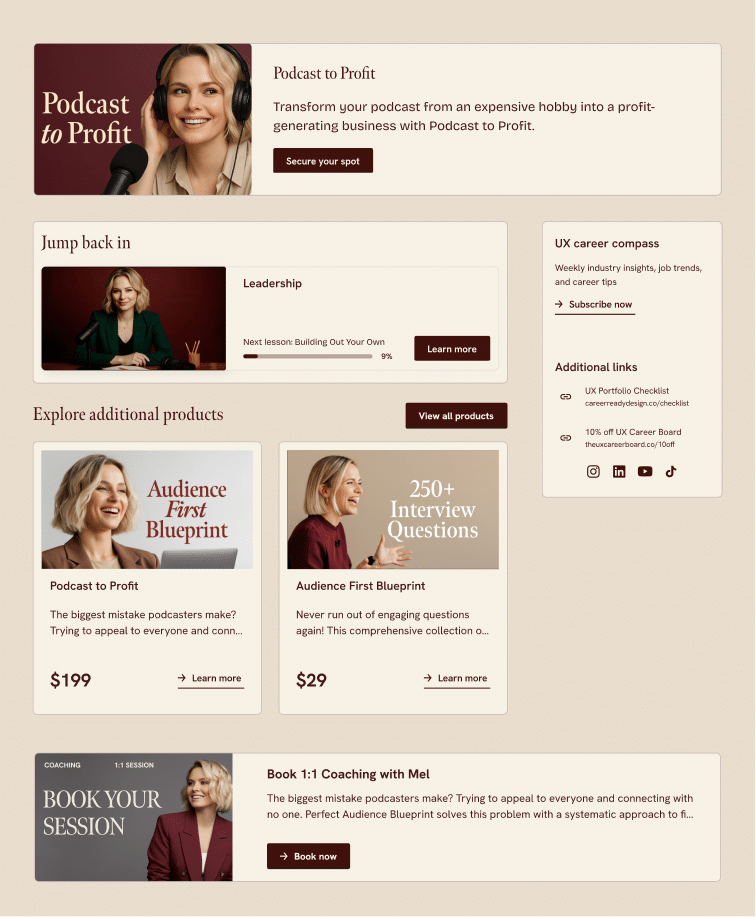
Teachable’s platform supports pre-recorded courses, live coaching, community memberships, and one-time digital downloads. For a creator entering owned revenue for the first time, choosing among them is often the first obstacle.
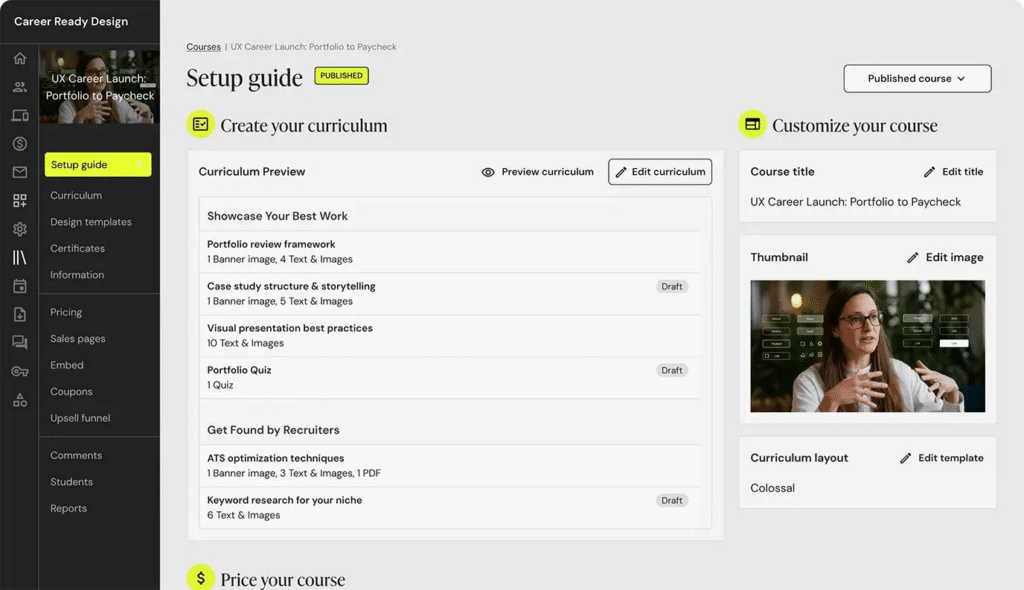
Olivia evaluates the decision through three lenses. The first is the creator’s own capacity: how much ongoing time they want to invest, and whether they prefer hands-on community engagement or a finished, evergreen asset. A pre-recorded course requires upfront effort but can sell indefinitely. A membership requires consistent, active engagement to retain subscribers.
The second lens is community demand: specifically, whether an audience is drawn to a creator’s knowledge or to their presence. “Are they really just getting access to what’s in your brain, or is it your personality that they’re really trying to connect with?” Olivia says. If the audience wants proximity to the creator, live programming or a membership may be a better fit than a static course.
The third lens is what she calls the creator’s “superpower,” i.e., the differentiated expertise that justifies paying for access. “It’s what’s the world that you can create for your community that’s unique to you, gives you the infrastructure that allows you to scale, and meets the demand of what your community wants,” she says. When those three inputs converge, the right product format tends to become clear.
Most Creators Monetize Too Late, Then Overthink the Design
The most common error Olivia observes among creators moving from brand deals to owned products is a timing mistake, not a strategic one.
“They wait too long,” she says. “They don’t do it fast enough.” Part of the hesitation resembles the confidence shortfall she observed at IFundWomen: a reluctance to ask an audience to pay directly for something the creator has made. But a design error compounds the problem once creators do commit.
Creators building their first educational product tend to overload it, attempting to compress 15 years of expertise into a single course rather than designing toward a specific, achievable result. The better design principle, Olivia argues, is to optimize for an outcome, not volume. A career course covering resumes, LinkedIn optimization, and interview skills does its job when a student watches only the interview module and then lands their next role.
“Rethinking the value exchange for your digital products,” she says, “and optimizing for the short-term kind of outcome you can drive for them.”
AI Helps Creators Mine the Content They Already Have
On AI-generated courses, Olivia believes a “human in the loop is still something that learners desire.” She would be surprised if a fully AI-authored course outperformed one a creator wrote themselves, and frames the hypothetical as a prompt to diagnose what the original was missing.
Where AI adds clearer value, she says, is in pattern recognition across a creator’s existing output. Creators with active social presences and newsletters produce substantial content volume. The harder task is identifying which of that material has the potential for a paid product.
“Is there a course born out of this post?” Olivia says, describing the question AI makes easier to answer at scale. A content pillar that performs consistently may have a natural digital download inside it. A popular newsletter series may carry the structure of a coaching program. The value, she argues, is in connecting those dots more efficiently, getting more commercial mileage from material that already exists rather than generating something from scratch.
The Creators Who Survive Platform Shifts
Olivia’s test for a durable creator business is direct: remove brand budgets and platform monetization programs, and see what remains.
“The ones on Teachable,” she says. “The ones who are making revenue because they’ve already created the dynamic where their audience is willing to invest in them and willing to help push their business forward.” A creator whose audience has already demonstrated willingness to pay for access is operating from a fundamentally different base than one whose revenue depends entirely on third-party decisions.
Over the next five years, Olivia expects the barriers to building this model to fall. “The ability to create a high-value learning experience that creates an outcome for your student takes a shorter period of time,” she says, predicting that creators who have been waiting for the right moment to launch will find fewer reasons to keep waiting.
The belief underlying Teachable’s case is narrow and verifiable. “A higher-level belief that their expertise is worth paying for,” Olivia says, “and that people are willing to do it. We’re seeing it happen every single day on our platform.”
Subscribe to Our Newsletter
Check Out Our Podcast