








Talent Collectives
Arcade Sets Out to Bring Primetime Budgets to European Creator Media

Television continues to command a large share of traditional media budgets, even as young adults increasingly spend their viewing time on YouTube and creator-led programming. Arcade, the London-based entertainment company managing The Sidemen and six newly signed creators, hosted Europe’s first creator media Upfront to press the case that advertising dollars should follow the audience.
Making that case is Matt Elek, who joined Arcade as CEO in July 2026 after 18 years at Vice Media, where he served as CEO of its Europe, Middle East and Africa operations for over a decade. The Vice parallel is one he returns to readily. “It feels like we’re right on day one of the next wave of media innovation,” he says, framing the Creator Economy the way the early days of online publishing felt. His bet is that professional creator representation is at the same inflection point.
The company he now leads was founded in 2021 by Jordan Schwarzenberger, Sam Uwins, and Aaron O’Neill as the management and ventures company for The Sidemen. It has since relaunched as an entertainment company, adding Max Fosh, Friends From Work, John Nellis, Faith Kelly, Generation Football, and Fallow Chefs to its roster. The expansion is backed by a seven-figure investment from Lumina Media, which also holds a strategic advisory role.
On September 17, Arcade convened more than 150 advertisers and brand partners at an invite-only event in London, presenting creator content slates alongside audience data. In Matt’s framing, it was an industry statement as much as a sales pitch, drawing, in his words, “a line in the sand of the next phase of the Creator Economy in the UK and Europe.”
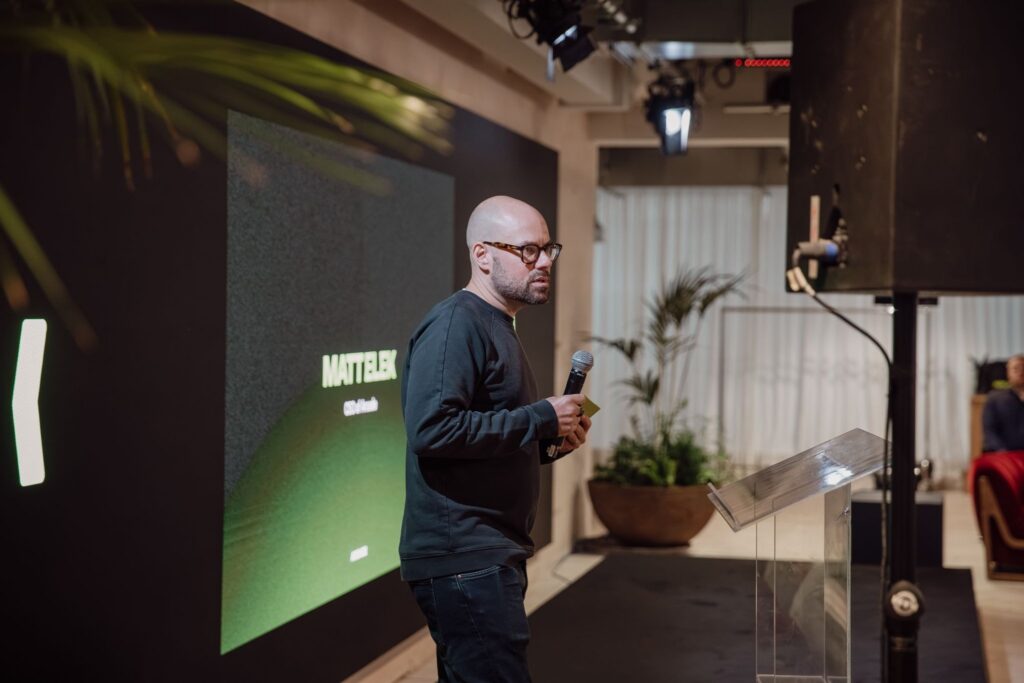
Photo: Matt Elek at Arcade’s Upfront
Creator Media Should Command Primetime Budgets
The Upfront’s central argument is behavioral. Young audiences have not just discovered YouTube; they consume it the way earlier generations used broadcast television. “If you’re an 18-to-34-year-old, you’re not coming home on a Thursday night finishing school or work and turning on a TV channel,” Matt says. “You are turning on YouTube, watching specific creators in the same way that you would watch a specific show or a specific channel.”
In Matt’s view, advertising budgets have not kept pace with that behavioral shift. Creator media still sits in a secondary or experimental tier for many brands, even as it has become primary media for the demographic they most want to reach. “These creators are the go-to trusted voices in media that people are choosing to spend vast quantities of their time with,” he says. “If you want to reach people at their peak consumption moments with trusted voices, it’s creators.”
Matt knew in advance that the room would not be uniformly persuaded. Some attendees already engaged in creator media; others, he says, were “creator-curious,” aware of the category but uncertain how to engage at scale. The Upfront format itself borrowed from broadcast media, where similar events have long served to secure advance advertising commitments from brand buyers.
Bringing Broadcast Accountability to Creator Campaigns
Audience arguments alone are unlikely to move media buyers who require the measurement standards broadcast media provides. Matt’s answer is to import those standards into creator campaigns.
“We’re trying to bring rigor and operational excellence, where the basic things one might expect if you’re spending money with broadcast media are campaign reports and marketing efficiency and ROI,” he says. The goal is to merge creator content’s reach with a level of accountability that, in Matt’s assessment, remains inconsistent across the broader market.
Arcade’s commercial business has already drawn partners including Virgin Media O2, Formula E, Esports World Cup, Unilever, Lego, and Papa Johns, according to the company. Its Creator Access division holds a YouTube Partner Sales license that enables guaranteed ad delivery against its creator roster, a mechanism closer to traditional media buying than the typical influencer deal structure. The company frames this combination as a “safe haven” for brand investment.
“It’s not a legacy media business trying to figure out how to work with creators,” Matt says of Arcade’s positioning in the market. “That’s all we do. That’s our specialty.” Deep industry fluency, in his view, is what makes the accountability pitch credible rather than merely aspirational.

An Elite-Only Roster Is Both Strategy and Signal
The addition of six creators was announced in a week, but Matt is clear that the signings were the result of many months of work. More to the point, the expansion did not change Arcade’s threshold for who qualifies. The company targets what he calls the “1% of the 1%,” assessed on audience size, output quality, engagement, and projected career trajectory. No single metric determines inclusion.
“It’s about a holistic approach to the quality of the creator and how we feel like we can help grow their careers,” Matt says. The company’s ability to add value matters as much as a creator’s current scale. He points to The Sidemen as the reference model, not as a ceiling but as a trajectory others can follow. “There is a wider group of creators that have the potential to go on at least a similar journey,” he says.

The selectivity also carries a commercial function. According to Matt, a curated roster of elite creators with measurable audiences makes a cleaner proposition to brand buyers than an open network. He describes the UK market as having had room for a company with both the credibility and the operational know-how to execute that model.
Arcade Aims to Be a Business Partner, Not Just a Manager
For creators on Arcade’s roster, the ambition extends beyond brand campaigns and YouTube growth. Matt frames Arcade as a full business partner, helping creators expand to streaming, television, film, and live events, while also supporting product launches and equity investment when creators want to build or invest in businesses. The entertainment company framing, he explains, is meant to signal that Arcade expects its creators to operate across multiple screens and formats, not just on YouTube.
“It’s not about getting endorsement deals, although we do that,” he says. “It’s more like when creators want to genuinely get involved in businesses or products, when they want to launch things, can we be the business partner for them.” The financial structure reflects that orientation: Arcade’s returns track with its creators’ success rather than with the volume of deals processed.
The Sidemen benefit from the roster expansion alongside the newer signings. More creators bring more infrastructure, more brand relationships, and greater deal flow across the network. A larger, more diverse roster, Matt notes, makes the pitch to media buyers more analogous to buying against a publisher’s programming slate. “A rising tide lifts all boats,” he says of the arrangement with the founding group.
European Creator Media Is Still in Its Opening Chapter
Matt’s five-year vision for European creator media is as much a commercial pitch as a prediction. He wants the ecosystem to resemble television in its commercial prime, with star performers, broad subject-matter coverage, and budgets to match.
“I hope it becomes a thriving ecosystem of creators that have increased reach on YouTube, increased audience scale,” he says, “where the Creator Economy starts to resemble that ecosystem of TV in its heyday.” The distance between that state and today is also, in his reading, what makes the timing of the Upfront useful.
The Vice parallel holds in one specific respect: early digital publishing also took years to convert advertiser recognition into committed budgets before the market shifted. That arc informs what Matt is building toward.
“We want Arcade to be the go-to company and name both for creators seeking to grow their careers and for brands and advertisers and platforms seeking to engage with the creator,” he says. “We want to be the dominant player in being the connective tissue in the Creator Economy.”
Photo credit: Thomas Morgan
Subscribe to Our Newsletter
Check Out Our Podcast