






Tech
How Viral Hub’s Co-Founders Turned Their Agency Workflow Into an Operating System for Influencer Agencies

Rafi Lieberman is the co-founder of Viral Hub Marketing, a U.S.-based Influencer Marketing and UGC agency he launched in January 2024 with Daniel Lieberman. Working inside the agency gave him a firsthand view of where the workflow broke down. Creator selection, brief matching, proposal generation, and pricing were spread across multiple tools and, at worst, managed through spreadsheets.
“I started to realize we’re juggling. Either we have 52 sheets, or we’re jumping in between different programs, and there are 20 different subscriptions that we’re paying for,” he says. “There has to be a way to make things quicker.”
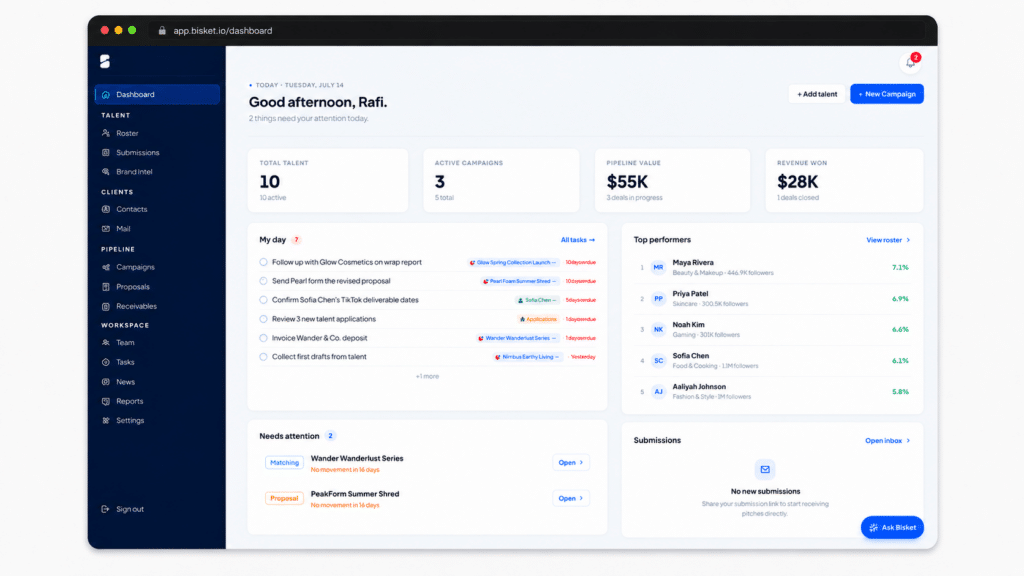
That workflow problem, something Rafi says he had wanted to solve for years before he had the technical resources to act on it, became Bisket, an AI-powered operating system for influencer agencies and talent managers that launched in May 2026. Daniel, who brings a background in customer support and operations and now leads Viral Hub’s day-to-day as CEO, co-founded Bisket alongside Rafi, who handles the platform’s architecture and product development. Four months after launch, Bisket has been adopted by 25 organizations, growing primarily through word of mouth and Rafi’s social channels.
The Standard Agency Stack Wasn’t Designed for Creator Work
The case for a purpose-built influencer operating system comes down to what general platforms cannot do. “All traditional CRMs or operating systems don’t have the tools you need for Influencer Marketing,” Rafi says. He explains that a system designed for sales pipeline management does not natively process social data, match creators to campaign briefs by platform and audience demographics, or generate media kits formatted for the specific requirements of talent deals.
Without a specialized tool, agencies juggle multiple subscriptions, spreadsheets for cross-referencing, and manual aggregation across systems. Brief matching is the first problem Rafi designed Bisket to solve. A user pastes a client brief into the platform; within a minute, according to Rafi, the system returns a ranked creator list from the agency’s roster. The user can then build the proposal and draft the outreach email within the same interface. “You have the list, a proposal, and you’ve already written up an email and sent it to the client,” he says.
The matching algorithm went through a period of testing and refinement following launch. “Early on, it was really about refining the system through real-world use,” Rafi says. “We tested it across different briefs, creator profiles, and campaign scenarios, and every round of feedback helped us make the matching more accurate and useful for agencies.” The system now incorporates decisions from ongoing use, improving its accuracy the more an agency runs campaigns through it.
Bisket offers a free tier supporting up to five creators, with no credit card required to get started, and paid plans for agencies operating at larger scale. Rafi designed the free plan to remove the commitment barrier he finds common in software trials. Agencies with five or fewer creators, he says, can use the free version indefinitely.
Brand Detection Turns Organic Creator Behavior Into a Sales Signal
The brief matcher addresses one part of the workflow problem. A separate feature identifies which creators in an agency’s roster already interact with specific brands organically, before any paid arrangement is in place.
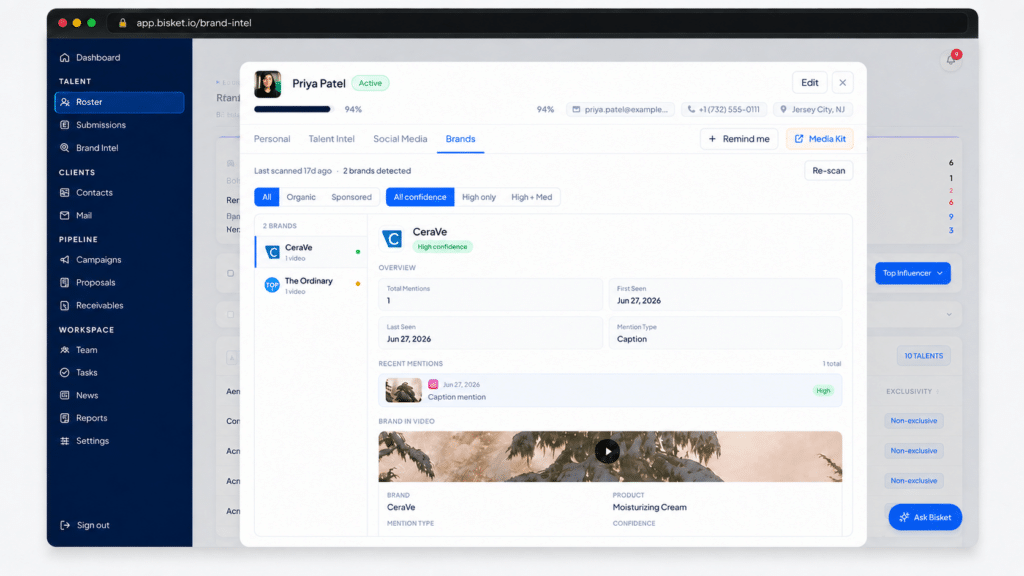
When a client asks whether any roster creators have worked with a given brand, answering the question traditionally requires watching creator content video by video. Bisket’s brand detection AI scans creator content and identifies brand appearances across verbal mentions, on-screen text, captions, hashtags, and visual brand and product appearances. “If I hold now, for example, any brand’s bottle up, it would detect that and log that as a brand placement in the video,” Rafi explains.
He highlights the commercial application: an agency spots that one of its creators consistently features a brand without any paid arrangement, then approaches that brand with documented behavioral data as the basis for a partnership pitch. A cold pitch becomes a data-backed one.
The platform also includes a pricing calculator that draws on Viral Hub’s historical deal data to suggest creator rates and client-facing charges, factoring in deliverables, exclusivity, platform, and agency margin. Rafi says the tool produces estimates that are “95% pretty accurate” relative to market rates, based on internal testing.
Selling the Platform to the Agencies That Compete With Viral Hub
Commercializing an internal tool means selling it to the market, including agencies competing directly with Viral Hub for the same brand assignments. Rafi does not treat this as a conflict. “If one pizza shop opens up, then the next one opens up next to it, it’s good for business at the end of the day,” he says.
His argument is that Bisket users become a professional network rather than a competitive threat. One Bisket user focuses on UGC content; another, based in Europe, specializes in skincare. When Viral Hub needs specialty talent for a campaign that falls outside its own roster, those users become referral contacts. “It benefits them, it benefits me,” Rafi says. “It’s a connection that I wouldn’t have had on this kind of level if it wasn’t for Bisket.”
On data separation, Rafi notes that Viral Hub’s client and creator records and Bisket’s platform data are entirely distinct. The platform’s design draws on Viral Hub’s workflow experience, but the two systems do not share information.
The Brief Matcher Learns, But Managers Still Know Their Talent
Bisket’s brief matcher performs reliably when a creator’s metrics align with a campaign brief’s stated criteria, Rafi says. It performs less reliably when a manager knows from direct experience that a specific creator would work for a campaign despite not matching the metrics cleanly. A talent manager who has placed a particular creator in multiple skincare campaigns carries context the algorithm does not yet have.
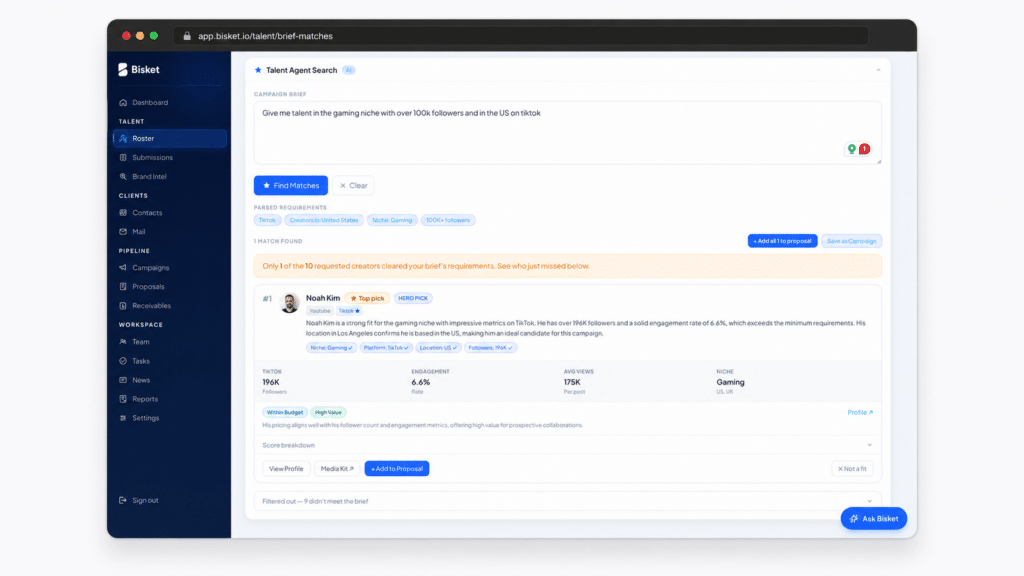
Where the system provides the greatest leverage, according to Rafi, is at scale, helping managers narrow larger rosters to the creators most aligned with a brief rather than manually reviewing profiles one by one. “You always need a little bit of a human touch,” he says. “The AI doesn’t necessarily know about that.” Override decisions feed back into the model over time, improving its matching accuracy. For agencies with smaller rosters, Rafi says the brief-matching feature may be less critical because managers often know their talent intimately. The efficiency case becomes clear, he adds, once the roster reaches 20-30 creators.
Bisket’s customization process follows the same feedback logic. When one early user requested a post-campaign creator ranking system, scoring reliability and performance on a five-point scale, Rafi’s team built and shipped it within a week at no additional charge.
One feature Rafi consistently highlights in demos is an automated birthday message sent to every creator in the roster on their birthday. “I know how much these small little gestures can make an impact with your talent and maintaining a good relationship,” he says.
Bisket Aims to Cut a Talent Manager’s Day to One Hour
In Rafi’s long-term vision, AI agents handle pitching, communication, invoicing, and financial management through the platform, with humans overseeing the work rather than executing every task themselves. “If somebody’s working 10-16 hours a day doing their job right now, cut it down to an hour,” he says.
That vision depends on proving the product outside the context of Viral Hub. Bisket’s early adoption across 25 organizations provides an early indication that the workflow challenges Rafi encountered at Viral Hub extend across the broader industry.
The near-term expansion plan includes expanding the development team as user feedback generates feature requests and adding automations where they make operational sense, without removing human oversight from the parts of the workflow where it matters most. “There always needs to be someone observing and making sure that it’s okay,” Rafi says. “We value all our customers, and we put an emphasis on the fact that it’s not just some tool that is working on its own.”
For now, the entry point stays frictionless. “I know that you’re going to like it and want to use it,” Rafi says. “I don’t want to put any barriers.”
Subscribe to Our Newsletter
Check Out Our Podcast