





Influencer
‘Tony Talks’ And The Art Of Turning Everyday Life Into Comedy Content

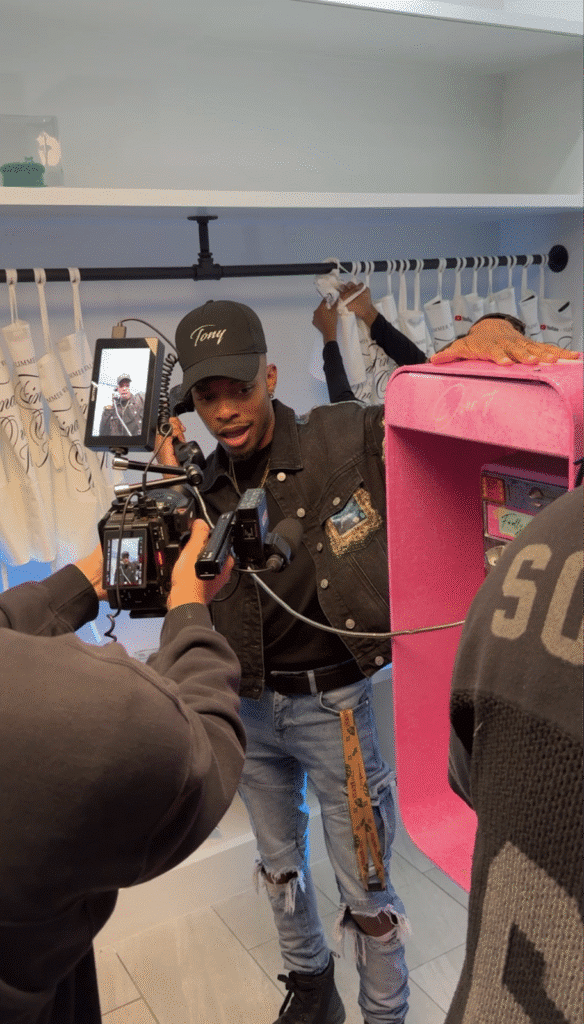
Antonio “Tony Talks” Baldwin’s comedy rarely starts with a punchline. He starts with a look, a tone, a moment pulled directly from real life and pushed just far enough to land. That approach has carried Antonio from short skits filmed between shifts to a multi-platform audience of millions and a growing business spanning brand partnerships and film.
“I dealt with so many different personalities,” he says of his early jobs. “I felt like that really helped me respond in any situation. It made me a well-rounded person. So when I started having more eyes on me, it made things a lot easier to take the pressures of social media.”
Today, Antonio commands an audience of millions of followers across YouTube, TikTok, Instagram, Facebook, Snapchat, and X. His rise began in 2020 with a single video that captured a very specific moment in time. Since then, he has expanded beyond short-form comedy, resisting pressure to optimize his work solely for numbers.
From Customer Service to Content Creation
Before social media became his full-time focus, Antonio was selling cars at CarMax, fitting content creation into the margins of a demanding work schedule. He filmed in concentrated bursts on weekends, edited videos between customers, and posted during lunch breaks. It was not glamorous, but the routine imposed an early discipline that still shapes how he works today.
That commitment occasionally spilled into unintended places. At one point, Antonio accidentally sent a script meant for a video to a customer. He did not get fired, but the moment lingered. “I realized, ‘Okay, I’m really invested in this, so I need to take it even more seriously,’” he says.
Still, growth was not the motivator. Few people were watching his videos at the time, and metrics barely registered. What mattered was the act of creating itself. Antonio describes those early uploads as a personal archive rather than a public performance. “I loved it. Nobody was really watching my stuff then,” he says. “I was creating my online photo album of videos where I could see all the awesome stuff I was creating.”
Everything changed in 2020. During the height of the COVID-19 pandemic, Antonio posted a short skit titled “Clock Out for Me,” built around a workplace moment where a sick employee is sent home. The video resonated at a time when anxiety around work, health, and job security was widespread. “It did so well because it was so relatable around COVID,” he says. “A lot of people were depressed, scared.”
For the first time, large audiences found his work. “The one thing I always asked God for was for people to see me,” Antonio says. “And then I told myself, ‘The minute they see me, I’m going to give them a reason to keep watching.’”
Characters Rooted in Real Life
As Antonio’s audience grew, so did the cast of characters in his videos. Many of them wear wigs and speak with exaggerated confidence, frustration, or authority. The inspiration, he shares, comes directly from home.
“I’m the only boy. I have three sisters,” Antonio explains. “All of them have such different personalities. My family is a reality show within itself.”
Those characters were never designed as intellectual property or recurring formats. They emerged organically from joking with family and reenacting familiar dynamics. “I didn’t even think there was going to be a brand,” he says. “It was just playing around. Put on a wig, tell a joke, and continue the story.”
Over time, those stories added up. Antonio estimates he has created thousands of scenarios, all loosely connected by tone rather than plot. Looking back, the lack of early planning became an advantage.
“The more authentic you are, the more you share stuff about yourself through your content, the greater it is,” he says.
Turning Creativity into a Business
The moment Antonio began to view his work as a business came down to a simple comparison.
“It became a brand when it started paying more of my bills than my actual job,” he says.
Rather than quitting immediately, Antonio took a measured approach. He saved money, tracked earnings, and eventually took a month-long mental health leave from his job to test whether content creation could fully support him.
“I wanted to jump into the world of social media, but also have a bungee cord attached to me,” he says.
When that month proved financially viable, he returned to work only long enough to formally resign. The transition marked a shift in mindset. Content was no longer something squeezed into spare time. It became the core operation.
Comedy, Boundaries, and Learning the Hard Way
Despite his success, Antonio does not describe himself as a lifelong comedian. As a child, he was shy and struggled with anxiety. Comedy entered his life gradually, shaped more by television than by performance.
“I used to watch ‘Family Guy’ and ‘Mad TV’ all the time,” he says. “Those are truly my inspirations.”
Learning how far to push a joke came through trial and error. Antonio recalls recreating a viral news clip involving a fake sign language interpreter, only to receive backlash from members of the Deaf community. “You learn by experiencing,” he says. “I experienced how far it was.”
That moment reshaped his approach. Antonio now limits his jokes to himself and his own experiences. He avoids politics entirely and tests ideas carefully.
“It’s never me against another person,” he says. “It’s me against me.”
A System Built on Simplicity
One of Antonio’s most counterintuitive strategies is platform distribution. Rather than tailoring content to each app, he posts the same video everywhere.
“I don’t overcomplicate it,” he says. “Same video everywhere.”
In Antonio’s view, that approach allows him to build distinct audiences on each platform while reducing creative overhead. He also notes that it diversifies revenue streams. “Take that extra five seconds to post it on another platform,” he says. “You don’t know how well that’ll do for your growth.”
Over time, Antonio has layered in structure where it serves him. He creates thumbnails to make older videos easier to find and organizes his workflow to avoid burnout.
“Work smarter, not harder,” the creator says. “Now I’m working smarter compared to before.”
Consistency and Success
One of the most notable shifts in Antonio’s creative life came when he removed the pressure to post constantly.
“Taking off the requirement to be consistent is what made me more consistent,” he says.
By easing expectations, he reduced stress and regained enthusiasm for making videos. He says the change also altered how he sees success; views and follower counts no longer define whether a piece of content worked.
“I know a piece of content is good when my friends comment on it and laugh,” he says. “They know me.”
Even strong performance metrics no longer motivate him the way they once did. Antonio delegates analytics to his team, choosing instead to focus on the work itself.
“Once I post it, I’m content,” he says.
Brand Partnerships and Creative Control
Antonio’s approach to brand work mirrors his approach to content. Early on, he promoted products for free, including his friends’ businesses and everyday items, to show how brands could fit into his storytelling.
“I would literally promote my phone,” he says. “Just to show how I can mix it into the kind of content that I create.”
According to him, that experimentation paid off. Over time, companies began reaching out, drawn by his ability to integrate products naturally into skits. His favorite partnerships have been those that respect his process. “I love when a company just lets me be me,” Antonio says.
When brands attempt to control messaging too tightly, Antonio pushes back, often through his team. “The minute you change that voice, it affects performance,” he says. “Sometimes companies forget the creator is the voice for their audience.”
His advice to creators is direct: “Always keep your voice. No matter how much money they’re throwing at you.”
Stepping Into Film and Long-Form Storytelling
In 2025, Antonio released his first feature-length project, “Boss Up: The Musical,” a self-funded film that he directed, produced, and starred in. The project premiered to sold-out audiences in Atlanta and won a Telly Award. It also revealed the challenges of longer formats.
“At first, I hated the process,” he admits. “Everything is stretched.”
Despite that frustration, Antonio found himself drawn to set life, collaboration, and the scale of filmmaking. He is now in the process of refilming the project entirely, rewriting the story, music, and choreography.
“I didn’t want this to be my first ‘what Tony can produce’ thing,” he says.
The goal is to complete the new version by the end of the year, without sacrificing quality.
What’s Next?
As Antonio looks toward 2026 and beyond, his ambitions extend beyond his own career. He wants to collaborate more deeply with other creators, build larger projects, and eventually launch his own sketch comedy show and production company.
“I want to show how influential a creator can really be,” he says.
Teaching has also entered the picture. Antonio plans to share what he has learned about turning ideas into sustainable income. “I want to show people how you can take your ideas and turn them into some form of currency,” he says.
For Antonio, the future is not about chasing scale for its own sake. It is about maintaining creative integrity while expanding what is possible.
“Creators have a lot of power,” he says. “And a lot of opportunity to do something really big if we stop sleeping on it.”
Subscribe to Our Newsletter
Check Out Our Podcast