






Influencer
Mariana Antaya Built a Creator Brand on Technical Credibility, Brands Like NVIDIA and Anthropic Noticed

When Mariana Antaya posts about predicting NBA Finals outcomes with machine learning, her comments are filled with developers debating half-life decay factors. That is not a coincidence. It is a business model.
Mariana is not a content creator who happens to understand AI. She is an AI product manager and founder who happens to have more than 700,000 followers. The distinction matters more than it appears.
The New York-based founder holds a double major in Applied Mathematics and Computer Science from Fairfield University, competed as a Division I golf athlete, and spent nearly three years as a Product Manager at Microsoft, leading AI voice agent evaluation for Teams. Today, she runs three interconnected ventures: quantifAI, a platform for building, shipping, and evaluating machine learning models; AI Product House, a builder community organized around applied AI education; and a creator brand across Instagram, Facebook, YouTube, and TikTok that documents all of it publicly.
This month, she will arrive at Cannes Lions as part of Billion Dollar Boy’s creator roster, part of a growing B2B creator presence at a festival historically built around consumer campaigns.
“Being able to have those conversations with people is really fascinating,” she says of her Cannes presence. “I’m pretty much building in public.”
The Coffee Chats That Launched a Creator Brand
Mariana’s path into content creation began not with a viral moment, but with a LinkedIn inbox problem. After landing her first role as an AI product manager at Microsoft and relocating to Seattle, she found herself fielding a steady stream of messages from students and early-career professionals asking how she had gotten there.
“I was getting a lot of requests on LinkedIn to have coffee chats,” she says. “People wanted to learn how to get into AI and how to become a product manager.”
After meeting after meeting taken after work, she asked a practical question: what if she simply posted the answers? She launched a Q&A diary on TikTok, then shifted toward something more specific. The hands-on coding work she missed from her product management role found a new outlet. “A part of the creative side of me definitely missed coding,” she says.
When she left Microsoft, she waited 86 days before addressing the transition publicly. She was relocating to New York City and building quantifAI.
Publishing the Code Was the Content Strategy
The move that separated Mariana from the expanding field of AI content creators was procedural: she publishes her code to GitHub. Every model she builds on camera becomes available for her audience to download, fork, and improve.
“I love it when people send me and tag me in their posts where they changed and altered the model to make it even better,” she says, “or they added new features and new data that they thought would help them create some sort of edge.”
That transparency is not incidental to her following. It is the mechanism by which her audience, which skews heavily toward developers and AI engineers, came to trust her. Most AI creators, she argues, are still operating at the level of explanation. “I think actually applying the technology is something that a lot of creators aren’t doing,” she says. “When you actually understand how it gets applied to different use cases is really when people are able to learn.”
Her position is simple. “I’m creating the content I wish that I had if I were learning,” she says.
The NBA Finals video brought sports fans and developers into the same comment section, where her audience actively teaches itself. “Everybody learns from each other,” she says. “People will chime in, share their own resources, share a different model that they use, or a different methodology or framework.”
A Pitch Competition Win and 350 Users Built on Organic Distribution
The creator brand, AI Product House, and quantifAI are legally and operationally distinct, but Mariana describes them as three expressions of the same thesis. The question her community kept asking most often, from beginners who had just built their first model and had no idea whether it was accurate, became the product specification for quantifAI. She describes model evaluation as one of the most underrated skills in applied AI.
“I kind of built this whole platform in order to answer the question that my community keeps asking me,” she says, “because there’s only one of me.
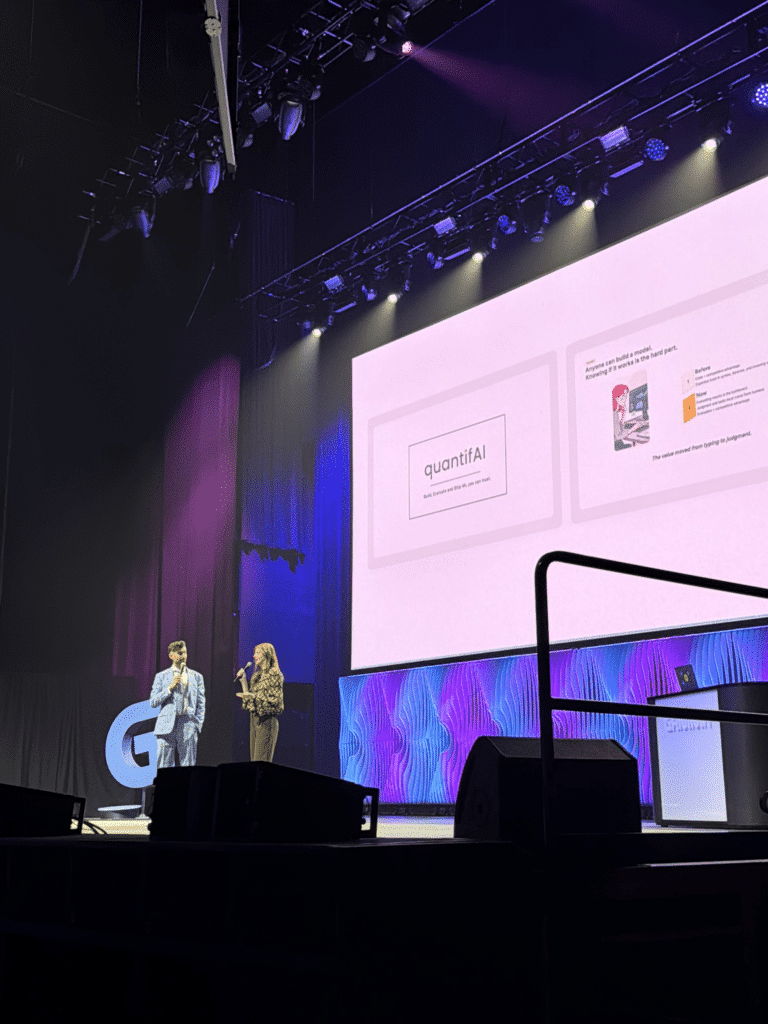
Photo: Mariana Antaya at the New York Tech Week
Credits: Patrick Zielinski
The business has attracted attention well beyond her follower base. During New York Tech Week this month, quantifAI won the “Gamma Pitch Competition,” the largest pitch competition at the event. The company has since surpassed 350 users. Everyone arrived through organic distribution.
“Everything came from my distribution channel,” she says. “Just sharing about my story and building in public.”
For investors watching the Creator Economy, that audience-to-product pipeline is increasingly what commands attention. “It’s really fascinating and interesting to see how investors, especially, are really tuning in,” she says, “and seeing how incredible creators can build their own businesses and platforms because distribution is so valuable now.”
What Brands Are Getting Wrong About Technically Credible Audiences
Mariana has built long-term partnerships with NVIDIA, Anthropic, LinkedIn, Meta, and IBM. Her criteria for saying yes are direct: she has to use the product herself, believe it serves her audience, and see genuine alignment between the product and her content.
What she pushes back against is the industry’s default approach to measuring those partnerships. Brands in the AI space, she argues, are optimizing for the wrong variables. “Seeing engagement in a one-off video is not going to hit the same or land the same as a multi-month contract or partnership where it seems much more organic,” she says.

Photo: Mariana Antaya at the New York Tech Week
Credits: Patrick Zielinski
The distinction is about narrative continuity. An audience watching a creator use a product once registers a transaction. An audience watching that same creator return to a product over months develops something more durable. “There’s more of a storyline there,” she says. “Their whole brand is now associated with this new product.”
“The fact that I get to say that I’ve worked for years with Anthropic and NVIDIA is incredible for me,” she says, “and it creates trust because I’ve worked with them for a long-term thing that my community expects me to create organic content about.”
Educational creators, she contends, are becoming the primary channel through which B2B brands reach the decision-makers actually making purchasing calls. “At the end of the day, a lot of the decision makers at those big companies are also watching social media,” she says. “If you’re not actually integrating the product in a way that somebody can really learn from it or spark creativity or an idea and see it in their lives, helping them,” she adds, “it’s a lot harder to sell.”
The Creator Economy She Expects to See in Five Years
Mariana was selected for Cannes Lions through Billion Dollar Boy’s competitive creator fellowship, a multi-stage process involving essays and a video interview. She arrived with planned surprises in her content calendar and a clear sense of what she wants to teach.
“A lot of these new AI tools have now democratized the fact that you can build agents and build workflows that seem intimidating but are actually quite easy if you have the correct prompts and put the correct guardrails in place,” she says. “I’m excited to meet people and hear what they’re doing, but I’m equally as excited to go out and teach people as well.”
Her presence at Cannes, alongside other B2B and professional creators, reflects a shift in how brands with institutional audiences are approaching the festival and the deals made there.
Looking further out, she expects the Creator Economy to fracture and reassemble around new forms. AI-generated content will multiply. Regulatory pressure will follow. And creators who have spent years building genuine technical credibility with specific audiences will hold a position that is difficult to replicate or automate.
“I think it’s going to be really exciting and create a lot of new forms of content,” she says, “and new ways that creators can actually connect with their audience and their communities.”
Cover photo credits: Iva Mrsic Creative Studio
Subscribe to Our Newsletter
Check Out Our Podcast