






Technology
Jukin Licensing Launches AI Integration For Enhanced UGC Content

Founded in 2010 in Los Angeles, Jukin Licensing sources user-generated content (UGC) primarily from platforms such as YouTube and other social media channels. The company’s core model revolves around identifying valuable UGC, securing rights from creators, and making this content available for commercial licensing to advertisers, brands, agencies, and media companies.
“We’re a sourcing platform, not a submission platform. We’re curating the content, finding what works for advertisers, and clearing the rights with creators,” says Sascha Weis, Head of Global Licensing and General Manager of Jukin Licensing, who joined the company a year ago after leadership roles at Getty Images, Shutterstock, Bill Gates-owned Corbis, and other content licensing companies.
Acquired three years ago by Trusted Media Brands (TMB), Jukin ensures every video in its library comes with copyright clearance and, when applicable, talent releases for individuals appearing in the footage. This approach ensures brands can confidently use the content in commercial campaigns without legal concerns.
Unlike royalty-free stock libraries, Jukin operates on a rights-managed business model. This approach enables Jukin to fairly compensate creators through revenue sharing, a model that has generated over $45 million for creators since the company’s inception. “They get a revenue share on every license that we give out,” Sascha says. “And that’s why they’re all excited about where we’re going, because we’re a growing business.”
Under the TMB umbrella, Jukin has maintained its focus on content while also powering branded channels, including “FailArmy,” “The Pet Collective,” and “People Are Awesome,” across various social media platforms.
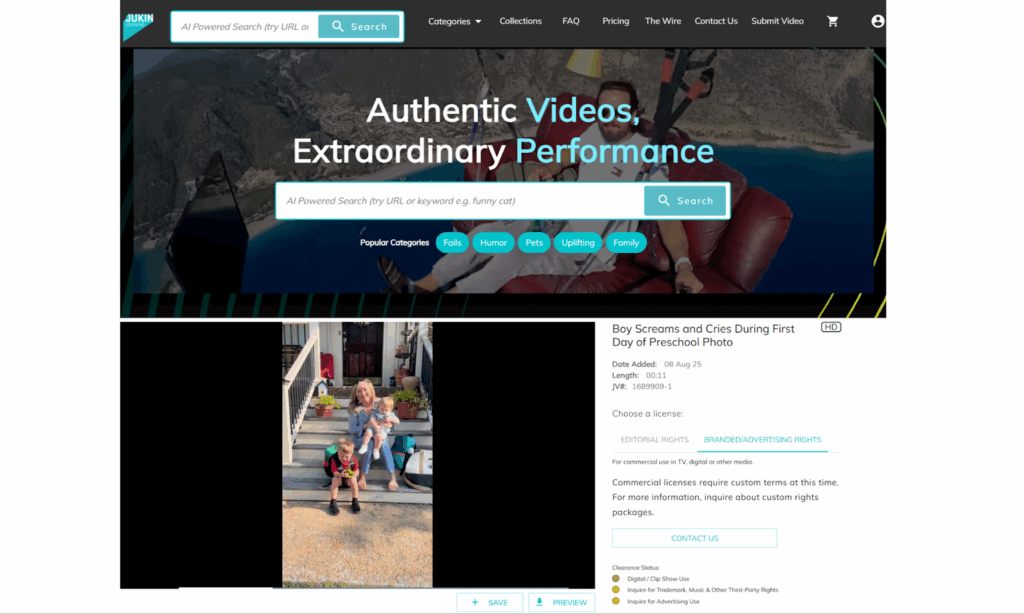
In August, Jukin Licensing launched a new AI-powered integration that transforms how brands find and license UGC, with technology that automates content acquisition, generates detailed metadata, and enhances search functionality for its library of nearly 300,000 rights-cleared videos.
Why AI for UGC Now?
The timing of Jukin’s AI integration coincides with a shift in how brands approach content marketing. The rise of influencer marketing has brought UGC into the mainstream advertising world, creating new opportunities for genuine storytelling. “Before, this was not part of an advertising campaign. Now our UGC content is part of a T-Mobile Super Bowl ad.”
This increased demand for genuine content comes as AI-generated imagery affects traditional stock content providers. While companies like Shutterstock and Getty Images face challenges from AI image generators, Jukin sees an opportunity to highlight the irreplaceable value of human experiences.
“Our consumers don’t want to see user-generated content created by AI,” Sascha notes. “That’s counterintuitive.”
For brands and agencies, finding and clearing rights for genuine UGC has remained a persistent challenge. As Sascha notes, many creative professionals, especially those new to the field, underestimate the importance of proper clearance.
“Creative people, especially art directors who come from college and enter an advertising agency, get a brief on what to find, search for it, and don’t even check the rights,” Sascha says, adding that this knowledge gap creates a clear market need for Jukin’s integrated approach to content discovery and rights management.
How the AI Integration Works
Jukin’s platform uses a practical combination of AI technologies to transform its content operations across three key areas: acquisition, analysis, and discovery.
For content acquisition, the system employs existing tools from Google and other technology providers to identify and ingest content at scale. This technological approach speeds up the pace at which new content enters the library. “With human power to catalog your content, it takes months and months. With AI, it takes days and weeks,” Sascha explains.
Once acquired, each video undergoes AI analysis to generate metadata. The system uses speech-to-text technology to transcribe spoken content, video detection to analyze the nature of the footage, object detection to identify people, animals, and objects, and brand safety detection to flag potential concerns, such as nudity, alcohol, or profanity.
“We use all of these things to index the content the right way so that we can bring the right content to our experience or our users’ experience on the website,” Sascha says.
The user-facing aspect of the platform features an AI-powered search that not only returns exact matches, but also suggests related content users might not have explicitly requested. “When you type in your search terms, you will see certain results that are suggestions from our AI based on algorithms that surface this content,” Sascha explains. “It enriches your search experience and gives you more search results and more relevant search results.”
Previously, users had to contact Jukin’s team after finding content to request master copies. “This becomes a white-glove service where you’re saying, ‘Hey, I have this project, I need to present this to my client. Can you send me a video like this?’ And it becomes a longer process,” Sascha says.
The new system eliminates this friction: “At this point, our website, if you’re logged in, you have download access automatically to master copies. Not only is your search experience much easier, you can just download the content, and then you go and work with it, and then you come back to us once this is all fully done.”
The Merging of UGC and Influencer Marketing
Sascha foresees a change in how the industry approaches content. According to him, the traditional separation between licensing existing UGC and commissioning new content from influencers is beginning to blur.
“Right now, I think there’s a path to say, ‘I’m going to license this content from Jukin,’ which is an existing piece of content. And if you want the creator to create something with a brand in the video, you might go to an influencer agency today,” Sascha explains. “I think in a couple of years from now, this will be blended.”
This merging is already emerging in client requests. “We are already seeing more advertisers coming to us saying, ‘I saw this video, I want this creator doing this with our product in the video. Can we redo the video?'” Sascha says. This trend positions Jukin to expand beyond pure licensing into facilitating relationships between brands and creators, a service they’re actively developing.
“That puts us closer to the creator economy because it also helps us to go to a creator and say, ‘Hey, our advertiser saw this video from you, they love this video, but we want to do this again with you so that there’s branded content,'” Sascha explains.
Beyond this merging with influencer marketing, Jukin is pursuing global expansion. “We’re not only focused on the U.S. market, but we’re expanding into EMEA [Europe, the Middle East, and Africa] and Asia Pacific with our approach,” Sascha says.
Responsible AI Usage
Throughout Jukin’s technological development, Sascha emphasizes a consistent philosophy about the role of AI in the content ecosystem. Rather than replacing human creativity, he believes AI should enhance workflows and distribution while preserving the value of real human experiences.
“We’re using AI everywhere in our system when it comes to acquiring content, accelerating our workflows, indexing content, producing metadata around it,” Sascha says. “And that applies to us as much as it applies to every creator. Use AI to finalize your content, add metadata, optimize it, and utilize AI platforms for this purpose. But stay real with your creation of the content.”
While AI tools can help optimize and distribute content, the core appeal lies in the genuine human experiences captured in Jukin’s videos.
“AI creation is happening, there’s no question about it,” Sascha acknowledges, “but it is really more about the background of a video; the sunset that can be created in a different way, the coloring that can be adjusted. The story and the main content of user-generated content is so much down to real moments from real people.”
As Jukin continues to improve and expand, this commitment to genuine human connection remains at the heart of their value proposition.
“The story and the main content of user-generated content,” Sascha concludes, “is so much down to real moments from real people. And you can see it everywhere when you talk to advertisers, how important real storytelling is to them.”
Checkout Our Latest Podcast