





Technology
Inside HypeAgent: How HypeAuditor Is Turning Influencer Data Into A Conversational AI Co-Worker


Influencer marketing has no shortage of data, dashboards, or discovery tools. What it still lacks, according to Alexander Frolov, is understanding.
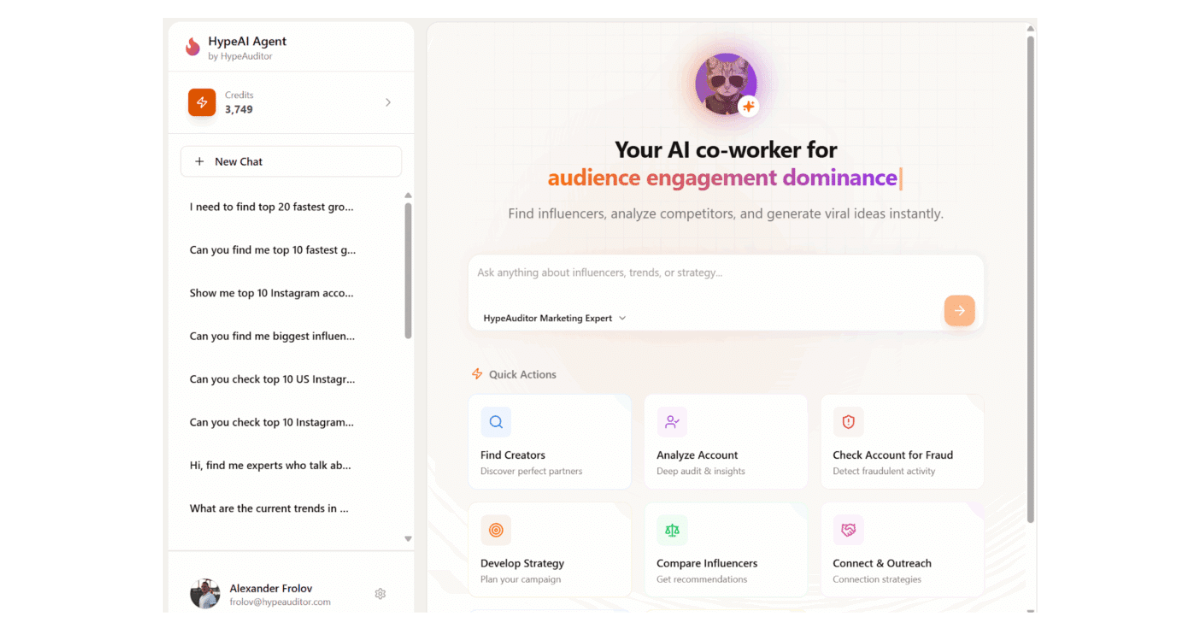
Alexander, CEO and co-founder of influencer marketing analytics firm HypeAuditor, is betting that the next phase of the industry will be shaped less by new metrics and more by how marketers interact with them. That belief has led to the launch of HypeAgent, a standalone AI product designed to function as a conversational co-worker for social media and influencer marketing teams.
Built around HypeAuditor’s proprietary dataset and fraud-detection infrastructure, HypeAgent lets users ask natural-language questions and receive immediate, data-backed responses that would typically require an analyst or strategist.
“We feel there is a big real gap between the tool and how to use the tool to be successful,” Alexander says. “People want better ROI (Return on Investment), but they do not always understand where they are losing money or what actually needs to change.”
Founded in 2017, HypeAuditor has grown into a full-stack influencer marketing platform used by brands and agencies to discover creators, detect fraud, analyze audiences, and manage campaigns at scale. With HypeAgent, Alexander and his team are extending that infrastructure beyond dashboards, aiming to make advanced influencer intelligence accessible to anyone, whether they run global programs or manage social media alone.

Alexander Frolov
Why HypeAgent Exists
Despite HypeAuditor’s breadth, Alexander saw a persistent issue: even advanced tools fail when users do not know how to ask the right questions.
“Market analysis can do very complicated things, but very few companies use it because it is complicated,” he says. “You need to understand what you want and how to use the tools.”
HypeAgent was created to bridge that gap.
Instead of navigating dashboards and filters, users interact with HypeAgent through natural language, asking questions such as which influencers are growing fastest in a niche, whether a specific account is legitimate, how competitors structure campaigns, or which content formats are currently driving growth.
“We see this conversational agent as a way to talk with a human,” Alexander says. “It helps cover the bridge between data and decision-making.”
Unlike embedded AI features within existing platforms, HypeAgent is a standalone product that runs entirely on HypeAuditor’s data. “You can go to the chat, have it on your phone, and do everything inside it,” he says. “Find influencers, analyze accounts, see reports, without additional interfaces.”

A Co-Worker, Not a Feature
Alexander is careful to position HypeAgent as more than an automation layer.
“We want it to feel like you hired a co-worker,” he says. “Someone who understands influencer marketing and has access to the data.”
That distinction also shapes its intended audience. While HypeAuditor primarily serves agencies and brands running large-scale campaigns, HypeAgent targets a broader market, including solo social media managers, consultants, and small teams.
“We want to empower even a one-person team to do an extremely good job,” Alexander says. “Not only the top companies with large budgets, but a much broader number of businesses.” The product’s pricing reflects that goal, with entry-level plans starting at just under $30 per month.

Early Learnings From Beta
HypeAgent is currently in beta, and Alexander says the focus is less on growth than on learning.
“We are trying to understand all the variations of use cases,” he explains. “Basic cases already work, but when a new case appears, sometimes the AI struggles.”
One recurring challenge has been education. Users often arrive with expectations that do not align with how influencer ecosystems actually function. “People want 80% or 90% of an influencer’s audience in one country,” Alexander says. “But for large English-speaking influencers, that almost never exists.”
In those moments, HypeAgent’s role is not just to retrieve data, but to explain why certain expectations are unrealistic. “We need to educate brilliantly,” he says. “Some results people want just do not exist in the real world.”
Market Positioning
As more influencer platforms introduce AI assistants, differentiation has become a central question. Alexander sees HypeAgent’s scope, as well as independence, as its defining advantage.
“Many AI tools inside platforms are focused on one thing, like matching influencers to a brief,” he says. “HypeAgent is much broader.”
The product is designed to handle strategy discussions, content analysis, competitive insights, trend identification, and campaign planning without requiring users to operate within a traditional platform interface. “Every part of the experience can happen inside the chat,” Alexander says. “You basically do not need anything else.”
Defining Success
For Alexander, success in HypeAgent’s first year will not be measured solely by adoption numbers.
“I want to see social media managers who are not influencer marketers come in,” he says. “That was intentional when we built the product.”
Retention matters even more.
“I want people to feel like they miss something if they do not have it,” Alexander says. “Like ChatGPT is always on your phone. The value should be so much bigger than the money they pay that it becomes their advisor for their whole career.”

Photo: HypeAuditor team
What the Industry Needs to Leave Behind
As the creator economy heads into 2026, Alexander believes one misconception continues to hold the industry back.
“I want us to leave behind the perception of comparing influencer marketing to paid channels like Google Ads,” he says. “It is such a misconception.”
Influencer marketing, he argues, requires fundamentally different measurement frameworks and time horizons. “You cannot just say, ‘I put tracking here, I want my money back,’” he says. “That is not how this works.”
According to Alexander, the brands that succeed invest in long-term creator relationships rather than one-off transactions. “They select the best influencers, build long-term contracts, and base decisions on performance,” he says. “Many others do one-time shots and then wonder two years later why it did not work.”
Ultimately, Alexander sees HypeAgent as part of a larger effort to professionalize influencer marketing and make its complexity more accessible.
“There are so many things that are obvious to us after years in this business, but not obvious at all to a broader audience,” he says. “If we can cover these gaps, we can really level up the market.”
As Alexander concludes, “I really wish both for us and for our clients to level up and understand the whole picture of the game and try to build long-term success instead of short-term results.”
Image credits: HypeAuditor
Checkout Our Latest Podcast