






Tech
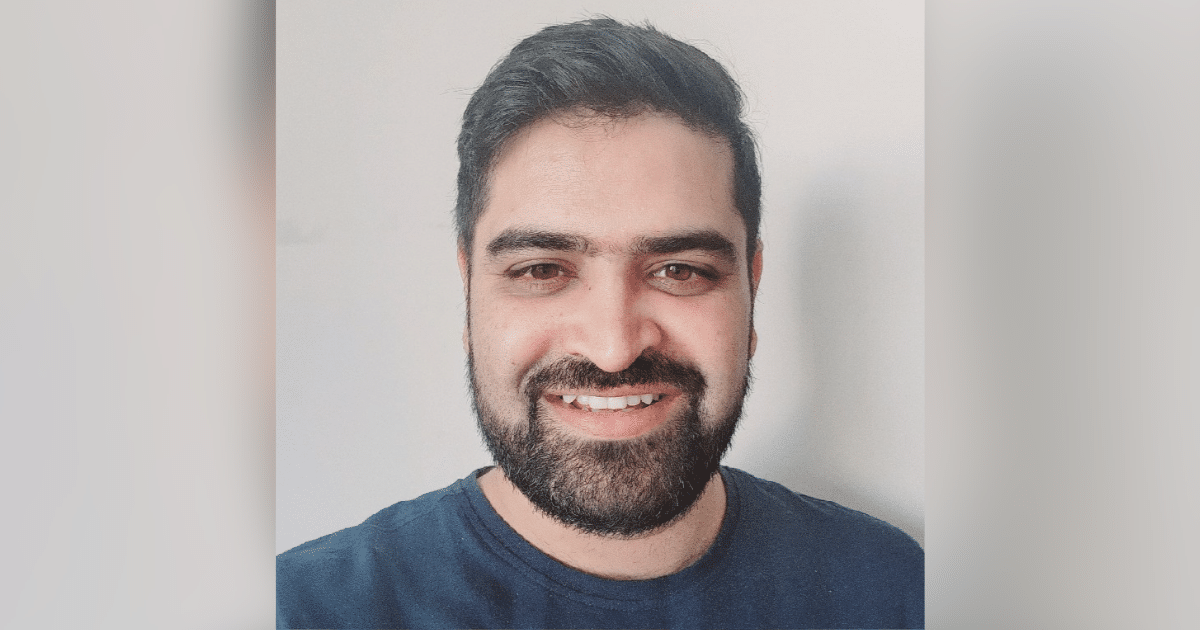
Flinque’s Ashish Gupta Says Influencer Marketing Isn’t Broken. The Way Brands Measure It Is

When Ashish Gupta ran influencer campaigns for a SaaS client, a YouTube creator with more than three million subscribers generated thousands of leads per month. The campaigns closed one sale. The audience, it turned out, was composed of regular viewers, not the IT managers and system administrators who actually purchase enterprise software.
That experience, compounded across multiple clients and roughly $20,000 in spend, became the founding argument for Flinque. Ashish and co-founder Abhishek Bakshi launched the platform in November 2025 out of India, targeting small and medium businesses that can’t afford enterprise discovery tools or the in-house expertise to vet creators manually. Flinque covers more than ten million verified creators across Instagram, TikTok, YouTube, and X, with audience-quality data spanning more than 25 countries, according to the company.
“The influencers we chose to work with were not the right fit because their followers, their engagement, and their content were mostly vanity metrics,” Ashish says.
Ashish has spent 17 years in performance-driven marketing, helping B2B SaaS and technology companies including FileCloud, Heepsy, LeadsBridge, Designlab, Aakash Education, and others before co-founding Flinque. That background is responsible for how he diagnoses the Influencer Marketing problem and what he built to address it.
Fake Followers Are the Costliest Problem Brands Aren’t Solving
Ashish identifies fake followers as the single largest financial risk in Influencer Marketing, and argues the problem is expanding. The supply side is cheap: manufactured followers and engagement can be purchased for under $100 from vendors in multiple markets. Platforms have introduced detection tools, but the financial incentive to inflate audiences remains strong.

The demand side has been slower to adapt. “A lot of big technology companies would just blindly trust the following of a particular influencer,” Ashish says. He describes brands reviewing creator specs on a spreadsheet, routing the list to leadership for approval, and beginning campaigns without verifying whether the audience behind the follower count is genuine or purchase-capable.
Flinque’s approach combines engagement rate, audience growth history, follower quality, and comment patterns into a creator quality score, giving marketers a composite signal rather than a binary real-or-fake verdict. A feature under development will surface estimated fake follower percentages at the list level, so brands scanning multiple profiles don’t have to open each account individually.
“We are giving brands an opportunity to look at the bulk of influencers, and there would be a screen which says, ‘20% fake followers’ or ‘30% fake followers,’” Ashish explains.
Discovery Built for Audience Quality, Not Reach
Flinque’s core search covers 12 filters across creator and audience data: category, follower range, location, engagement patterns, and audience demographics, among others. Users can compare profiles, build shortlists with a single click, and move directly to outreach through an email module inside the platform. Campaign briefs can also be broadcast to Flinque-registered creators, who apply through their own logins.
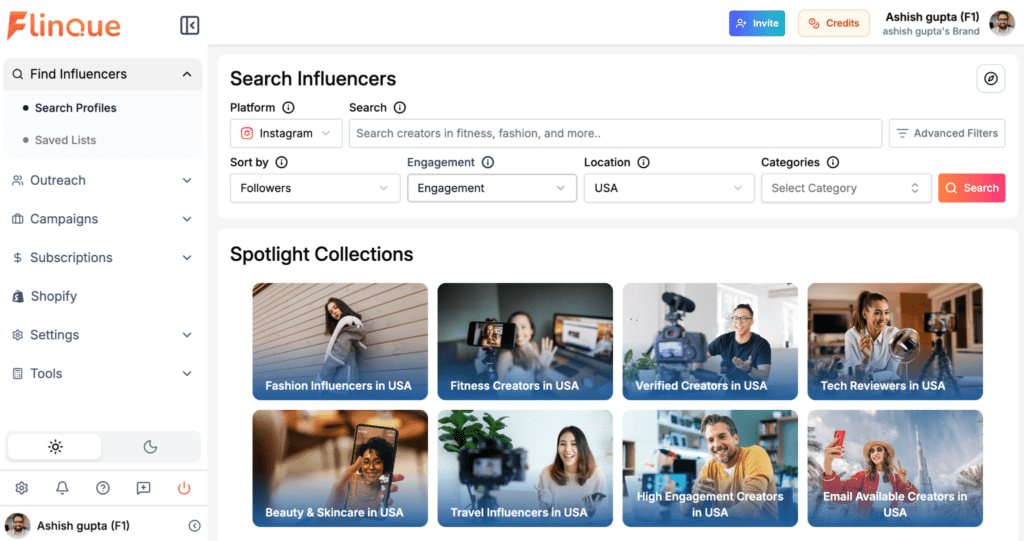
An incoming redesign of the onboarding experience adds a questionnaire that guides brands through defining campaign goals, setting budgets, and estimating expected ROI before they begin searching for creators. The output is directional rather than guaranteed. “The questions are mostly about building a media plan on a generic basis,” Ashish says. “What are the goals of your Influencer Marketing campaigns? Have you run campaigns before? What was your experience?”
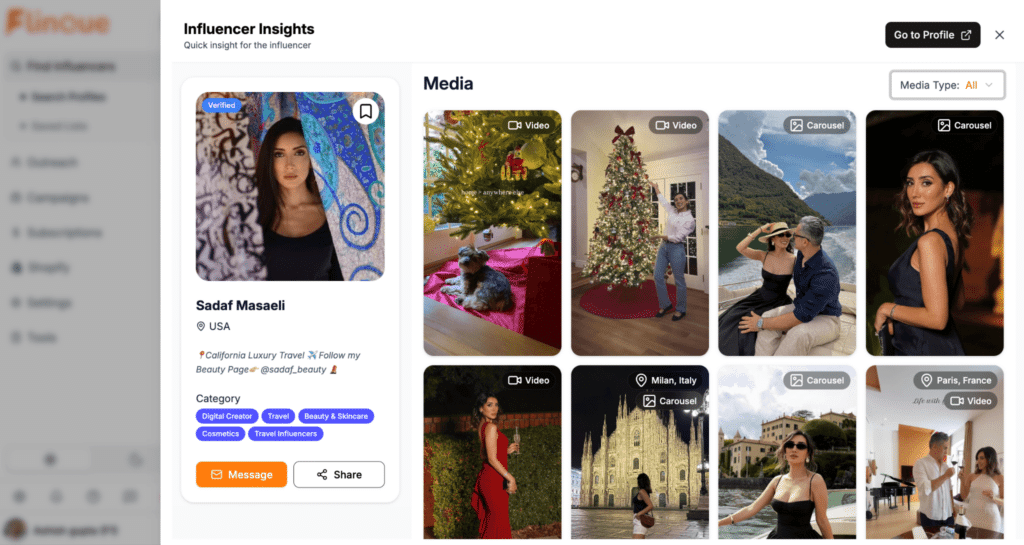
Image: Flinque’s Influencer Insights
Ashish believes that no Influencer Marketing platform has fully solved the discovery problem. Identifying the right creators requires evaluating a combination of signals, including audience authenticity, fake follower detection, engagement quality, audience demographics, growth patterns, and content relevance, rather than relying on a single metric. “There’s still a lot of work to be done across the industry, and we’re continuously improving Flinque to bring more of those signals together into a smarter discovery experience.”
He identifies AI-assisted prompting as the next development priority, allowing brands to describe a creator type in plain language and receive relevant matches.
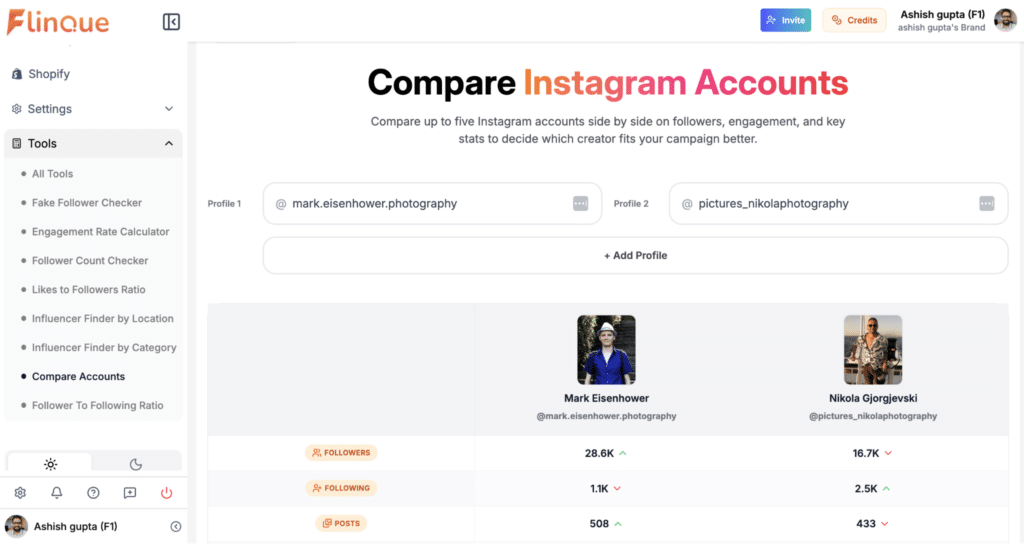
The Missing Benchmarks Behind Influencer Pricing
One of Influencer Marketing’s least-examined problems, in Ashish’s view, is the absence of pricing benchmarks comparable to those available in paid search. He points out that advertisers running Google campaigns can reference published cost-per-click data segmented by industry and market. No equivalent standard exists for creator partnerships.
“There’s no hard and fast rule or industry benchmarks where you can refer to as a guide,” Ashish says. The ranges that do circulate (for example: a creator with 500,000 followers might charge $5,000 to $10,000 per post) are too wide to serve as reliable guides. What a brand pays and what it gets depends on audience quality, niche alignment, and whether the creator’s followers have purchase intent, none of which follower count captures.
Ashish’s prescription for brands approaching pricing without historical benchmarks: audit engagement before negotiating, read the actual comments a creator receives to assess whether the audience is purchase-capable, and verify that the creator’s follower demographics match the brand’s customer profile.
For B2B SaaS, that check is often skipped. “We are working with brands whose audiences are IT managers or IT heads or system administrators,” he says. “These people don’t buy just by looking at a LinkedIn post or an Instagram post.”
Influencer Marketing Fails When It Runs in a Silo
Beyond discovery and vetting, Ashish argues that Influencer Marketing underperforms at most companies because it operates separately from paid advertising, with separate teams, separate budgets, and no shared attribution model.
“Influencer Marketing will lift your brand and give you a lot of impressions, but you can’t expect it to drive conversions unless you are reaching these users to come back another day,” he says. The model he advocates treats influencer campaigns as the top of a funnel: measure the brand lift and audience reach they generate, then retarget those exposed users through paid social, display, or higher-intent platforms.
Ashish singles out Reddit as an underused retargeting surface for B2B brands, noting that organic community-building on the platform drives conversion rates of around 40%, compared to 4 to 6% on Google Ads. “If you’re willing to put somebody who can go back and reach those audiences, or even an automation that can do those things, that’s the real game,” he says.
In his view, brands running influencer campaigns while neglecting email nurturing, retargeting flows, or cross-channel attribution are setting the channel up to fail. “You cannot expect Influencer Marketing to be a success if you’re not exploring these mediums collectively,” he says.
A Business Built to Stay Lean
Ashish and Bakshi are not positioning Flinque for a near-term exit or an investor round. The target Ashish describes is a thousand active brand subscriptions at the current price point, a sustainable business that competes on value rather than scale.
“We are marketers who are turning into product builders,” he says. “We are just happy with each subscriber that comes in, and we are really disappointed if somebody leaves us.” That philosophy extends to Flinque’s pricing structure: subscribers who join at $49 per month will hold that rate even if prices increase for new customers.
The industry Flinque is targeting is large enough to support a narrowly focused product, Ashish argues. Whether Flinque can capture enough of that market while staying lean enough to avoid the pricing model of the enterprise tools it competes against is the test ahead. “I’m not saying that if you’re using Flinque end to end, you are going to solve all your Influencer Marketing problems,” he says. “But using Flinque, if you are able to shortlist some of the best influencers for your niche, that’s the starting point.”
Subscribe to Our Newsletter
Check Out Our Podcast




