






Strategy
Behind the Creator Campaign: Dr Pepper’s 65M-View Campaign Started With a Fan’s TikTok

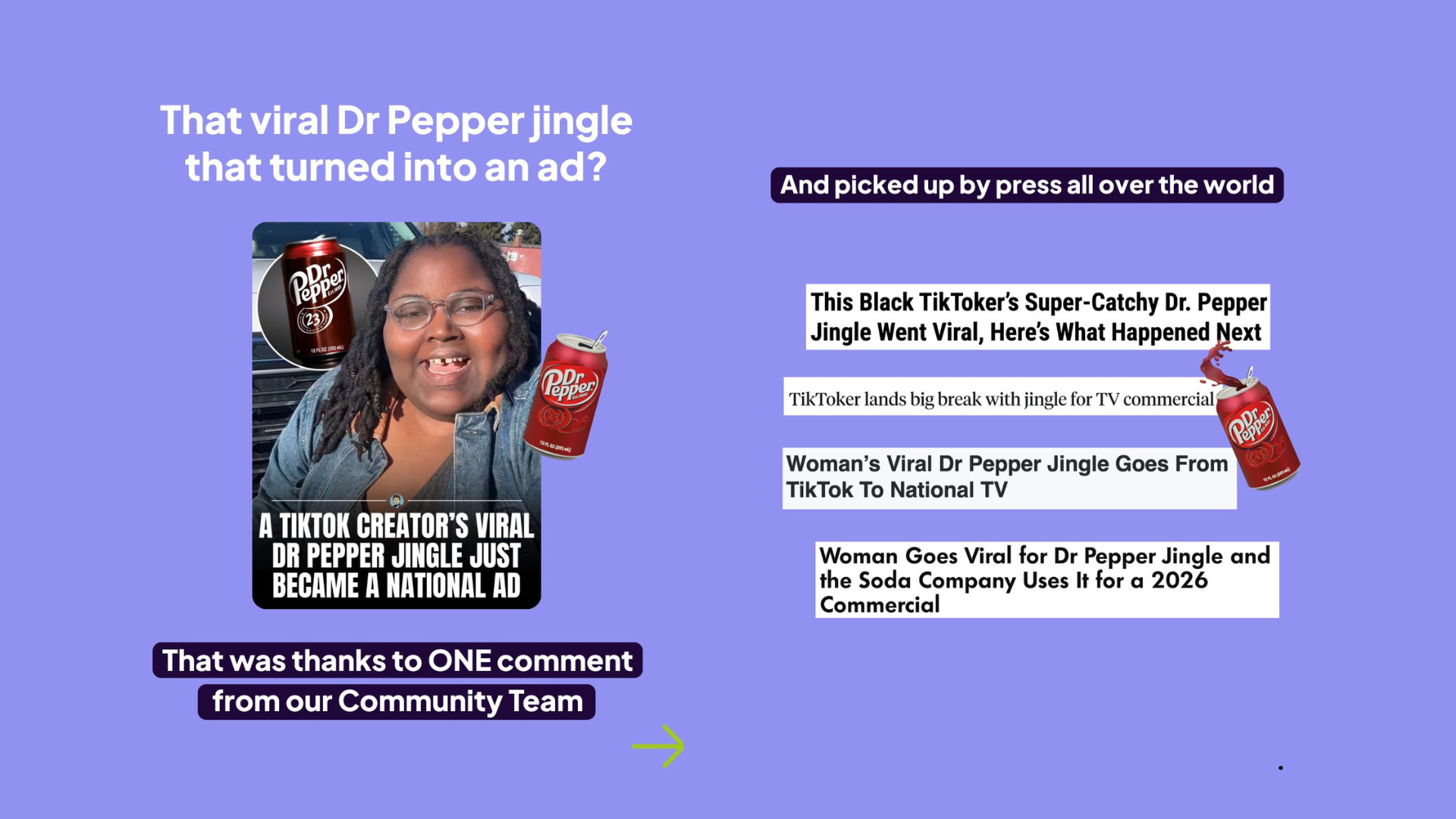
In late December 2025, content creator Romeo Bingham (@romeosshow) posted a short TikTok jingle about Dr Pepper. The clip was unsponsored. No one at Keurig Dr Pepper had seen it coming. Within 24 hours, Social Element, a MarketFully company and Dr Pepper’s social media agency, had commented on the video. Within weeks, the jingle had been licensed and aired during the College Football Playoff National Championship.
“It was great ‘listening’ and then exercise of ‘insights to action,’” says Lindsay Burstein, Senior Director of Integrated Social and Communications at Keurig Dr Pepper. “It’s not a question of do we take action, but what kind of action do we take?”
Lindsay leads the integrated social and communications function across the Keurig Dr Pepper portfolio, a team spanning organic content, community management, brand PR, social intelligence, and creator/influencer activation. Together with Victoria Hoyle, Global Head of Social Intelligence at Social Element, Deutsch LA, and Publicis, she navigated the Romeo activation upon initial discovery to television in a matter of weeks, without changing a word of the original jingle.
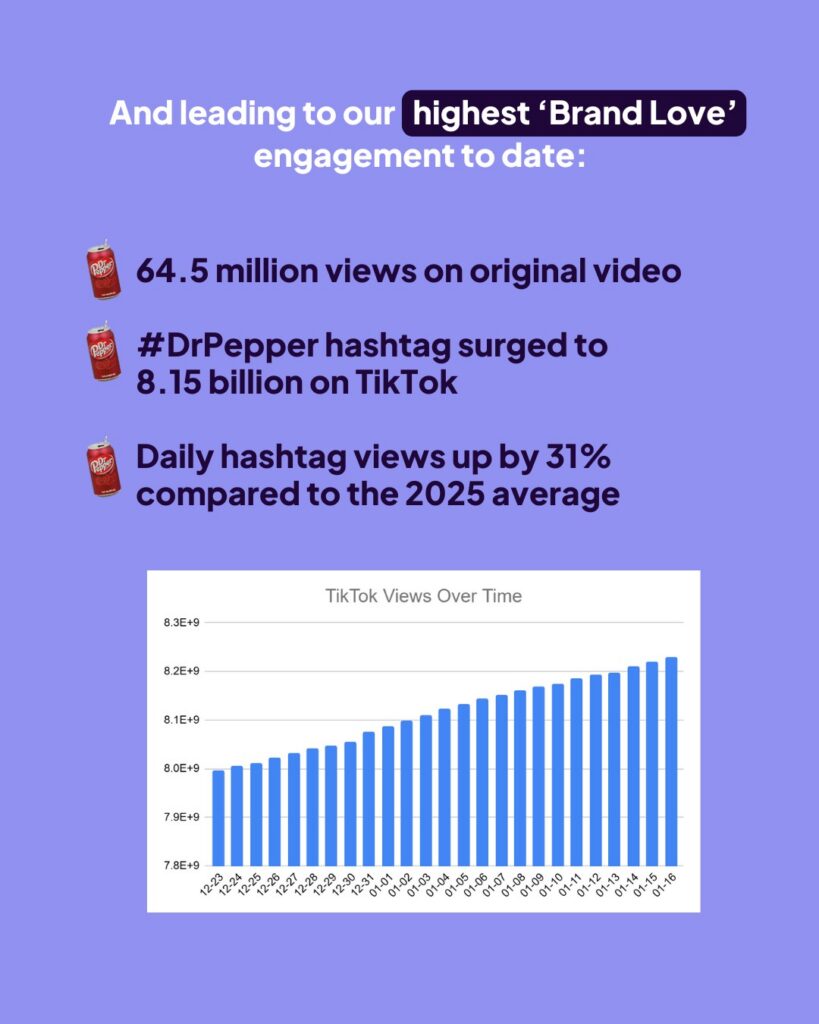
According to Dr Pepper data, the campaign has accumulated more than 65 million views and 7 million likes on the original content alone. Romeo went from roughly 300,000 followers to over one million. Dr Pepper recorded a sales spike. The story of how it happened is less about luck and more about infrastructure.
Living in the Comments
The Romeo clip did not surface through a campaign brief or a creator outreach list. It emerged the way most genuine cultural moments do: from someone paying close attention.
That someone was Social Element, and the attention was structural. The agency operates what Victoria describes as a cyclical process: identifying and acting on what is working in a brand’s comment section. The team monitors mentions not just for volume, but for tone, community traction, and brand proximity. Technology enables that monitoring at scale, but the judgment call, knowing when something is brand-relevant rather than simply popular, stays human.

“We’re looking for real conversations and signs that people care about what’s being shared,” Victoria explains. “Understanding not just what they say, but how they say it.”
The day after Romeo’s post, Social Element had already commented. Two signals drove the decision: early traction in the video’s comments and the presence of other brands beginning to engage.
“That’s how we knew,” Victoria says. “This is something interesting and something we should definitely be jumping onto as well.”
From Signal to Decision
Once the comment was live and traction was building, escalation inside Keurig Dr Pepper was fast. Lindsay describes it as a conversation that flowed naturally because the signal was clear and the brand had the right principles in place to receive it.
Keurig Dr Pepper operates with what Lindsay calls “creator principles,” a set of internal guidelines governing how the brand engages with organic co-creation. Dr Pepper looks for authentic, one-of-a-kind experiences that generate the kind of conversation the brand actively cultivates.
“We’re big on ‘moment making,'” Lindsay says. “And the ‘moment making’ that we do is bespoke to each situation.”
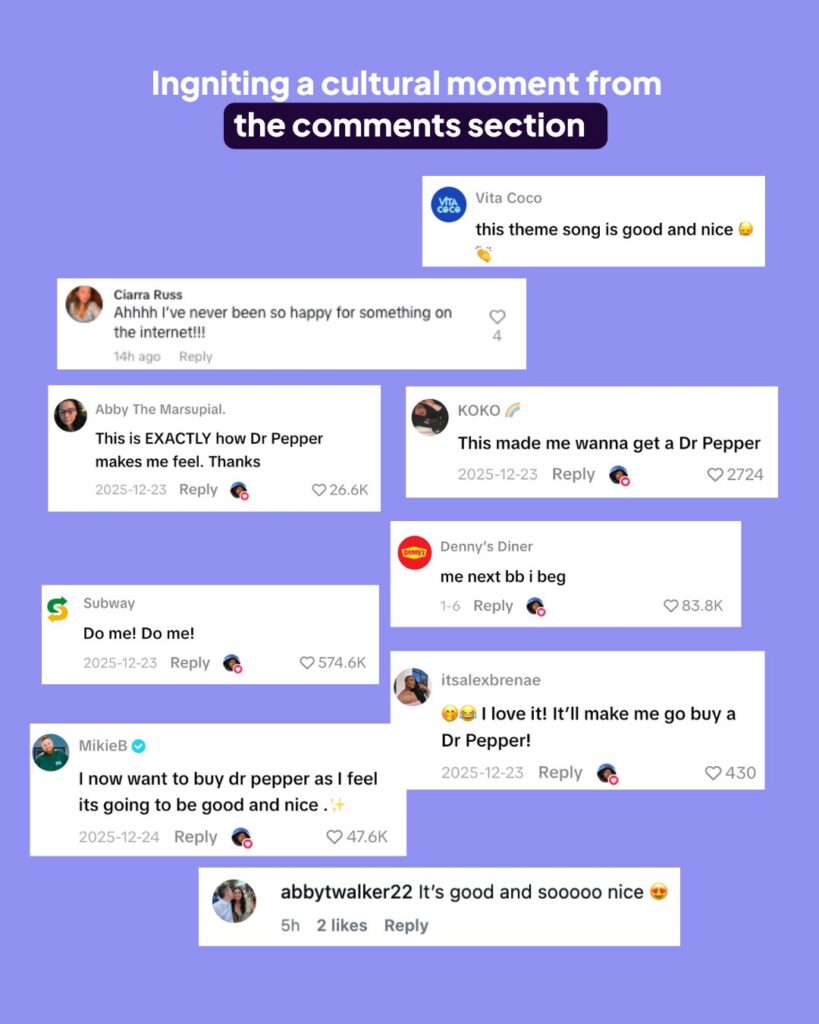
The conversations with Romeo’s team began via direct message, then moved to a call after the New Year. Lindsay shares that the discussions were generative rather than transactional. “The conversations were really around what we can do together,” she recalls. “What would make the most sense to keep the moment authentic to Romeo and also about the product?”
The Original Stays Original
The most consequential decision in the campaign was not the TV placement. It was what the brand chose not to change.
When Dr Pepper decided to air the jingle during the College Football Playoff National Championship, the team kept Romeo’s original audio intact.
Lindsay reveals that the decision was deliberate. “The jingle was really special,” she says. “We wanted to keep the authenticity and the realness of what Romeo originally created.”
The brand had also been watching social commentary. Audiences were already vocal about the moment, some calling on Dr Pepper to move faster. That pressure sharpened the case for doing it right over doing it quickly. “We feel good that while it may have moved more slowly in the eyes of the Internet, we did it right for Romeo and Dr Pepper,” Lindsay says.
Victoria describes the result as a marriage of art and science. “Someone who lives in the comment section day to day, understands the brand tone of voice, the moments that matter, and that strategic tracking and data intelligence piece. That’s what came to life here and was then translated into that TV campaign,” she says.
Moving at the Speed of Culture
Taking a social-native piece of content and placing it in a national TV spot is not a standard workflow.
Lindsay frames the tension directly: “Navigating the speed of the Internet with the speed at which spots get made can always be a hurdle.”
She believes the campaign cleared that hurdle because both teams had built the infrastructure to move without losing time on internal alignment. Social Element’s monitoring and escalation process delivered the signal without delay. Lindsay’s team had clear principles that guided the decision. There were multiple agency partners involved, and all partners were aligned on preserving the moment rather than over-engineering it.
What the Numbers Said
Dr Pepper data shows that the campaign delivered across multiple measurement layers. On TikTok, the average number of videos posted about the beverage brand grew 14%, and overall views grew 31%, both measured against the daily 2025 average. A regional signal also emerged: brand talkability rose in markets associated with college football, consistent with the Championship placement.
The company also recorded a sales lift, though Lindsay notes specific figures require further tracking. Romeo’s own growth was significant, with over 700,000 followers.
“When we go into commenting on posts, we’re doing that with the goal of driving brand love,” Victoria says. “And the reason it landed so well is that it was close to the brand and centered around heroing a product.”
Victoria’s team also tracked the halo effect on Dr Pepper’s own channel. When audiences encounter a compelling brand comment on TikTok, they often return to the brand’s profile, scroll through videos, and generate additional engagement. That knock-on impact, she says, is part of what the team looks for alongside direct metrics and sales data.
Flexibility Within a Framework
The Romeo campaign has attracted industry attention as a model for creator-led, community-driven marketing. Both Lindsay and Victoria push back on reducing it to a replicable formula.
“The opportunity will never always look the same,” Victoria says. “It could be more relevant for certain brands on Instagram. Your creator could have 3,000 or 10,000 followers. Going viral can come from so many different spaces.”
What remains consistent, in their view, is the underlying infrastructure: a team permanently embedded in the comment section, technology enabling real-time signal identification, and a brand framework that allows action without every decision requiring senior sign-off.
Lindsay calls it “flexibility within a framework.” The brand’s principles are fixed. The execution adapts. “Having that framework in place to be able to take advantage of the moments when they hit,” she says, “whether it’s going to be a single or a mega hit, that stays the same.”
She also identifies the gap most brands haven’t yet closed: the transition from social listening to social intelligence. “It’s the intelligence within these communities. How we listen, how memes show up, videos, text, and what it looks like all together,” Lindsay says. “And translating those into action.”
The Next Comment Section
For Victoria, the practical implication for brands is incremental rather than transformational. “Focus on ‘what does good look like?’ Small steps in the right direction, understanding what links back to your brand and the moments you want to go after,” she says.
The monitoring apparatus, the escalation routes, and the creative principles all need to be in place before the moment arrives, not assembled in response to it.
Dr Pepper’s position is also, Lindsay notes, the product of years of investment in community management as a core function rather than a support role. “Dr Pepper was built based on these community management efforts,” she says. “We love to see it.”