The hottest pitch at Cannes Lions this year is not an AI demo. It is the microdrama: ultra-short vertical series, shot for the phone, that Hollywood studios and talent agencies have decided is the next great medium. Studios are spinning up vertical slates, agencies are signing creators to serialized shows, and everyone in the tent believes they are about to win the same bet. The last time this much Hollywood money chased short-form mobile video, the company was called Quibi. It raised $1.75 billion and lasted six months.
This time the format is working. ReelShort and DramaBox, the two apps that built it, have pulled hundreds of millions of dollars out of a model almost no one in Hollywood took seriously two years ago. A single microdrama typically costs $50,000 to $350,000, with AI-assisted productions running well below that and premium titles above it, all of it a rounding error against a prestige budget. A vertical thriller can premiere on TikTok and clear tens of millions of views in a week. The audience is already there, it is growing, and it is paying.
None of that means the studios win. The format succeeding and the studios profiting from it are two different things, and confusing them is exactly how this ends in tears. The boom fixed the half of Quibi’s failure everyone remembers, distribution. It left the other half untouched, and that half decides who captures the value.
Microdramas Fixed Quibi’s Distribution, Not Its Cost
Quibi failed for two separate reasons, and the industry remembers only one of them. The obvious failure was distribution. Quibi built a destination, a standalone subscription app, in a world where attention had already moved into feeds. It asked people to leave the feed, open a separate app on a schedule, and pay to watch clips they could not share. The quieter failure was cost. Quibi spent premium Hollywood money, six and seven figures per short episode, on the theory that production value was the moat.
The current microdrama boom fixed the distribution failure cleanly. Microdramas live inside the feed instead of asking the audience to leave it. The first episodes are free, engineered to travel, and spread by the audience that shares them, so discovery costs the maker almost nothing. Distribution was Quibi’s grave, and the microdrama climbed out of it.
The cost failure is a different story. Microdramas are cheaper to make than Quibi series by an order of magnitude, but lower production budgets do not touch the structural problem heading toward the studios. The issue was never the size of the check. It was who holds the leverage in the market the check gets spent in, and nothing about the microdrama format changes that.
The Studios Are Price-Takers by Design
The platforms commissioning microdramas are the same platforms distributing them, which means they control both the checkbook and the feed placement. A studio can negotiate the production fee. It cannot negotiate its way onto the front page. ReelShort and DramaBox decide which shows get promoted into the acquisition funnel and which ones sit in the catalog, and that decision determines whether a show earns back its budget or disappears. A show that does not get pushed into paid acquisition on TikTok and Meta does not exist. The studio delivers the content and hands over the keys.
ReelShort, DramaBox, and a handful of Chinese-owned competitors are the only platforms with the budgets and the user bases to make commissioning worthwhile at scale. Every Hollywood studio, every independent producer, and every agency spinning up a vertical slate is selling into the same five checkbooks. When the supply of sellers is fragmented and the demand is concentrated in a few buyers, the buyers set the terms. Commission rates compress, creative control goes to the platform, and the margin available to the studio shrinks toward whatever the platform decides to leave it. You can out-execute a cost problem. You cannot out-execute being the commodity.
For the people who actually make the shows, the boom is real money, for a while. A format starved for scripts and fast production is a hiring event, and for a year or two writers, directors, and producers get paid a premium because demand has outrun the supply of people who can deliver it.
Microdramas work because they are formulaic: betrayal, revenge, a cliffhanger every eighty seconds, the same beats a model can generate on demand. That formula is what converts a free viewer into a paying one, and it is also exactly what generative tools are built to produce. The platforms know this. Cheaper scripts are pure margin to them, so they have every incentive to move production toward AI as fast as the tools allow. The writers and producers flooding into the format are not competing against each other. They are competing against the economic interests of the only buyers in the market.
The Apps Win the Way Spotify Won
Spotify never made a single song. It made the place songs had to go, and once it owned the demand, everyone who supplied it, labels and artists included, became an interchangeable input competing for placement on a surface they did not control. The value settled at the aggregator, not the source. ReelShort and DramaBox are running the same play, adapted to the feed.
The model has one job, to own the transaction with the viewer, and it is built so the studio never gets near it. Free episodes seeded into TikTok and Meta pull the audience in. A paywall drops at a cliffhanger and converts the scroller into a payer. Then a coin economy meters the rest of the story out at twenty to fifty cents an episode, so a finished arc runs ten to thirty dollars, more for a long premium title, across dozens of taps that each feel like nothing. That per-user take is larger than any flat subscription clears on mobile, and it runs directly between the app and the viewer. The studio delivered the show. It does not hold the wallet, see the buyer, or set the price.
Owning the wallet is half of it. The other half is where the cost sits. The studios carry it in production, committed up front and lost if the show fails. The apps carry it in acquisition, committed against conversion they can measure and scaling with the revenue it produces. One cost is a bet placed before the result. The other is paid out of the result. Same boom, opposite risk, and the apps put themselves on the side that does not have to guess.
The one real threat to the apps is self-inflicted. If they finish the Spotify arc and converge on an all-you-can-watch flat-rate bundle to take share from each other, they trade away the per-episode pricing that funds the supply chain beneath them. It would still be a win for the aggregator, just a smaller one, and a worse one for everyone feeding it. The per-episode model is the only part actually worth defending, and the only thing that can break it, assuming consumers do not tire of it, is the apps competing it away.
Everyone else is betting on a prize they cannot measure. No one at Cannes can name how big the microdrama market gets, whether finished story can hold its own against a free feed that never runs out, or what a winning show is worth before it airs. The apps do not have to know. They hold the demand data, the direct wallet relationship, and a cost structure that lets them keep testing until the answer arrives. The studios hold none of it. They front the production, deliver the show, and find out what it was worth only after the platform has already priced it. They are not competing for the prize. They are paying to discover how big it is. And the room celebrating loudest at Cannes will have paid the most to find out.
Nii A. Ahene is the founder and managing director of Net Influencer, a website dedicated to offering insights into the influencer marketing industry. Together with its newsletter, Influencer Weekly, Net Influencer provides news, commentary, and analysis of the events shaping the creator and influencer marketing space. Through interviews with startups, influencers, brands, and platforms, Nii and his team explore how influencer marketing is being effectively used to benefit businesses and personal brands alike.


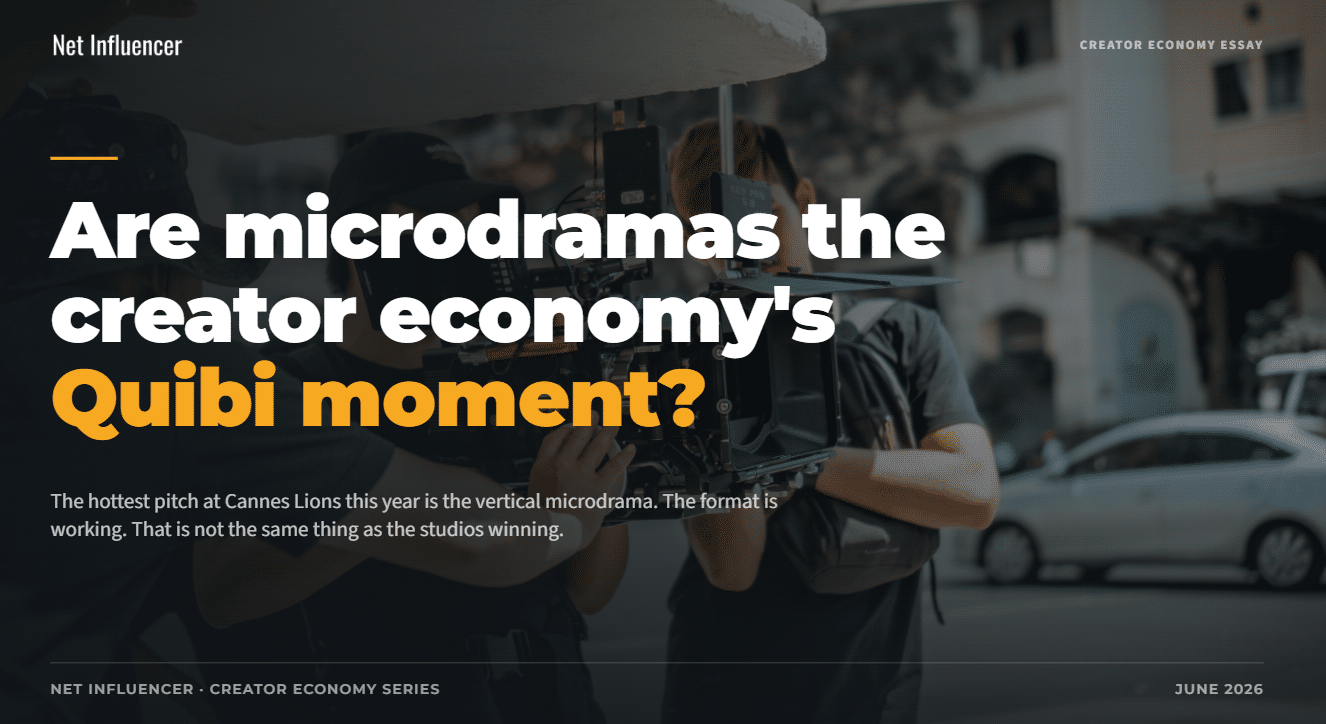







The hottest pitch at Cannes Lions this year is not an AI demo. It is the microdrama: ultra-short vertical series, shot for the phone, that Hollywood studios and talent agencies have decided is the next great medium. Studios are spinning up vertical slates, agencies are signing creators to serialized shows, and everyone in the tent believes they are about to win the same bet. The last time this much Hollywood money chased short-form mobile video, the company was called Quibi. It raised $1.75 billion and lasted six months.
This time the format is working. ReelShort and DramaBox, the two apps that built it, have pulled hundreds of millions of dollars out of a model almost no one in Hollywood took seriously two years ago. A single microdrama typically costs $50,000 to $350,000, with AI-assisted productions running well below that and premium titles above it, all of it a rounding error against a prestige budget. A vertical thriller can premiere on TikTok and clear tens of millions of views in a week. The audience is already there, it is growing, and it is paying.
None of that means the studios win. The format succeeding and the studios profiting from it are two different things, and confusing them is exactly how this ends in tears. The boom fixed the half of Quibi’s failure everyone remembers, distribution. It left the other half untouched, and that half decides who captures the value.
Microdramas Fixed Quibi’s Distribution, Not Its Cost
Quibi failed for two separate reasons, and the industry remembers only one of them. The obvious failure was distribution. Quibi built a destination, a standalone subscription app, in a world where attention had already moved into feeds. It asked people to leave the feed, open a separate app on a schedule, and pay to watch clips they could not share. The quieter failure was cost. Quibi spent premium Hollywood money, six and seven figures per short episode, on the theory that production value was the moat.
The current microdrama boom fixed the distribution failure cleanly. Microdramas live inside the feed instead of asking the audience to leave it. The first episodes are free, engineered to travel, and spread by the audience that shares them, so discovery costs the maker almost nothing. Distribution was Quibi’s grave, and the microdrama climbed out of it.
The cost failure is a different story. Microdramas are cheaper to make than Quibi series by an order of magnitude, but lower production budgets do not touch the structural problem heading toward the studios. The issue was never the size of the check. It was who holds the leverage in the market the check gets spent in, and nothing about the microdrama format changes that.
The Studios Are Price-Takers by Design
The platforms commissioning microdramas are the same platforms distributing them, which means they control both the checkbook and the feed placement. A studio can negotiate the production fee. It cannot negotiate its way onto the front page. ReelShort and DramaBox decide which shows get promoted into the acquisition funnel and which ones sit in the catalog, and that decision determines whether a show earns back its budget or disappears. A show that does not get pushed into paid acquisition on TikTok and Meta does not exist. The studio delivers the content and hands over the keys.
ReelShort, DramaBox, and a handful of Chinese-owned competitors are the only platforms with the budgets and the user bases to make commissioning worthwhile at scale. Every Hollywood studio, every independent producer, and every agency spinning up a vertical slate is selling into the same five checkbooks. When the supply of sellers is fragmented and the demand is concentrated in a few buyers, the buyers set the terms. Commission rates compress, creative control goes to the platform, and the margin available to the studio shrinks toward whatever the platform decides to leave it. You can out-execute a cost problem. You cannot out-execute being the commodity.
For the people who actually make the shows, the boom is real money, for a while. A format starved for scripts and fast production is a hiring event, and for a year or two writers, directors, and producers get paid a premium because demand has outrun the supply of people who can deliver it.
Microdramas work because they are formulaic: betrayal, revenge, a cliffhanger every eighty seconds, the same beats a model can generate on demand. That formula is what converts a free viewer into a paying one, and it is also exactly what generative tools are built to produce. The platforms know this. Cheaper scripts are pure margin to them, so they have every incentive to move production toward AI as fast as the tools allow. The writers and producers flooding into the format are not competing against each other. They are competing against the economic interests of the only buyers in the market.
The Apps Win the Way Spotify Won
Spotify never made a single song. It made the place songs had to go, and once it owned the demand, everyone who supplied it, labels and artists included, became an interchangeable input competing for placement on a surface they did not control. The value settled at the aggregator, not the source. ReelShort and DramaBox are running the same play, adapted to the feed.
The model has one job, to own the transaction with the viewer, and it is built so the studio never gets near it. Free episodes seeded into TikTok and Meta pull the audience in. A paywall drops at a cliffhanger and converts the scroller into a payer. Then a coin economy meters the rest of the story out at twenty to fifty cents an episode, so a finished arc runs ten to thirty dollars, more for a long premium title, across dozens of taps that each feel like nothing. That per-user take is larger than any flat subscription clears on mobile, and it runs directly between the app and the viewer. The studio delivered the show. It does not hold the wallet, see the buyer, or set the price.
Owning the wallet is half of it. The other half is where the cost sits. The studios carry it in production, committed up front and lost if the show fails. The apps carry it in acquisition, committed against conversion they can measure and scaling with the revenue it produces. One cost is a bet placed before the result. The other is paid out of the result. Same boom, opposite risk, and the apps put themselves on the side that does not have to guess.
The one real threat to the apps is self-inflicted. If they finish the Spotify arc and converge on an all-you-can-watch flat-rate bundle to take share from each other, they trade away the per-episode pricing that funds the supply chain beneath them. It would still be a win for the aggregator, just a smaller one, and a worse one for everyone feeding it. The per-episode model is the only part actually worth defending, and the only thing that can break it, assuming consumers do not tire of it, is the apps competing it away.
Everyone else is betting on a prize they cannot measure. No one at Cannes can name how big the microdrama market gets, whether finished story can hold its own against a free feed that never runs out, or what a winning show is worth before it airs. The apps do not have to know. They hold the demand data, the direct wallet relationship, and a cost structure that lets them keep testing until the answer arrives. The studios hold none of it. They front the production, deliver the show, and find out what it was worth only after the platform has already priced it. They are not competing for the prize. They are paying to discover how big it is. And the room celebrating loudest at Cannes will have paid the most to find out.
Subscribe to Our Newsletter
Check Out Our Podcast