








Talent Collectives
A Fashion Agency Veteran Says the Creator Economy Is Undercharging Itself

The modeling industry spent the early 2000s paying premium rates for the right face. The Creator Economy, Marissa Muscari argues, still hasn’t figured out what to charge for one.
After 14 years at Wilhelmina and subsequent senior roles at Muse Model Management and Elite World Group, Marissa is joining TBN Talent as Director of Talent this month. The New York-based boutique agency operates across talent management, brand partnerships, and affiliate strategy. Her two decades of deal-making across fashion and beauty, including campaigns for brands like L’Oréal, YSL Beauty, Clinique, and Ralph Lauren, give her a precise view of where the Creator Economy still falls short.
“Modeling is very transactional,” she says. “The agent receives the creative brief; you book a model; you get the rate; here’s the usage. Now there’s a whole other realm of things we can pursue. There’s really no ceiling to how creators can grow their business.”
TBN positions itself as a culture-first boutique, small by design. Marissa’s background offers a specific vantage point: she was working in fashion when bloggers first appeared in front-row seats at New York Fashion Week, when brands began shifting budgets away from traditional editorial, and when the phrase “Creator Economy” wasn’t yet in common use. That history shapes both her diagnosis of where the industry falls short and what she intends to build at TBN.
The Scarcity Logic Behind Fashion’s Deal Structures
Marissa’s first years in the industry were built around physical presence and long relationship cycles. At Wilhelmina, where she rose to lead a full division, business happened at industry events and fashion parties. “Everybody was face to face,” she says. “We were not sitting behind a desk. We were really interpersonal.”
The rates of that era reflected a system built on scarcity. A brand selected one face, paid for exclusivity, and maintained the relationship across multiple campaigns. The logic was straightforward: the scarcer the talent, the higher the price. That structure produced rate discipline across the industry because the terms of engagement were narrow and clearly defined.
The Creator Economy, in Marissa’s reading, has not replicated that discipline. Brands that once negotiated with a single model against a clear usage brief now face a fragmented field of potential partners, and many have responded by spreading budgets thin rather than concentrating them.
When Bloggers Broke the Editorial Monopoly
The first disruption Marissa noticed in fashion was not social media. It was earlier and slower: bloggers writing their own commentary, photographing their own outfits at shows, building audiences that the major publications didn’t control.
“Those were the original content creators,” she says. “They were the ones sitting front row at New York Fashion Week.” The significance was structural. Smaller brands had, for the first time, a way to reach specific demographics without competing against the advertising budgets of major luxury houses. The message was no longer dictated by editors. It came from people who had already earned a following and kept it through consistency.
That observation shifted how Marissa thought about talent value. A model’s worth had always been tied to the look. A creator’s worth, she came to understand, was the audience, the consistency of voice, and the trust that audience extended over time.
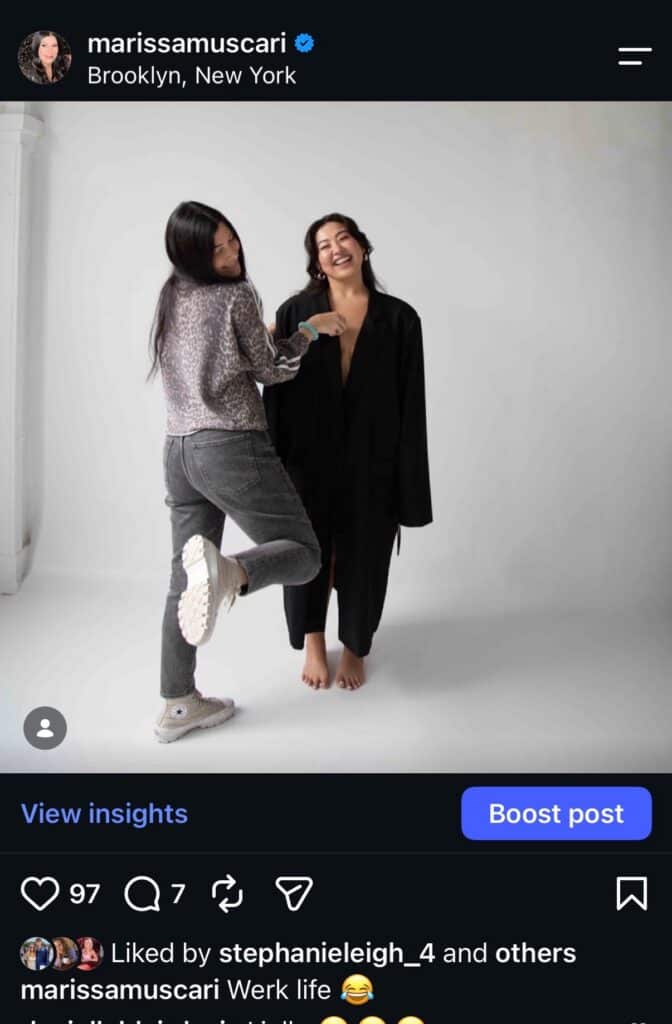
Post: Marissa Muscari & content creator Sarah Kim
Why Creators Are Accepting Too Little
One of Marissa’s sharpest observations about the current market concerns compensation. Creators, she argues, have been conditioned to accept less than the market will bear, and many lack the context to know it.
“Creators have gotten used to accepting lower rates,” she says. “As managers, we see what comes in, we see what different markets are paying, we see what brands are willing to pay from all different sides. If we have 20 creators we represent, we know what different brands are paying.”
That market intelligence is the practical case for professional representation. A creator negotiating alone has one data point: the offer in front of them. A manager aggregating across a roster has a range and can push back with context rather than guesswork. Marissa argues that this is where management has the most immediate commercial impact for creators who are already producing quality work.
The supply-side dynamic compounds the problem. Brands, she says, are oversaturating campaigns by contracting large numbers of creators at low rates. “The scarcer something is, the more someone wants it,” she says. “It becomes more high-profile.” Running the same product through dozens of creators at minimal fees produces volume, not credibility.
TikTok Discovers, Instagram Converts, YouTube Compounds
On where creators should direct their energy, Marissa breaks it down by platform function rather than follower count.
According to her, TikTok remains the strongest discovery surface: analytics are strong, and reach is wide. Instagram is where brands concentrate budgets, she says, because the format lets a client evaluate a creator’s posts, videos, and engagement in a single view. YouTube carries a different kind of value. Its long-form content has a compounding shelf life; work published years ago can still generate returns.
Her practical advice is to maintain presence across all three because the audiences and content purposes are distinct, and brand partners will look at the full picture.
Affiliate revenue follows the same principle as long-term brand relationships. It converts when driven by genuine interest rather than a transactional brief. “If you’re constantly posting with excitement about things that you really love … the more you drive awareness, the more money you can make with affiliate links,” she says. “There really will be no ceiling if it’s something you can curate and keep up with consistently.”
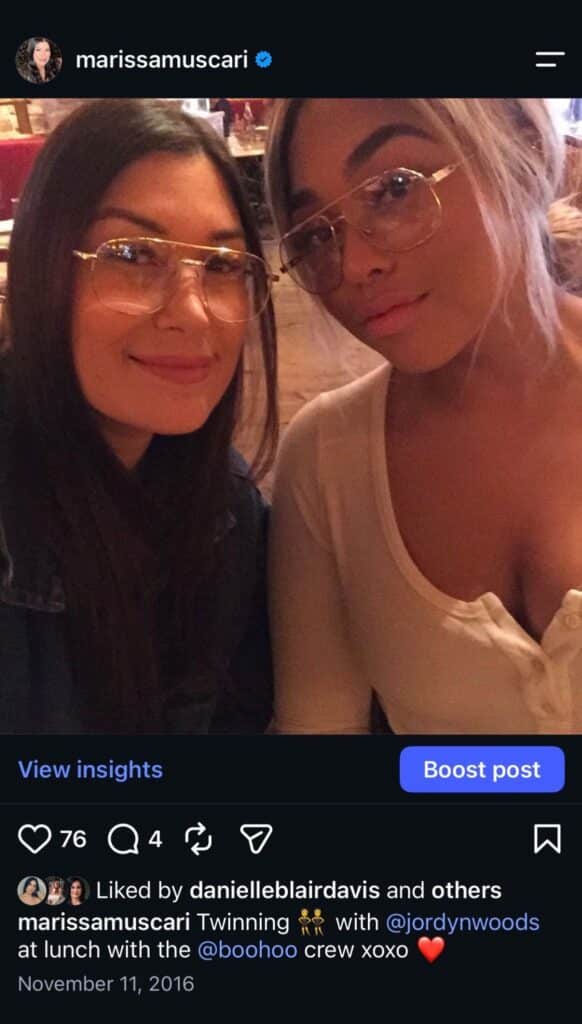
Post: Marissa Muscari & Jordyn Woods
Saying No as a Business Strategy
One of the more direct pieces of advice Marissa offers creators concerns turning down work. Many, she notes, accept opportunities out of fear that the next offer won’t come, and that instinct compresses rates across the market.
“The more you say no to things and stand your ground, it’s really making more of an impact,” she says. “Brands will come back for the right person.”
The corollary is consistency. Audience trust, in her framing, is built through repetition: the same message, the same image, the same subject matter handled in a recognizable way. A creator who pivots frequently for the right rate signals the opposite of authority. “Theme is consistent, message is consistent, image is consistent,” she says. “People feel like they’re coming home. That’s sacred.”
What She Is Bringing to TBN
Marissa’s remit at TBN will cover the fashion and beauty vertical, scouting and signing new talent, and deepening existing brand relationships. She also sees an area most talent management agencies have left unclaimed: on-camera training.
Her background includes working with talent through live runway presentations, press appearances, and editorial shoots. Among the creators she developed at Wilhelmina were Barbie Ferreira, whom she describes as someone who refused to compromise and posted what she wanted from a very young age, and Jordyn Woods, whom she scouted on Instagram when Woods had approximately 500,000 followers.
She plans to apply that development practice at TBN. “Coaching models behind the scenes on a photo shoot is super important,” she says. “All of these skills are things I would like to bring to TBN.”
Marissa also sees former models as an underused pipeline for the Creator Economy. Models already have foundational skills that creators spend years acquiring: camera comfort, screen presence, and confidence in front of a client. “They can really translate a lot of those skills into live sales or actually speaking on camera,” she says. “They can take that autonomy and grow a business in ways they didn’t expect.”
The broader trajectory she anticipates at TBN reflects what she watched happen to fashion editorial 20 years ago, when authority shifted from institutions to individuals.
“Brands are realizing that content creators are not a one-off,” she says. “They are not an addition. They are direct-to-consumer.”
Subscribe to Our Newsletter
Check Out Our Podcast