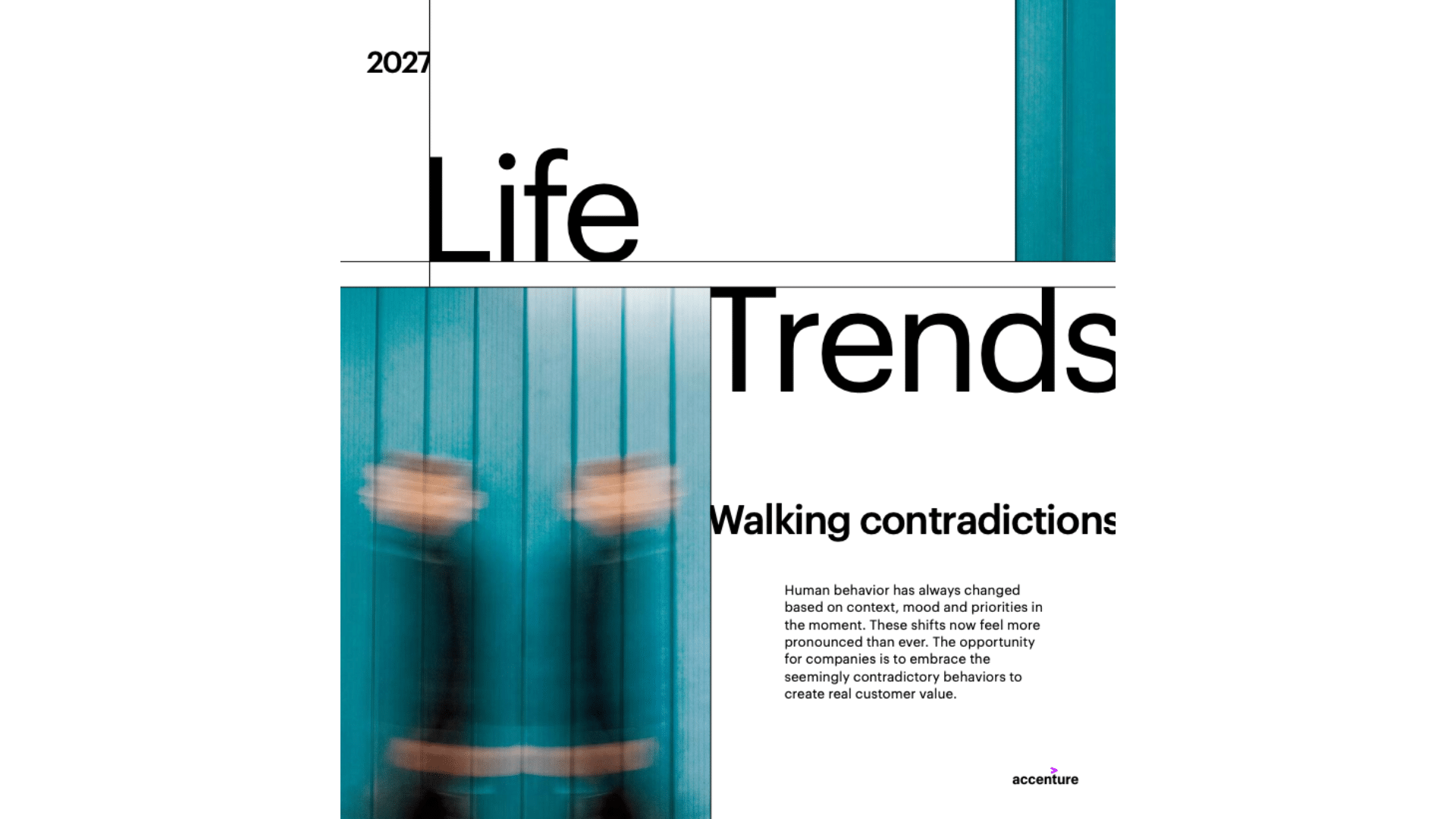
Sixty-four percent of creators say they make the content they think will land better online, not necessarily the content they would like to make, according to Accenture‘s “Life Trends 2027” report. The same survey found that 32% of consumers followed creators directly through newsletters or podcasts in the past year.
The survey classified 4,472 of its 28,209 respondents as creators, defined as people who earned at least $200 from creating content online in the past 12 months. Accenture says the finding signals that hard-won differentiation is disappearing among creators and that the risk of commoditization is real.
The report, the 20th edition of the series, comes from Accenture Song. It is based on an online survey across 26 countries fielded in August 2026, about 100 in-depth consumer interviews in 11 countries, netnographic analysis of public online discourse, and interviews with executives at major companies.
Audiences Move Toward Direct Creator Relationships
Beyond the 32% following creators through newsletters or podcasts, 27% of respondents joined communities in smaller, interest-based spaces in the past 12 months. Another 25% replaced time on social media with in-person connection. Accenture says people are paying for direct relationships with the creators they want to hear from and support.
“Smaller creators, like micro and nano, tend to have a lot more trust, and they’re baked into these niche communities. And brands need to continue to stay in those niche communities,” an Influencer Marketing director told Accenture researchers.
A content strategist interviewed for the report said newsletters are a leading route to added income for creators. “I always push my clients to make a newsletter. You already have a community of people who trust you, who went the extra mile to subscribe. That’s the number one way to grab extra income. The other way is Discord.”
AI-Made Brand Content Draws Skepticism
Sixty percent of 18- to 24-year-olds globally say brands that use AI for content or advertising look lazy, careless, and cheap. Half of all respondents say their feeds are becoming irrelevant. Accenture’s social listening found that posts using phrases such as “AI could never” and “Made by humans” drew hundreds of thousands of likes across social platforms.
Accenture says people welcome AI for search when they choose to use it but push back when synthetic content is forced on them.
Social Media Leads Wellness Discovery
Eighty-three percent of people globally follow some form of health improvement or optimization routine, and more than half of them find it exhausting. Social media posts and influencer recommendations were the most common way people found these routines, cited by 44% of respondents. Online search followed at 40%, and health professionals at 34%.
Forty-one percent of people globally, and about 50% of those ages 18 to 34, say what they see online makes them feel they are not doing enough with their body, health, or life. Online mentions of “-maxxing” terms, such as looksmaxxing and sleepmaxxing, rose 270% in the past year.
The report also identifies social media as a key channel for awareness of pharmaceutical advances. Clinicians are building large followings by stitching or reacting to viral health claims. Nonmedical creators are using the same channels to promote unapproved alternatives.
Side Income and AI Tools
Sixty-seven percent of consumers say they made money beyond their main job in the past year. Sixty-three percent agree that relying on a single job is too risky financially, a figure that rises to 76% among people with a second job, business or side hustle.
Fifteen percent of respondents used AI tools in the past year to create a product or service to sell. That share rises to 27% among people with a second job or their own business, and to 20% among those with a side hustle. Online use of the term “solopreneur” grew 70% between 2024 and 2026.
Local Credibility
Sixty-two percent of consumers globally say they can tell when a brand genuinely understands their culture and when it is only performing understanding. That figure rises to 80% in Africa and 66% in Latin America.
Image source: Accenture The full report can be foundhere
Dragomir is a Serbian freelance blog writer and translator. He is passionate about covering insightful stories and exploring topics such as influencer marketing, the creator economy, technology, business, and cyber fraud.












Sixty-four percent of creators say they make the content they think will land better online, not necessarily the content they would like to make, according to Accenture‘s “Life Trends 2027” report. The same survey found that 32% of consumers followed creators directly through newsletters or podcasts in the past year.
The survey classified 4,472 of its 28,209 respondents as creators, defined as people who earned at least $200 from creating content online in the past 12 months. Accenture says the finding signals that hard-won differentiation is disappearing among creators and that the risk of commoditization is real.
The report, the 20th edition of the series, comes from Accenture Song. It is based on an online survey across 26 countries fielded in August 2026, about 100 in-depth consumer interviews in 11 countries, netnographic analysis of public online discourse, and interviews with executives at major companies.
Audiences Move Toward Direct Creator Relationships
Beyond the 32% following creators through newsletters or podcasts, 27% of respondents joined communities in smaller, interest-based spaces in the past 12 months. Another 25% replaced time on social media with in-person connection. Accenture says people are paying for direct relationships with the creators they want to hear from and support.
“Smaller creators, like micro and nano, tend to have a lot more trust, and they’re baked into these niche communities. And brands need to continue to stay in those niche communities,” an Influencer Marketing director told Accenture researchers.
A content strategist interviewed for the report said newsletters are a leading route to added income for creators. “I always push my clients to make a newsletter. You already have a community of people who trust you, who went the extra mile to subscribe. That’s the number one way to grab extra income. The other way is Discord.”
AI-Made Brand Content Draws Skepticism
Sixty percent of 18- to 24-year-olds globally say brands that use AI for content or advertising look lazy, careless, and cheap. Half of all respondents say their feeds are becoming irrelevant. Accenture’s social listening found that posts using phrases such as “AI could never” and “Made by humans” drew hundreds of thousands of likes across social platforms.
Accenture says people welcome AI for search when they choose to use it but push back when synthetic content is forced on them.
Social Media Leads Wellness Discovery
Eighty-three percent of people globally follow some form of health improvement or optimization routine, and more than half of them find it exhausting. Social media posts and influencer recommendations were the most common way people found these routines, cited by 44% of respondents. Online search followed at 40%, and health professionals at 34%.
Forty-one percent of people globally, and about 50% of those ages 18 to 34, say what they see online makes them feel they are not doing enough with their body, health, or life. Online mentions of “-maxxing” terms, such as looksmaxxing and sleepmaxxing, rose 270% in the past year.
The report also identifies social media as a key channel for awareness of pharmaceutical advances. Clinicians are building large followings by stitching or reacting to viral health claims. Nonmedical creators are using the same channels to promote unapproved alternatives.
Side Income and AI Tools
Sixty-seven percent of consumers say they made money beyond their main job in the past year. Sixty-three percent agree that relying on a single job is too risky financially, a figure that rises to 76% among people with a second job, business or side hustle.
Fifteen percent of respondents used AI tools in the past year to create a product or service to sell. That share rises to 27% among people with a second job or their own business, and to 20% among those with a side hustle. Online use of the term “solopreneur” grew 70% between 2024 and 2026.
Local Credibility
Sixty-two percent of consumers globally say they can tell when a brand genuinely understands their culture and when it is only performing understanding. That figure rises to 80% in Africa and 66% in Latin America.
Image source: Accenture
The full report can be found here
Subscribe to Our Newsletter
Check Out Our Podcast