





Influencer
Xavier Mortimer Figured Out That Social Media Is His Most Effective Ticket Agent

Xavier Mortimer was already a Las Vegas headliner before he was a social media creator. What well over 30 million followers changed was not his career, but the economics behind it, and understanding how is more or less the whole story.
Since launching his social media presence in 2020, the French-born illusionist and former Cirque du Soleil performer has built one of the highest-reach magic followings in short-form video, accumulating billions of views across platforms and driving his “XtraOrdinaire” tour to sold-out rooms. He runs XM Productions, a company that manages his live shows, private events, and digital output, and he holds the record for one of the most-viewed magic short videos on YouTube. Today, the measure of success has shifted from cumulative view totals to a simpler question: how many of those viewers will buy a ticket.
“We just had to put a video on Facebook or an advertisement on YouTube and boom, people are like, ‘Oh yeah, I saw his videos. I’m going to go.’ And we fill up the rooms,” Xavier says, describing what it now means to “sell out a room.”
The 30/30/30 Split
The business did not always look this way. In 2020, platform ad revenue was essentially everything. Facebook was paying aggressively to bring creators onto its video infrastructure, and Xavier’s magic content, which crosses language and age barriers without needing translation, performed at a scale that made purely digital income viable. YouTube followed.
“The first revenue that I got from the videos being a content creator was in 2020 with Facebook,” he says. “It was insane. It was really amazing; 99% of my revenue was Facebook.”
That window has closed, Xavier notes. In the peak years, creators could collect incentive payouts across Snapchat, YouTube Shorts, and Facebook Reels, bonuses that, at their height, were genuinely substantial. The programs attracted the content the platforms needed to build their video infrastructure. As those incentives were wound back, Xavier felt the change directly. “The revenue from the video itself has gone down tremendously,” he says. Facebook and YouTube have both moved toward longer formats, and the economics of short-form content creation shifted with them.
What replaced them is brands. As platforms matured, advertisers followed. He estimates the business currently runs on three roughly equal revenue streams: live shows, ad revenue from longer-format content, and brand partnerships. The actual mix shifts with touring schedules and individual deal timing. On tour, live shows can temporarily dominate. A major brand deal produces the same swing in the other direction. The three streams are less a fixed formula than a structural balance.

The Biggest Change in His Career Is Also the Simplest
Of all the revenue streams, the one Xavier keeps returning to is the one hardest to put a line item on: social discovery driving his live audience. It is also, he says, the largest change in how he understands his work.
“I used to be a performer,” he says. “When I was in Vegas, I was just performing. And today, I see people buying tickets because they saw my videos, because they knew my name, because somehow they saw one of my videos and they want to see the show.”
For someone who spent years building Las Vegas residencies through conventional promotion, the distinction is structural rather than incidental. The same audiences who encounter his tricks on Facebook or YouTube become ticket buyers in the cities where he tours. The content does not replace the show. It advertises it, at a scale and cost no traditional agency could match. “It’s like social media changed my life because of that,” he says.
This also explains why raw follower counts have become less interesting to him than the quality of engagement behind them. “You can have 20 million followers and no presence at all,” he says. A creator with an inflated following and a passive audience cannot sell a tour the way one with a genuinely active community can. The seat either gets filled or it does not.

The Creative Test Behind Every Brand Deal
Xavier’s criteria for brand partnerships differ from the alignment-first language common to most creator marketing conversations. Because his content crosses age, language, and cultural contexts, he describes his audience as broad enough that strict category alignment rarely limits him. What matters instead is whether a product gives him something to do.
“My way to do it is: am I inspired to do something good for them?” he says. A video game company presents a harder creative challenge. A paper towel brand is an easier yes. “If a brand of paper towel reaches out to me, I get inspired because I know I could do so many things with a paper towel,” he says. “It’s more about what I can do, how I get inspired by what the product is.”
He describes the advantage as scale of appeal. “I’m more like the Samsung of social media,” he says, meaning his content reaches broadly enough, across age groups, languages, and cultures, that almost any product can become a potential prop. A paper towel, a drink, a bar of soap: the category of the brand matters less than whether it gives him something to do on camera.
Merchandise has operated under a different set of constraints. Xavier sold magic kits and T-shirts during his Las Vegas residency but paused the operation when the Vegas show ended. Shipping at scale required manufacturing and logistics partners he has not yet secured. “Hopefully with the show going back on tour, we’re going to get back to the merch,” he says.
Why He Stopped Counting Views
Around 2022, Xavier says the metrics stopped making sense. Cumulative view totals had grown past the point where they communicated anything useful for running a company, and monthly viewership became the more honest measure of actual presence. But the shift went deeper than just which number to track.
Viral views, he argues, can be manufactured without building anything durable. “It’s very easy,” he says. “I can give you 10 openers for a video, and you’re going to have a million views tomorrow.” The clickbait hook gets the number. It does not get the audience, and it does not fill a room.
Brands have arrived at the same conclusion. A creator who spiked six months ago and has since gone quiet is a different proposition to an advertiser than one whose engagement holds consistently week over week. For Xavier, the audience that stays is also the audience that buys a ticket, and those two things are not separable from each other.
Toward Streaming, One Fewer Video at a Time
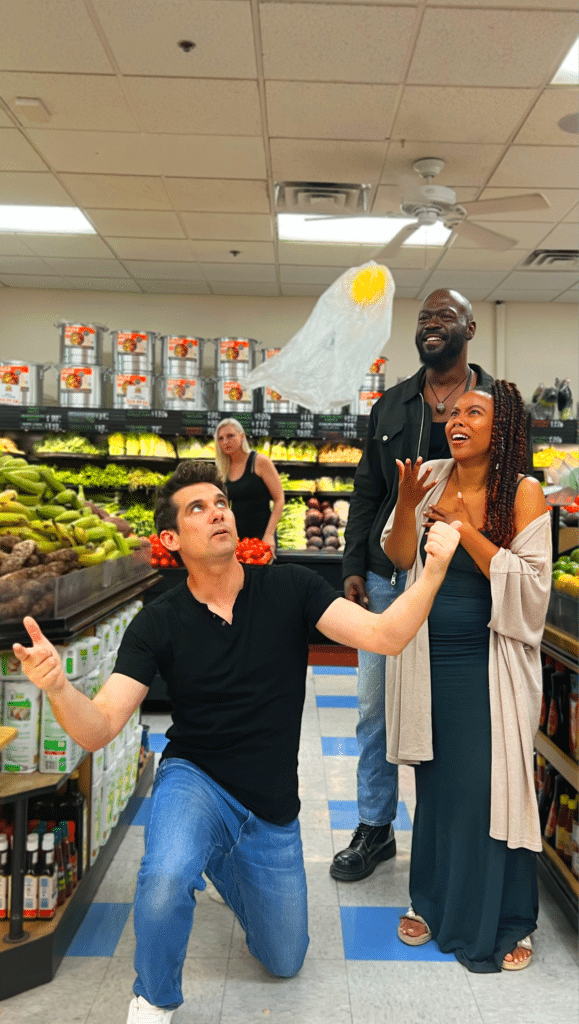
The next direction for Xavier is one fewer short video, not one more. He is developing a pilot for streaming platforms, and the logic behind that move connects directly to how he thinks about the ticket-sales pipeline he has spent five years building. The audience that buys a seat is not the one that watched a 30-second clip once. It is the audience that knows who he is across formats and over time. Long-form content builds that kind of familiarity in ways short clips cannot, and it also addresses a challenge that has hit magic harder than most creator niches: the AI credibility problem.
“You can’t do AI if you put too much of your personality in a long format,” he says. Short clips are easier to question; a personality sustained across 30-60 minutes is harder to replicate, and harder to dismiss. Live performance does the same work in a different register. “I’m doing things outside of the Internet,” he says, “so people know. ‘Oh yeah, he’s that guy who tours. He was in that city. He’s in Vegas. He’s performing for real.’”
The magician is also working on what he describes only as “a huge trick,” currently unsolved and currently in development. It is the kind of creative problem, he says, that produces the one thing AI cannot replicate. “The creativity that it takes to create something magical, it just comes from you,” he says. “It cannot come from ChatGPT.”
His advice for creators navigating platform shifts or AI anxieties is simple. “Just get out with your camera and do it,” he says.
For Xavier, the value of social media was never the view count. It is whether someone who watched a clip years ago decides to buy a ticket today. “I want to produce quality, and I want to produce less, but I want people to remember, and I want people to mostly say, ‘I like this guy. I want to see what’s next.’”
Subscribe to Our Newsletter
Check Out Our Podcast