U.S. commerce media ad spending will climb from $83.71 billion in 2026 to $142.07 billion in 2030, accounting for 23.9% of all digital ad spending by the end of the forecast period, according to EMARKETER‘s “Commerce Media Ad Spending Forecast 2026,” sponsored by LiveRamp.
The channel’s share of digital ad spending will continue to rise even as its growth rate slows. Commerce media will account for 20.5% of U.S. digital ad spending in 2026 and 23.9% in 2030, while year-over-year growth decelerates from 22.2% to 10.1%. EMARKETER describes the trajectory as a sign of a maturing advertising channel, with commerce media still growing faster than most other digital formats.
Retail Still Dominant, but Nonretail Closing the Gap
Retailer-owned networks remain the largest share of commerce media, adding $41.03 billion in new ad dollars between 2026 and 2030. But nonretail commerce media, spanning travel, financial services, and commerce intermediaries such as Uber, DoorDash, and Instacart, is growing faster off a smaller base. Nonretail spending will rise from $10.75 billion in 2026 to $23.81 billion in 2030, pushing its share of total commerce media from 13.0% to 17.4% and its share of digital ad spending past 4% by 2030.
The shift is sharper when Amazon is excluded from retail media. Amazon will represent more than three-quarters of all retail media ad spending through 2028, and the remaining 70-plus retail media networks will add $7.24 billion in ad spending between 2025 and 2028. Nonretail commerce media will add $9.15 billion over the same stretch, narrowing the gap between the two segments from $4.73 billion in 2025 to $2.82 billion in 2028.
Among nonretail verticals, growth engines diverge. Commerce intermediary media is projected to grow from $1.68 billion in 2023 to $6.10 billion in 2028, a 29.4% compound annual growth rate, and Uber, DoorDash, and Instacart will each generate more than $1 billion in commerce media revenue in 2026. Financial media networks are the smallest cohort but the fastest-growing, expanding at a 77.6% CAGR to reach $3.15 billion by 2028, drawing on cross-merchant transaction visibility that individual retailers cannot replicate. Travel media is growing more slowly, adding roughly $2 billion between 2023 and 2028, with EMARKETER noting the vertical lacks the purchase frequency that fuels retail media demand and will instead need to prove the value of high-intent traveler engagement.
Advertisers Are Buying In, but Operational Maturity Lags
Advertiser commitment to commerce media is deepening despite added complexity. The share of U.S. commerce media ad buyers working with nine or more commerce media networks rose from 8% in 2023 to 33% in 2025, a more than fourfold increase, according to March 2026 survey data from McKinsey & Company cited in the report. Objectives are also broadening beyond performance marketing: the share of commerce media spend directed at brand building rose from 29% in 2024 to 34% in 2026.
Commerce media also now ranks competitively against established channels. Advertising decision-makers in an August 2025 survey by the Interactive Advertising Bureau and Advertiser Perceptions rated commerce media essential to their media plans at the same rate as connected TV, 40% each, trailing creators (48%), paid search (60%), and social media (74%).
Supply-side infrastructure hasn’t kept pace with that demand. November 2025 research from Forrester Consulting, commissioned by Koddi, found that 59% of commerce media decision-makers in North America and Western Europe describe their organizations as still in the early stages of developing their commerce media capabilities, while just 12% say they offer full-funnel, advanced capabilities.
The Next Phase Rewards Differentiation, Not Imitation
EMARKETER’s central argument is that the tactics that built commerce media’s first act, replicating the retail media playbook of transaction data and closed-loop measurement, are becoming less reliable as the market matures. Amazon’s scale and advertiser familiarity make direct competition difficult, pushing financial media networks, travel networks, and commerce intermediaries toward the advantages specific to their own ecosystems: cross-merchant visibility, traveler intent, and cross-retailer reach, respectively.
The report’s recommendations follow from that thesis. It advises commerce media networks to build on advantages retail media cannot copy and to close operational gaps in measurement, planning, and buying before growth slows further. For advertisers, it recommends diversifying beyond retailer-owned networks and prioritizing partners with scalable capabilities rather than audience reach alone.
Image source: EMARKETER The full report is available here
Dragomir is a Serbian freelance blog writer and translator. He is passionate about covering insightful stories and exploring topics such as influencer marketing, the creator economy, technology, business, and cyber fraud.




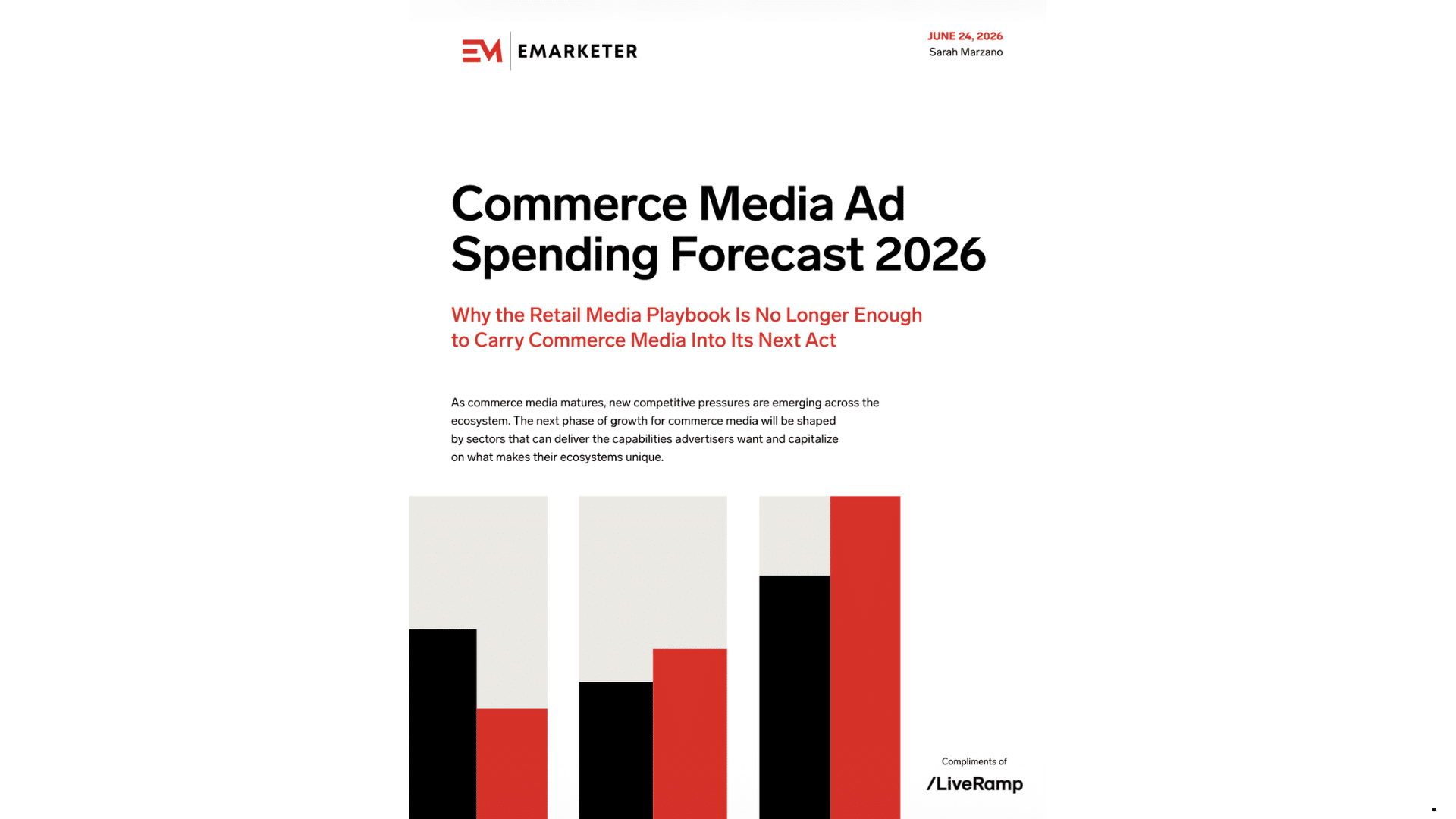












U.S. commerce media ad spending will climb from $83.71 billion in 2026 to $142.07 billion in 2030, accounting for 23.9% of all digital ad spending by the end of the forecast period, according to EMARKETER‘s “Commerce Media Ad Spending Forecast 2026,” sponsored by LiveRamp.
The channel’s share of digital ad spending will continue to rise even as its growth rate slows. Commerce media will account for 20.5% of U.S. digital ad spending in 2026 and 23.9% in 2030, while year-over-year growth decelerates from 22.2% to 10.1%. EMARKETER describes the trajectory as a sign of a maturing advertising channel, with commerce media still growing faster than most other digital formats.
Retail Still Dominant, but Nonretail Closing the Gap
Retailer-owned networks remain the largest share of commerce media, adding $41.03 billion in new ad dollars between 2026 and 2030. But nonretail commerce media, spanning travel, financial services, and commerce intermediaries such as Uber, DoorDash, and Instacart, is growing faster off a smaller base. Nonretail spending will rise from $10.75 billion in 2026 to $23.81 billion in 2030, pushing its share of total commerce media from 13.0% to 17.4% and its share of digital ad spending past 4% by 2030.
The shift is sharper when Amazon is excluded from retail media. Amazon will represent more than three-quarters of all retail media ad spending through 2028, and the remaining 70-plus retail media networks will add $7.24 billion in ad spending between 2025 and 2028. Nonretail commerce media will add $9.15 billion over the same stretch, narrowing the gap between the two segments from $4.73 billion in 2025 to $2.82 billion in 2028.
Among nonretail verticals, growth engines diverge. Commerce intermediary media is projected to grow from $1.68 billion in 2023 to $6.10 billion in 2028, a 29.4% compound annual growth rate, and Uber, DoorDash, and Instacart will each generate more than $1 billion in commerce media revenue in 2026. Financial media networks are the smallest cohort but the fastest-growing, expanding at a 77.6% CAGR to reach $3.15 billion by 2028, drawing on cross-merchant transaction visibility that individual retailers cannot replicate. Travel media is growing more slowly, adding roughly $2 billion between 2023 and 2028, with EMARKETER noting the vertical lacks the purchase frequency that fuels retail media demand and will instead need to prove the value of high-intent traveler engagement.
Advertisers Are Buying In, but Operational Maturity Lags
Advertiser commitment to commerce media is deepening despite added complexity. The share of U.S. commerce media ad buyers working with nine or more commerce media networks rose from 8% in 2023 to 33% in 2025, a more than fourfold increase, according to March 2026 survey data from McKinsey & Company cited in the report. Objectives are also broadening beyond performance marketing: the share of commerce media spend directed at brand building rose from 29% in 2024 to 34% in 2026.
Commerce media also now ranks competitively against established channels. Advertising decision-makers in an August 2025 survey by the Interactive Advertising Bureau and Advertiser Perceptions rated commerce media essential to their media plans at the same rate as connected TV, 40% each, trailing creators (48%), paid search (60%), and social media (74%).
Supply-side infrastructure hasn’t kept pace with that demand. November 2025 research from Forrester Consulting, commissioned by Koddi, found that 59% of commerce media decision-makers in North America and Western Europe describe their organizations as still in the early stages of developing their commerce media capabilities, while just 12% say they offer full-funnel, advanced capabilities.
The Next Phase Rewards Differentiation, Not Imitation
EMARKETER’s central argument is that the tactics that built commerce media’s first act, replicating the retail media playbook of transaction data and closed-loop measurement, are becoming less reliable as the market matures. Amazon’s scale and advertiser familiarity make direct competition difficult, pushing financial media networks, travel networks, and commerce intermediaries toward the advantages specific to their own ecosystems: cross-merchant visibility, traveler intent, and cross-retailer reach, respectively.
The report’s recommendations follow from that thesis. It advises commerce media networks to build on advantages retail media cannot copy and to close operational gaps in measurement, planning, and buying before growth slows further. For advertisers, it recommends diversifying beyond retailer-owned networks and prioritizing partners with scalable capabilities rather than audience reach alone.
Image source: EMARKETER
The full report is available here
Subscribe to Our Newsletter
Check Out Our Podcast