Nearly half of marketing organizations worldwide have already built podcasts into their strategy, and another quarter plan to launch one within the next year, according to a global survey of 861 marketing and communications professionals conducted by Outcomes Rocket and Health Podcast Library. Yet the same data shows the channel’s growth is outpacing the industry’s ability to measure whether it works, with commercial outcome tracking lagging far behind engagement metrics.
The survey, fielded in May 2026 through the research platform Prolific, found that 44.9% of organizations currently incorporate podcasts into their marketing in some form: 16% host a branded podcast, 16.6% advertise or sponsor external podcasts, and 12.3% do both. A further 25% plan to enter the space within 12 months, while 30.1% have no plans to do so.
Skepticism, Not Budget, Is the Top Barrier
Among organizations without a branded podcast, the leading obstacle is not cost or production capacity but doubt about effectiveness. 45.8% of respondents said they are not convinced podcasts work for their marketing goals, ahead of uncertainty about audience listenership (36.3%), lack of a clear roadmap (35.0%), limited internal production resources (31.6%), and budget constraints (29.1%). Despite that skepticism, 28.5% of non-hosting organizations said they are interested in launching a branded podcast within the next 12-18 months.
Launch Speed Outpaces Publishing Consistency
Organizations that commit to a branded podcast move quickly: 65.3% publish a first episode within six months of the initial idea, and 32.0% go live within one to three months. Only 10.3% take longer than a year. Maintaining a consistent release schedule proves harder. Monthly episodes (26.6%) and inconsistent or unscheduled releases (26.0%) together account for more than half of branded podcast operations, while only 23.3% publish weekly and 18.3% bi-weekly.
Format has consolidated around conversation. Interview or guest-led shows lead at 32.8%, followed by co-hosted formats (28.9%), panels or roundtables (15.9%), and solo monologues (9.4%). By intended audience, 33.3% of hosts target the general public, 24.0% target prospective customers, 22.0% target industry peers, and 15.5% target existing customers.
A Top-of-Funnel Tool With Growing AI Ambitions
Brand awareness remains the dominant strategic goal, cited by 58.1% of podcast marketers, ahead of mid-funnel consideration and education (43.9%) and customer retention (42.1%). Lead generation and conversion trail at 23.3%. Notably, 12.9% of podcast-running organizations already list AEO or AIO as an explicit goal.
Organizations devote an average of 7.3% of their total marketing budget to podcast activity, with 39.3% spending under 5% and 35.4% spending between 5% and 10%. Investment appetite is rising: 56.9% of organizations currently in podcasting said they are likely or very likely to increase spend over the next 12 months.
The Measurement Gap
The survey’s clearest tension sits in how success is tracked. Audience engagement metrics, such as completion rates and shares, are monitored by 70.8% of podcast marketers, and downloads or listens by 61.2%. Tracking drops sharply further down the funnel: lead generation metrics are tracked by 32.8%, direct sales or revenue attribution by 20.4%, and formal ROI by just 16.8%.
Despite this, 47.3% of podcast marketers rate their overall ROI as strong, a judgment the survey suggests often rests on engagement signals rather than pipeline or revenue data. Budget allocation compounds the gap: 41.8% of organizations spend more on production than on marketing and promotion, and 17.8% direct more than 80% of their podcast budget to production alone.
On AI-driven discovery, 45.2% of podcast marketers already use podcast content to support traditional SEO, while 28.9% apply it to AIO, 25.8% to AEO, and 21.4% to GEO. The most common tactic is repurposing: 37.0% adapt clips and transcripts for AI search engines, and 33.6% produce transcript-rich, question-based episodes designed for citation in AI responses.
Production cost and time remain the top overall challenge, cited by 54.8% of respondents, ahead of audience discovery (43.9%) and low engagement or retention (38.8%). Looking to 2027, 43.1% expect the channel to specialize in smaller, more targeted audiences, while 35.0% anticipate deeper AI integration and 32.3% foresee growing saturation.
“Downloads are vanity. Contacts and contracts are sanity,” said Saul Marquez, CEO and founder of Outcomes Rocket, which conducted the research. “Most people are measuring the wrong things, and that is exactly why so many organizations remain skeptical about the channel.”
“Think about who you invite into your kitchen or your car,” said Dan Kendall, CEO of Health Podcast Library. “It’s probably only people you know and trust. And that is exactly what listeners do with podcasts.”
The survey drew respondents primarily from Europe (31%) and the UK (30.8%), with the United States at 18.8% and the Middle East and Africa at 8.8%. Managers made up the largest seniority group (33.9%), and organizations of 1-50 employees were the most represented company size (35%).
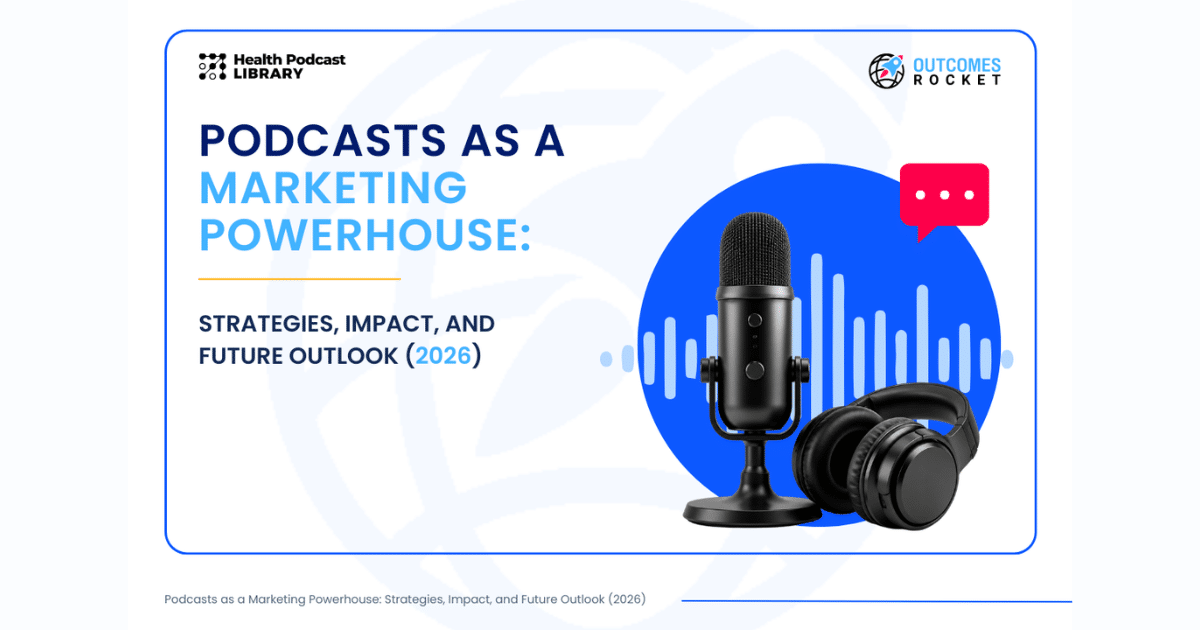
Image source: Outcomes Rocket & Health Podcast Library The full survey is available here
Dragomir is a Serbian freelance blog writer and translator. He is passionate about covering insightful stories and exploring topics such as influencer marketing, the creator economy, technology, business, and cyber fraud.














Nearly half of marketing organizations worldwide have already built podcasts into their strategy, and another quarter plan to launch one within the next year, according to a global survey of 861 marketing and communications professionals conducted by Outcomes Rocket and Health Podcast Library. Yet the same data shows the channel’s growth is outpacing the industry’s ability to measure whether it works, with commercial outcome tracking lagging far behind engagement metrics.
The survey, fielded in May 2026 through the research platform Prolific, found that 44.9% of organizations currently incorporate podcasts into their marketing in some form: 16% host a branded podcast, 16.6% advertise or sponsor external podcasts, and 12.3% do both. A further 25% plan to enter the space within 12 months, while 30.1% have no plans to do so.
Skepticism, Not Budget, Is the Top Barrier
Among organizations without a branded podcast, the leading obstacle is not cost or production capacity but doubt about effectiveness. 45.8% of respondents said they are not convinced podcasts work for their marketing goals, ahead of uncertainty about audience listenership (36.3%), lack of a clear roadmap (35.0%), limited internal production resources (31.6%), and budget constraints (29.1%). Despite that skepticism, 28.5% of non-hosting organizations said they are interested in launching a branded podcast within the next 12-18 months.
Launch Speed Outpaces Publishing Consistency
Organizations that commit to a branded podcast move quickly: 65.3% publish a first episode within six months of the initial idea, and 32.0% go live within one to three months. Only 10.3% take longer than a year. Maintaining a consistent release schedule proves harder. Monthly episodes (26.6%) and inconsistent or unscheduled releases (26.0%) together account for more than half of branded podcast operations, while only 23.3% publish weekly and 18.3% bi-weekly.
Format has consolidated around conversation. Interview or guest-led shows lead at 32.8%, followed by co-hosted formats (28.9%), panels or roundtables (15.9%), and solo monologues (9.4%). By intended audience, 33.3% of hosts target the general public, 24.0% target prospective customers, 22.0% target industry peers, and 15.5% target existing customers.
A Top-of-Funnel Tool With Growing AI Ambitions
Brand awareness remains the dominant strategic goal, cited by 58.1% of podcast marketers, ahead of mid-funnel consideration and education (43.9%) and customer retention (42.1%). Lead generation and conversion trail at 23.3%. Notably, 12.9% of podcast-running organizations already list AEO or AIO as an explicit goal.
Organizations devote an average of 7.3% of their total marketing budget to podcast activity, with 39.3% spending under 5% and 35.4% spending between 5% and 10%. Investment appetite is rising: 56.9% of organizations currently in podcasting said they are likely or very likely to increase spend over the next 12 months.
The Measurement Gap
The survey’s clearest tension sits in how success is tracked. Audience engagement metrics, such as completion rates and shares, are monitored by 70.8% of podcast marketers, and downloads or listens by 61.2%. Tracking drops sharply further down the funnel: lead generation metrics are tracked by 32.8%, direct sales or revenue attribution by 20.4%, and formal ROI by just 16.8%.
Despite this, 47.3% of podcast marketers rate their overall ROI as strong, a judgment the survey suggests often rests on engagement signals rather than pipeline or revenue data. Budget allocation compounds the gap: 41.8% of organizations spend more on production than on marketing and promotion, and 17.8% direct more than 80% of their podcast budget to production alone.
On AI-driven discovery, 45.2% of podcast marketers already use podcast content to support traditional SEO, while 28.9% apply it to AIO, 25.8% to AEO, and 21.4% to GEO. The most common tactic is repurposing: 37.0% adapt clips and transcripts for AI search engines, and 33.6% produce transcript-rich, question-based episodes designed for citation in AI responses.
Production cost and time remain the top overall challenge, cited by 54.8% of respondents, ahead of audience discovery (43.9%) and low engagement or retention (38.8%). Looking to 2027, 43.1% expect the channel to specialize in smaller, more targeted audiences, while 35.0% anticipate deeper AI integration and 32.3% foresee growing saturation.
“Downloads are vanity. Contacts and contracts are sanity,” said Saul Marquez, CEO and founder of Outcomes Rocket, which conducted the research. “Most people are measuring the wrong things, and that is exactly why so many organizations remain skeptical about the channel.”
“Think about who you invite into your kitchen or your car,” said Dan Kendall, CEO of Health Podcast Library. “It’s probably only people you know and trust. And that is exactly what listeners do with podcasts.”
The survey drew respondents primarily from Europe (31%) and the UK (30.8%), with the United States at 18.8% and the Middle East and Africa at 8.8%. Managers made up the largest seniority group (33.9%), and organizations of 1-50 employees were the most represented company size (35%).
Image source: Outcomes Rocket & Health Podcast Library
The full survey is available here
Subscribe to Our Newsletter
Check Out Our Podcast