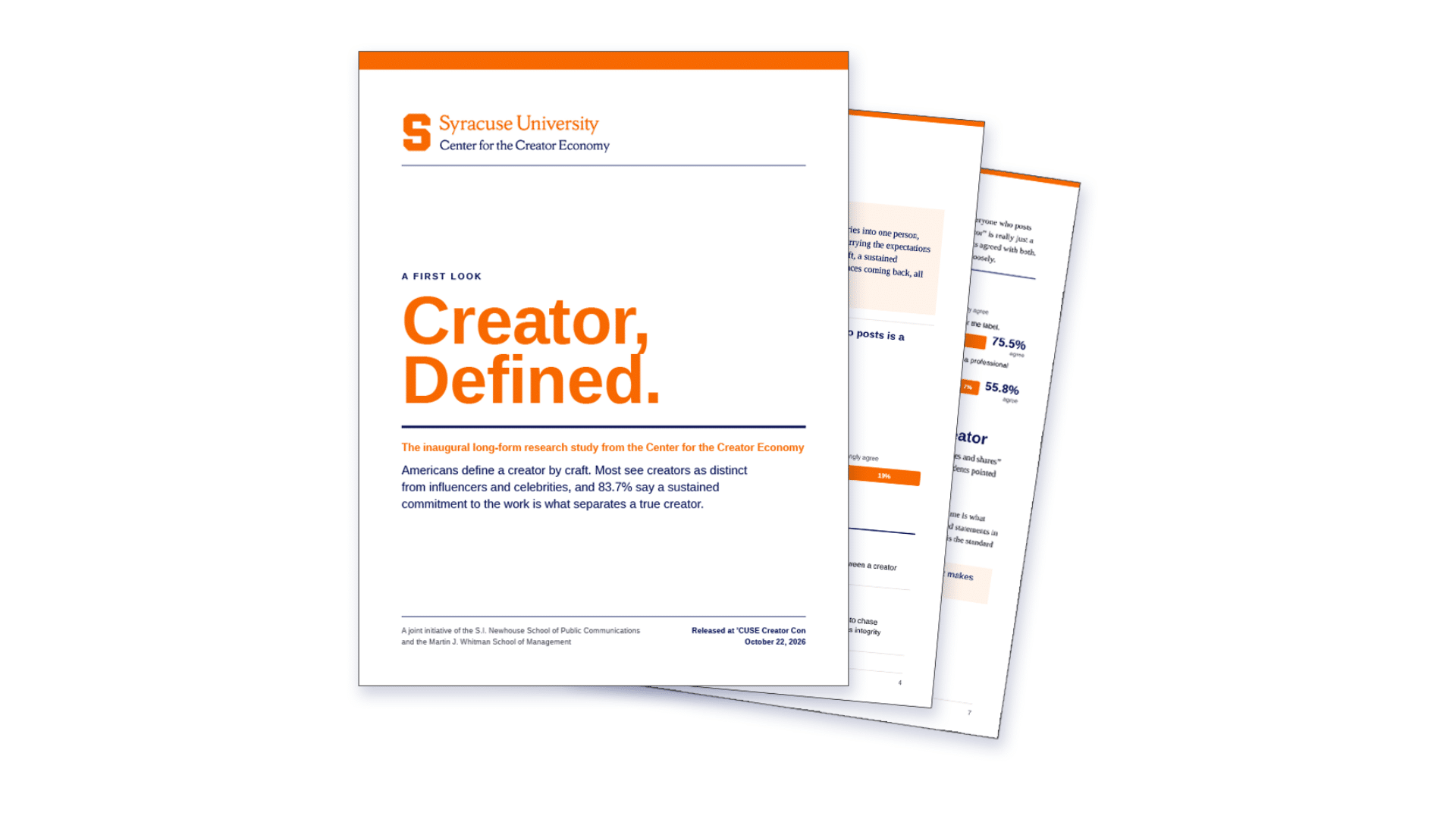
More than eight in ten U.S. adults (83.7%) say a sustained commitment to craft over time separates a true creator from a casual internet user who posts, according to a study from Syracuse University’s Center for the Creator Economy.
The report, titled “Creator, Defined.,” was released October 22 at ‘CUSE Creator Con. It is the center’s first long-form research study. The center is a joint initiative of the S.I. Newhouse School of Public Communications and the Martin J. Whitman School of Management. The study combines 40 interviews with creators and industry professionals and a national survey of 989 U.S. adults.
Creators Seen as Distinct From Influencers and Celebrities
Two-thirds of survey respondents (66.7%) see a difference between a creator and a social media influencer. Another 20.5% see no difference, and 12.7% are not sure. For creators versus celebrities, 87.2% see a difference, 6.4% do not, and 6.5% are not sure.
The survey’s working definition told respondents that creators may include people “sometimes referred to by other terms (e.g., ‘influencer,’ ‘streamer,’ ‘blogger’).” The researchers say the influencer result is likely a conservative measure because two-thirds of respondents still drew a distinction.
Respondents’ own relationship to content creation shaped their answers. Among non-creators, 58% distinguish creators from influencers. The share rises to 71% among hobby and casual creators and to 76% among creators who are monetizing or earning. Non-creators were the most likely to be unsure, at 19% compared with 8% to 10% of creators.
A Professional Role, and a Loose Label
Three-quarters of respondents (75.5%) see “creator” as a distinct professional role that not everyone who posts online qualifies for. Some 55.8% also say that for many people, calling themselves a content creator is a way of describing a hobby. At least three in ten respondents agreed with both statements, according to the report.
Craft Ranks Ahead of Brand and Community
Respondents rated three descriptions of what a creator is. The “Maker,” described as a digital artisan valued for skill, production quality, and mastery of craft, scored highest, with an average fit of 5.11 on a seven-point scale. The “Community Builder” scored 4.80, and the “Brand,” described as a business entrepreneur running a personal brand as a commercial enterprise, scored 4.71. The report describes the differences as statistically significant but modest. All three scored above the scale’s midpoint.
The study based the descriptions on research on entrepreneurial passion that identifies three founder role identities: inventor, founder, and developer.
Profit Accepted, Changing Content to Chase Sponsors Is Not
Seven in ten respondents (69.7%) said it is fully acceptable for a creator to treat their channel purely as a business designed to maximize profit. Nearly two-thirds (64.7%) said a creator who changes their content style specifically to attract higher-paying brand sponsorships has compromised their creative integrity.
The report concludes that the line falls between earning from the work and reshaping the work to earn.
Interviews Point to the Same Line
The report includes initial findings from the 40 interviews, split evenly between 20 creators and 20 industry professionals. Participants described creators through labor and autonomy and influencers through persuasion.
“A creator to me is really someone who’s doing a 360 business… they are writing, directing, producing, editing, doing the marketing campaign strategy,” one participant said. Another said, “An influencer, I think, in the way I use it, is more as somebody who is persuading you to buy, consume, or move.”
An industry interviewee linked authenticity to selling: “Having that credibility, they can talk about everything they’re selling more authentically.” Another described the profession taking shape: “My son went to a creator economy camp… there’s a bunch of tracks now that legitimize the path of it as a business.”
The report offers its own definition. A creator is “an independent studio,” defined by a love of the craft, a sustained commitment to it over time, and an authenticity that earns trust, all practiced amid the opportunities and pressures of platforms.
Methodology: The survey was fielded Oct. 10 to 11 through Prolific to 989 U.S. adults who use at least one social media or video platform weekly, with quotas based on U.S. Census benchmarks for age, gender, race and ethnicity, region and household income. Respondents had a mean age of 45.4, were 50.9% female and 49.1% male, and all passed two attention checks; the sample included 385 non-creators, 461 hobby and casual creators, and 143 monetizing and earning creators. Interview participants were not screened by follower count, platform verification, or income and qualified by self-identification, and open-ended survey responses are being analyzed separately and will be reported later.
Image source: Syracuse University The full study can be foundhere
Dragomir is a Serbian freelance blog writer and translator. He is passionate about covering insightful stories and exploring topics such as influencer marketing, the creator economy, technology, business, and cyber fraud.










More than eight in ten U.S. adults (83.7%) say a sustained commitment to craft over time separates a true creator from a casual internet user who posts, according to a study from Syracuse University’s Center for the Creator Economy.
The report, titled “Creator, Defined.,” was released October 22 at ‘CUSE Creator Con. It is the center’s first long-form research study. The center is a joint initiative of the S.I. Newhouse School of Public Communications and the Martin J. Whitman School of Management. The study combines 40 interviews with creators and industry professionals and a national survey of 989 U.S. adults.
Creators Seen as Distinct From Influencers and Celebrities
Two-thirds of survey respondents (66.7%) see a difference between a creator and a social media influencer. Another 20.5% see no difference, and 12.7% are not sure. For creators versus celebrities, 87.2% see a difference, 6.4% do not, and 6.5% are not sure.
The survey’s working definition told respondents that creators may include people “sometimes referred to by other terms (e.g., ‘influencer,’ ‘streamer,’ ‘blogger’).” The researchers say the influencer result is likely a conservative measure because two-thirds of respondents still drew a distinction.
Respondents’ own relationship to content creation shaped their answers. Among non-creators, 58% distinguish creators from influencers. The share rises to 71% among hobby and casual creators and to 76% among creators who are monetizing or earning. Non-creators were the most likely to be unsure, at 19% compared with 8% to 10% of creators.
A Professional Role, and a Loose Label
Three-quarters of respondents (75.5%) see “creator” as a distinct professional role that not everyone who posts online qualifies for. Some 55.8% also say that for many people, calling themselves a content creator is a way of describing a hobby. At least three in ten respondents agreed with both statements, according to the report.
Craft Ranks Ahead of Brand and Community
Respondents rated three descriptions of what a creator is. The “Maker,” described as a digital artisan valued for skill, production quality, and mastery of craft, scored highest, with an average fit of 5.11 on a seven-point scale. The “Community Builder” scored 4.80, and the “Brand,” described as a business entrepreneur running a personal brand as a commercial enterprise, scored 4.71. The report describes the differences as statistically significant but modest. All three scored above the scale’s midpoint.
The study based the descriptions on research on entrepreneurial passion that identifies three founder role identities: inventor, founder, and developer.
Profit Accepted, Changing Content to Chase Sponsors Is Not
Seven in ten respondents (69.7%) said it is fully acceptable for a creator to treat their channel purely as a business designed to maximize profit. Nearly two-thirds (64.7%) said a creator who changes their content style specifically to attract higher-paying brand sponsorships has compromised their creative integrity.
The report concludes that the line falls between earning from the work and reshaping the work to earn.
Interviews Point to the Same Line
The report includes initial findings from the 40 interviews, split evenly between 20 creators and 20 industry professionals. Participants described creators through labor and autonomy and influencers through persuasion.
“A creator to me is really someone who’s doing a 360 business… they are writing, directing, producing, editing, doing the marketing campaign strategy,” one participant said. Another said, “An influencer, I think, in the way I use it, is more as somebody who is persuading you to buy, consume, or move.”
An industry interviewee linked authenticity to selling: “Having that credibility, they can talk about everything they’re selling more authentically.” Another described the profession taking shape: “My son went to a creator economy camp… there’s a bunch of tracks now that legitimize the path of it as a business.”
The report offers its own definition. A creator is “an independent studio,” defined by a love of the craft, a sustained commitment to it over time, and an authenticity that earns trust, all practiced amid the opportunities and pressures of platforms.
Methodology: The survey was fielded Oct. 10 to 11 through Prolific to 989 U.S. adults who use at least one social media or video platform weekly, with quotas based on U.S. Census benchmarks for age, gender, race and ethnicity, region and household income. Respondents had a mean age of 45.4, were 50.9% female and 49.1% male, and all passed two attention checks; the sample included 385 non-creators, 461 hobby and casual creators, and 143 monetizing and earning creators. Interview participants were not screened by follower count, platform verification, or income and qualified by self-identification, and open-ended survey responses are being analyzed separately and will be reported later.
Image source: Syracuse University
The full study can be found here
Subscribe to Our Newsletter
Check Out Our Podcast