Meta internally projected that approximately 10% of its 2024 revenue (roughly $16 billion) would come from advertising for scams and banned goods, according to company documents reviewed by Reuters. The social media giant estimates it shows users about 15 billion “higher risk” scam advertisements daily, generating approximately $7 billion in annualized revenue from this category alone.
Enforcement Policies Raise Questions
The documents, created between 2021 and 2025, reveal that Meta only bans advertisers if its automated systems determine they are at least 95% likely to be committing fraud. For advertisers who fall below this threshold, but are still suspected of fraudulent activity, Meta implements “penalty bids,” charging higher rates as a deterrent.
Meta’s own research suggests its platforms have become a significant channel for global fraud, with a May 2025 presentation estimating the company’s products are involved in approximately one-third of all successful scams in the United States.
“If regulators wouldn’t tolerate banks profiting from fraud, they shouldn’t tolerate it in tech,” Sandeep Abraham, a former Meta safety investigator who now runs Risky Business Solutions, told Reuters.
Revenue Protection Measures
Internal documents indicate Meta has placed restrictions on how much revenue it is willing to sacrifice in its efforts to combat suspicious advertisers.
In the first half of 2025, the team responsible for vetting questionable advertisers was reportedly not permitted to take actions that could cost Meta more than 0.15% of total revenue – approximately $135 million out of the $90 billion generated during that period.
“Let’s be cautious,” wrote the manager overseeing these efforts, noting that the allowed revenue reduction included both scam ads and “benign” ones mistakenly blocked. “We have specific revenue guardrails.”
Gradual Reduction Strategy
Following a meeting with CEO Mark Zuckerberg in October 2024, Meta executives adopted what they termed a “moderate approach” to scam enforcement. Rather than implementing an immediate crackdown, the company plans to focus efforts on countries where it anticipates near-term regulatory action.
The strategy aims to reduce the percentage of revenue attributable to scams, illegal gambling, and prohibited goods from an estimated 10.1% in 2024 to 7.3% by the end of 2025. Further reductions to 6% by the end of 2026 and 5.8% in 2027 are planned, according to strategy memos.
Regulatory Pressure Mounting
The revelations come as Meta faces increasing regulatory scrutiny. The U.S. Securities and Exchange Commission is investigating the company for running ads promoting financial scams, according to the internal documents.
In the United Kingdom, regulators reported that Meta’s products were involved in 54% of all payment-related scam losses in 2023, more than double the figure for all other social platforms combined.
Meta anticipates regulatory fines of up to $1 billion, according to one internal document. However, a separate November 2024 document notes that every six months, Meta earns approximately $3.5 billion from just the portion of scam ads that “present higher legal risk,” likely exceeding “the cost of any regulatory settlement involving scam ads.”
Meta’s Response
Meta spokesman Andy Stone disputed several aspects of the Reuters report, stating the documents “present a selective view that distorts Meta’s approach to fraud and scams.”
The internal revenue estimate was “rough and overly-inclusive,” he said, claiming the company later determined the true figure was lower because the estimate included “many” legitimate ads. Stone declined to provide an updated figure.
“Over the past 18 months, we have reduced user reports of scam ads globally by 58% and, so far in 2025, we’ve removed more than 134 million pieces of scam ad content,” Stone said in a statement.
Nii A. Ahene is the founder and managing director of Net Influencer, a website dedicated to offering insights into the influencer marketing industry. Together with its newsletter, Influencer Weekly, Net Influencer provides news, commentary, and analysis of the events shaping the creator and influencer marketing space. Through interviews with startups, influencers, brands, and platforms, Nii and his team explore how influencer marketing is being effectively used to benefit businesses and personal brands alike.




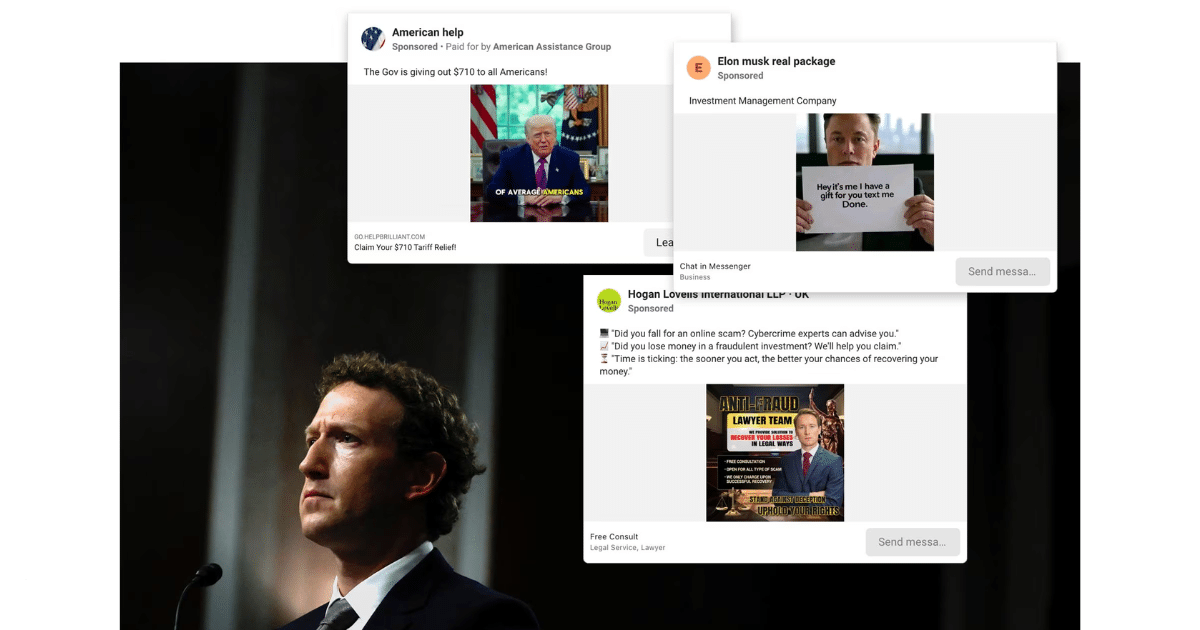












Meta internally projected that approximately 10% of its 2024 revenue (roughly $16 billion) would come from advertising for scams and banned goods, according to company documents reviewed by Reuters. The social media giant estimates it shows users about 15 billion “higher risk” scam advertisements daily, generating approximately $7 billion in annualized revenue from this category alone.
Enforcement Policies Raise Questions
The documents, created between 2021 and 2025, reveal that Meta only bans advertisers if its automated systems determine they are at least 95% likely to be committing fraud. For advertisers who fall below this threshold, but are still suspected of fraudulent activity, Meta implements “penalty bids,” charging higher rates as a deterrent.
Meta’s own research suggests its platforms have become a significant channel for global fraud, with a May 2025 presentation estimating the company’s products are involved in approximately one-third of all successful scams in the United States.
“If regulators wouldn’t tolerate banks profiting from fraud, they shouldn’t tolerate it in tech,” Sandeep Abraham, a former Meta safety investigator who now runs Risky Business Solutions, told Reuters.
Revenue Protection Measures
Internal documents indicate Meta has placed restrictions on how much revenue it is willing to sacrifice in its efforts to combat suspicious advertisers.
In the first half of 2025, the team responsible for vetting questionable advertisers was reportedly not permitted to take actions that could cost Meta more than 0.15% of total revenue – approximately $135 million out of the $90 billion generated during that period.
“Let’s be cautious,” wrote the manager overseeing these efforts, noting that the allowed revenue reduction included both scam ads and “benign” ones mistakenly blocked. “We have specific revenue guardrails.”
Gradual Reduction Strategy
Following a meeting with CEO Mark Zuckerberg in October 2024, Meta executives adopted what they termed a “moderate approach” to scam enforcement. Rather than implementing an immediate crackdown, the company plans to focus efforts on countries where it anticipates near-term regulatory action.
The strategy aims to reduce the percentage of revenue attributable to scams, illegal gambling, and prohibited goods from an estimated 10.1% in 2024 to 7.3% by the end of 2025. Further reductions to 6% by the end of 2026 and 5.8% in 2027 are planned, according to strategy memos.
Regulatory Pressure Mounting
The revelations come as Meta faces increasing regulatory scrutiny. The U.S. Securities and Exchange Commission is investigating the company for running ads promoting financial scams, according to the internal documents.
In the United Kingdom, regulators reported that Meta’s products were involved in 54% of all payment-related scam losses in 2023, more than double the figure for all other social platforms combined.
Meta anticipates regulatory fines of up to $1 billion, according to one internal document. However, a separate November 2024 document notes that every six months, Meta earns approximately $3.5 billion from just the portion of scam ads that “present higher legal risk,” likely exceeding “the cost of any regulatory settlement involving scam ads.”
Meta’s Response
Meta spokesman Andy Stone disputed several aspects of the Reuters report, stating the documents “present a selective view that distorts Meta’s approach to fraud and scams.”
The internal revenue estimate was “rough and overly-inclusive,” he said, claiming the company later determined the true figure was lower because the estimate included “many” legitimate ads. Stone declined to provide an updated figure.
“Over the past 18 months, we have reduced user reports of scam ads globally by 58% and, so far in 2025, we’ve removed more than 134 million pieces of scam ad content,” Stone said in a statement.
Subscribe to Our Newsletter
Check Out Our Podcast