





Talent Collectives
Inside HERA Media’s Mission To Empower Women’s Voices In Podcasting

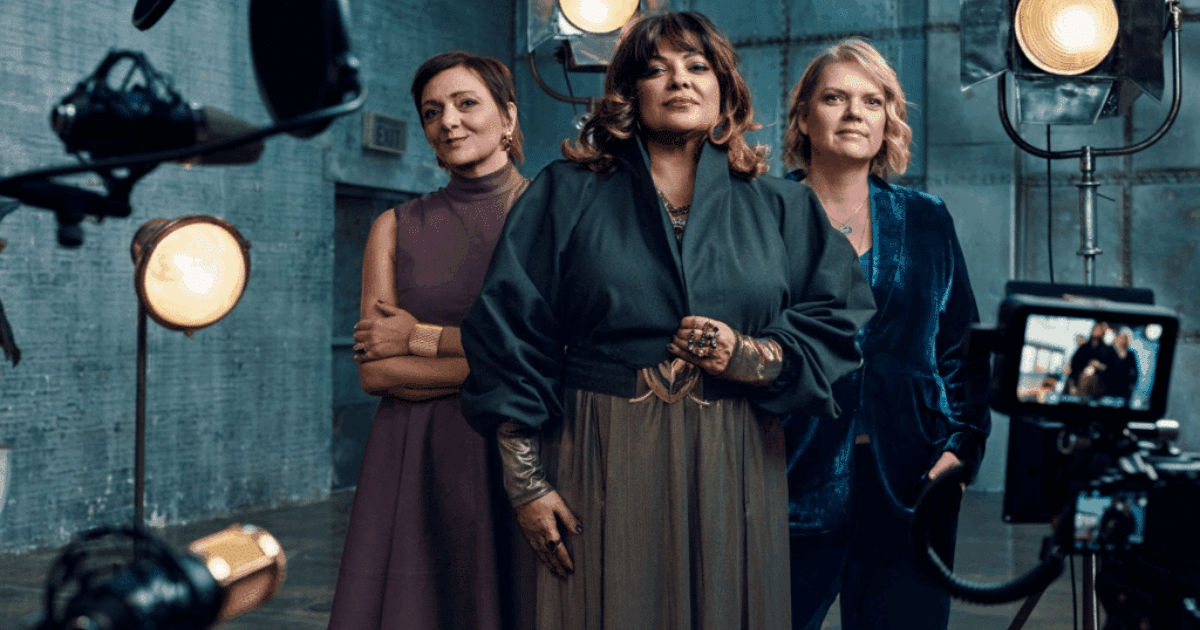
UK-based video podcast network HERA Media launched at the beginning of October this year, with its three founders, Rosie Allimonos, Nishma Patel Robb, and Kirsty Hunter, sharing a clear conviction: women’s voices were missing from the mainstream podcast market.
Although women are expected to control 75% of discretionary spending by 2030, 80% of the UK’s top podcasts are still hosted by men. That imbalance, they say, signals both a cultural gap and a commercial opportunity.
“We just looked around and realized, ‘What’s the female version of UNILAD? What’s the female version of LADBible?’” says Rosie, a former BBC and YouTube executive. “No one could answer that question because it doesn’t exist.”
The absence of female-led storytelling became the starting point for HERA Media. The company is the creation of Nishma, former Google UK Brand & Reputation Chief; Rosie, who helped launch YouTube Originals, BBC iPlayer, Instagram Reels, and Facebook Watch across EMEA; and Kirsty, an Emmy Award-winning producer behind “Lady Killers with Lucy Worsley” and “Climate of Change with Cate Blanchett and Danny Kennedy.”
Together, they are building what they call a “media-tech company with a mission”: part studio, part community, part technology platform.
Identifying a Gap in the Market
The founders met in mid-2024, shortly after Edison Research data revealed that only two of the top 25 UK podcasts were hosted by women. For Kirsty, who had seen strong audiences for female-focused projects at the BBC, the findings were a wake-up call.
“It just struck me that we are missing a huge cohort of storytelling,” she recalls. “We’re not hearing women’s voices, and we know from other markets like Australia and the U.S. that female-led storytelling cuts through.”
Nishma, who also runs Glittersphere, a consultancy that helps women build personal brands, sees the mission as both commercial and cultural. “When women are seen, heard, and believed, they don’t just change their own careers. They change the rules of the game,” she says. “Stories can change the world. And right now, we’re not telling enough of them through that lens.”
HERA’s founders frame the venture as more than a studio or agency. “It’s a movement,” Rosie adds. “In the next five years, most of the world’s wealth will be in women’s hands. If this demographic can’t even express themselves, we have to do something about that.”
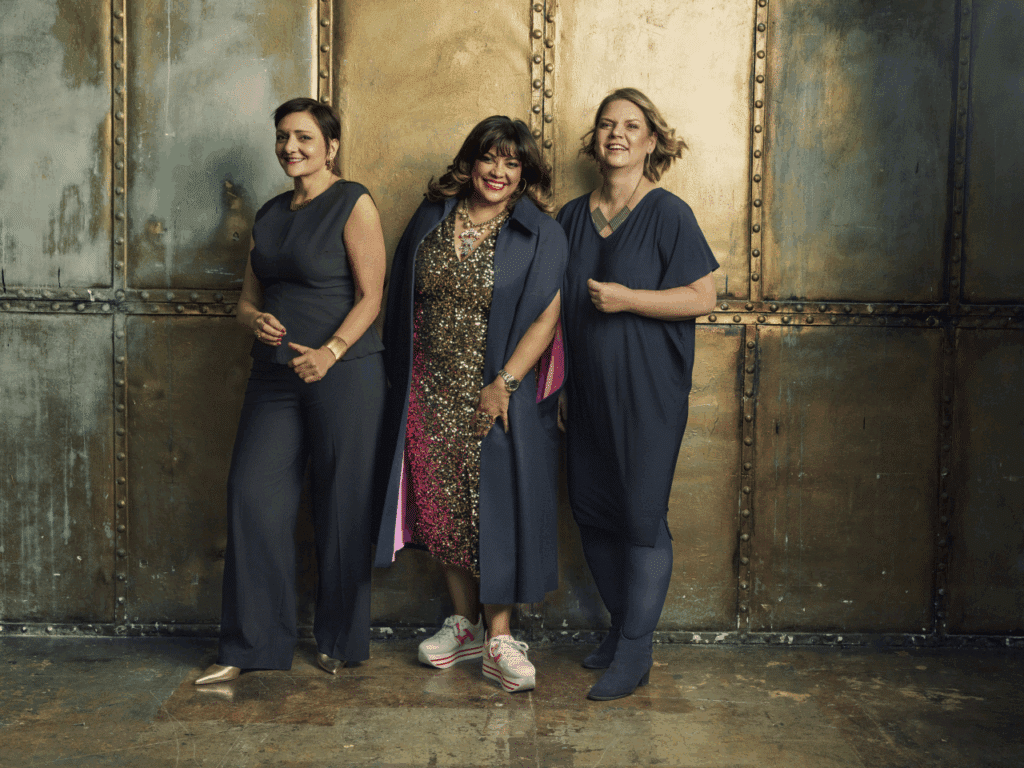
Rosie Allimonos, Nishma Patel Robb, and Kirsty Hunter
Building a New Kind of Media Company
HERA’s business model rests on three interconnected pillars: content, community, and technology, a structure the founders describe as a “flywheel effect.” Each element feeds the other: content builds community, community drives product needs, and technology reduces production barriers.
Kirsty brings her long-form storytelling and production expertise, having worked at Fremantle, Sony Pictures Television, and Lion Television. “I’ve always worked in environments where one idea could proliferate across multiple platforms,” she says. “We’re taking that same approach; developing ideas that can become a slate of shows, live experiences, and potentially entire franchises.”
For Rosie, who once helped change the perception of YouTube from “dogs on skateboards to very professional content”, the technology layer is key to scaling. “If we’re going to be working with hundreds of thousands of female podcast creators, we need tools that let them go from idea to finished product quickly,” she explains. “Women are time-poor. We’re building systems that make production about 65% more efficient.”
The HERA Club: Community at the Core
Central to HERA’s model is the HERA Club, a membership community for women who host, produce, or aspire to create podcasts. The initiative offers access to industry experts, monetization guidance, and AI-powered tools for streamlining production.
“It’s quite a lonely pursuit to build a podcast,” says Nishma. “We’ve met so many women with incredible voices who struggle with technology, knowledge, or monetization. HERA Club is about changing that and creating a space to learn, collaborate, and actually earn from their work.”
Since its soft launch, the community has exceeded its early targets and attracted interest from creators outside the UK. “The appetite has been overwhelming,” Nishma notes. “It really shows how many women want to be part of something bigger.”
Beyond online collaboration, HERA plans to host live gatherings and workshops that connect creators with audiences. “Everyone is craving connection,” Rosie says. “We’re designing live experiences around shows and shared interests so the community extends beyond the screen.”
Programming With Purpose
While the company is keeping its initial slate under wraps, Kirsty says HERA will produce original series, acquire promising podcasts to “supersize” through visualization, and collaborate with brands to develop storytelling-driven formats.
“We’ll have always-on shows that reflect what women are talking about every week,” she explains. “There’s a real gap in the UK market for programming that’s conversational, entertaining, and distinctly female in tone.”
Genres will span from lifestyle and history to true crime, told from new perspectives. “Often true crime has become about the ‘dead woman on a slab,’” Kirsty says. “We’re more interested in flipping the script and giving women back their agency.”
Recent industry developments, such as Spotify’s collaboration with Netflix to distribute video podcasts, have reinforced HERA’s emphasis on visual storytelling. “It’s a clear signal that the digital media marketplace is shifting,” says Nishma. “We see video podcasts as the next frontier for quality storytelling.”
Integrating AI with Boundaries
HERA is also developing proprietary AI tools to automate repetitive production tasks, an approach the founders describe as assistive rather than replacement-based. “We’re using AI to remove friction from the workflow, but not to replace human creativity,” Rosie says. “You’ve probably seen those fully AI-generated podcasts, and they’re terrible.”
Kirsty agrees, emphasizing the balance between efficiency and artistic control. “Production costs are high because creators now make content for 20 platforms, not one,” she says. “AI can help with that, but the heart of storytelling has to remain human.”
Nishma adds that HERA’s team is also mindful of representation in technology itself. “Most large language models are built by male engineers, and that bias shows up in content,” she says. “We’re working with female software engineers to make the tools we use more equitable.”
A Framework for Brands
HERA’s founders believe the same precision that drives their content will appeal to advertisers. Nishma, whose career spans brand strategy and digital marketing, says HERA will prioritize brand safety and relevance in its partnerships. “We’ve lived through those challenges on platforms like YouTube,” she notes. “Our content is human-first, purpose-driven, and deeply vetted.”
From her perspective, the podcast medium offers marketers more than reach; it offers trust. “This is about reinventing how brands build relationships,” she says. “Podcasts allow for deeper storytelling and reputation building at a time when attention is harder than ever to capture.”
The Definition of Success
When it comes to measuring success, the founders cite three priorities: cultural impact, equitable monetization, and systemic change in production.
“One measure will be gender parity in podcast charts,” Nishma says. “But it’s also about money flowing into women’s pockets. Real financial freedom.”
For Kirsty, success means reshaping the production pipeline. “I’ve walked onto sets where I’m one of two women among twenty men,” she says. “We want to change that and bring in new production talent, new voices, and give them room to thrive.”
Rosie points to the funding gap facing female entrepreneurs as another barrier they hope to address. “Less than 2% of UK female-founded businesses receive investment,” she notes. “We’ve already surpassed that milestone for HERA, and we want to be a beacon for others.”
What’s Next for HERA?
Heading into 2026, HERA’s focus will be on scaling its technology, expanding the club community, and launching its first slate of original programming. Events and live experiences are also in development, designed to bridge the company’s three pillars of content, community, and tech.
Nishma emphasizes that HERA’s ambitions extend far beyond the UK. “We are a UK business today, but our vision is global,” she says. “In other markets, there’s even more work to be done and greater opportunity.”
Two years from now, the founders hope their company will no longer stand out as an anomaly. “I’d like to look at the industry and not have to explain why we exist,” says Rosie. “When women’s voices are part of the norm, not the exception, that’s when we’ll know we’ve succeeded.”
Kirsty adds one final measure of impact: “If I can look around a future HERA office and see hundreds of young women thriving, feeling safe, valued, and credited for their ideas, that’s the legacy we want to build.”
Subscribe to Our Newsletter
Check Out Our Podcast