


Agency
B2B Influencer Marketing Fails When Judged by the Click, According to Directive’s Garrett Mehrguth

For roughly four years, Directive spent $270,000 a month on LinkedIn ads that traded gift cards for sales meetings, according to founder and CEO Garrett Mehrguth. The B2B agency formally retired that playbook in early 2026 as acquisition costs climbed, shifted its spending toward Meta and TikTok, and now tells clients that Influencer Marketing judged by the click fails every time.
The click is the obstacle Garrett returns to most. LinkedIn’s CPMs have risen over the last 36 months in his account, making direct response there expensive, yet B2B teams still report on leads and MQLs, and social video rarely produces a click. “The B2B marketer is terrified to take their budget and put it into something that they cannot directly attribute leads to. It is that simple,” Garrett says.
Directive’s answer is InfluenceOS, a framework launched in October 2026 that treats employees, customers, practitioners and analysts as an ongoing channel of influence measured against business performance. Garrett founded Directive with his best friend in 2013 while in college, bootstrapping it on $5 social media calendars sold on Fiverr, and the Irvine, California-based agency now has more than 128 full-time staff serving mid-market and enterprise B2B companies, many in tech and industrial categories.
Garrett acts as Directive’s CMO and CRO, overseeing eight full-time marketers and four salespeople, and treats the multimillion-dollar in-house budget as R&D. Services are the hardest thing to market in B2B, he argues, so a tactic that works for Directive should carry over to its software and industrial clients. His own focus is how clients should frame and measure influencer campaigns.
Influence Arrives Through the Direct Channel
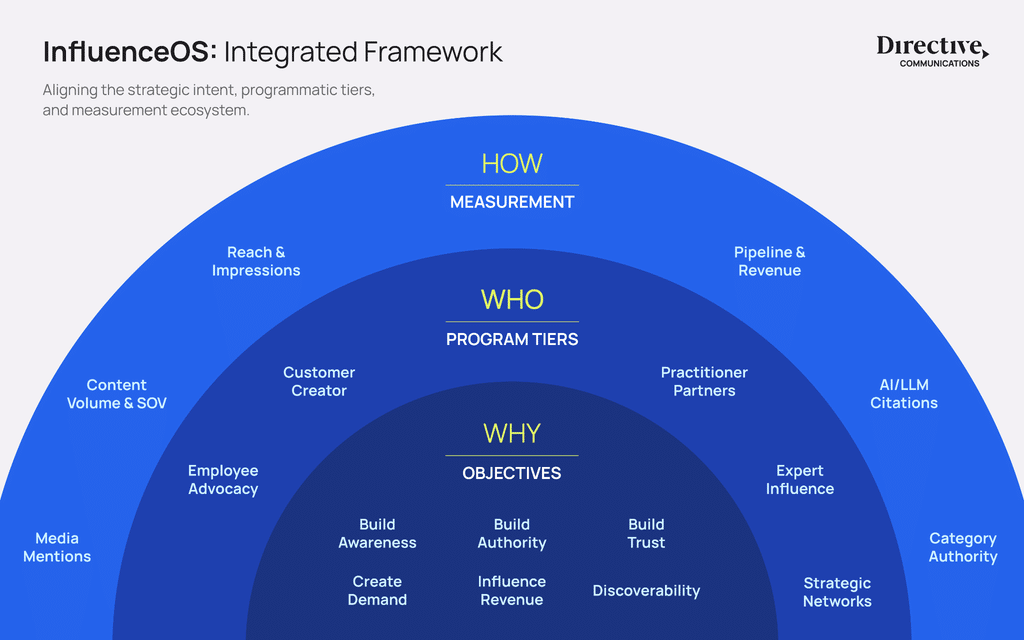
Measurement is where B2B influencer programs break, Garrett argues. In an example he gives, a cybersecurity software company recruits practitioners with perhaps 15,000 followers, all of them cybersecurity professionals. A buyer watches one of them, whom he calls Janice, discuss the product, goes back to work, and about two weeks later visits the company’s website directly.
“So now the influencer campaign did not work according to how we do click-based attribution in B2B, but it actually did,” Garrett says. “It actually resulted in a lot more demos, and it resulted in a lot more bookings.” He also cites Meta’s 24-hour view-through conversion window as one reason click-measured B2B teams avoid consumer tactics.
The measurement choice shapes the campaign itself. A campaign held to direct sales attribution would be the wrong campaign, Garrett argues, and would perform worse. “I don’t believe you should be slinging affiliate links. That’s not what influencer is about,” he says.
He expects the problem to grow. “I do believe that we’re going to have less and less attribution tomorrow, not more,” Garrett says. Marketers, in his view, will have to trust that reaching the right person at the right account produces measurable lift without a click.
Market Share Replaces the Lead Count
The right accounts, in Directive’s model, come out of a regression. Directive enriches a client’s current customers with private and third-party data from sources such as ZoomInfo, Apollo and Clay, then makes monthly recurring revenue the dependent variable. For a client that wants customers paying more than $10,000 a month, Garrett explains, variables with a t-stat above 2 define the firmographic and technographic profile Directive then targets.
In one example he walks through, that process yields 10,000 U.S. accounts. If the client already works with 15% of them, through its pipeline or a conversation in the last 12 months, the InfluenceOS goal is 30% penetration within 12 months. “Instead, I want it to be about if I spent $30,000 more, how much more audience penetration could I get?” Garrett says. He still holds that penetration accountable to pipeline, win rate, contract value and bookings.
Directive has not yet taken enough clients through a full cycle to report results, Garrett says, but its own test is further along. Of the 10,000 accounts Directive targeted for itself, it has held sales calls with 6,800 in about 18 months, a result he credits to InfluenceOS running alongside DiscoverabilityOS, the agency’s broader framework, with Google Ads, SEO, LinkedIn and Meta in the same program. The number reflects that combined effort.
Brands Have to Promote Themselves First
The voices reaching those accounts start with the brand’s own founder, Garrett argues, with outside influencers second. Influencers research the brands they partner with, and the most sought-after ones worry about promotional fatigue with their own audiences. “They’re not gonna say yes to a brand that’s not already promoting themselves,” he says.
Directive has also tested how to keep its own employees posting. One internal launch offered something like a $1,500 flight credit for the most engagement, which Garrett says left staff without large followings disengaged. A later one paid everyone a $25 Amazon gift card for posting and drew more reach and participation. “People were less competitive about winning if they didn’t think they had a chance,” he says.
For outside creators, Garrett’s test is to read the comments. He would pick a creator with 15,000 followers whose posts draw engagement from the ideal customer persona over one with 50,000 broad followers. “I would rather get that niche influencer every time,” he says. The same 15,000-follower figure anchors his cybersecurity example, where every follower is a practitioner.
One-Off Tests Are Built to Fail
The right voices still fail, in Garrett’s view, if the program is bought as an experiment. Most B2B communications packages, as he describes them, cover press releases and founder and brand comms, with influencer sold separately as a one-time test of $15,000 to $50,000. “It’s almost like the structural nature of the test prevents it from working,” Garrett says. Directive instead includes influencer work in the base deliverable of its ongoing communications services.
Garrett placed InfluenceOS in communications so clients expect preference to build over 12 months and the pool of leads with no known source to grow. That unattributed bucket is the same direct traffic his cybersecurity example produced. He frames the sale around one question. “Do you want your brand to matter more 36 months from now than it matters today?”
Garrett compares B2B communications without influencers to buying Yellow Pages listings. “People don’t want to hear you say how great you are. They want to hear the people they trust in their feed saying how great you are,” he says.

Every Post Gets a $5 Test
An ongoing program needs an ongoing budget, and Directive’s runs weekly. Corporate pages get almost no organic reach in B2B, Garrett says, so Directive puts $5 behind every post on its YouTube, X, Instagram and LinkedIn accounts, targeted to its 10,000 accounts. A full-time team of an editor, a content creator and an advertiser runs the process, and each week’s winners move into ongoing campaigns with more money behind them.
Garrett splits spending into a fixed beta budget for testing, such as $15 a week for three Instagram posts, and a variable alpha budget for winners. Adding a winner to a fixed budget would pull spending from existing winners, he explains. “So I’m never wasting my money on testing,” he says.
For an in-house B2B brand, he puts the floor at $30,000 a month on Meta behind those winners. Influencer content feeds the same system, turned into ads served to the named accounts. “It’s like we’re running ABM on steroids,” Garrett says. Those ads reach the account list the penetration targets are built on, which is where the content program and the measurement model meet.
B2B Is Funding What B2C Funded a Decade Ago
Garrett describes B2B marketing as 10 to 15 years behind consumer marketing. Over the next five years, he wants Directive to play a small part in persuading B2B marketers to fund what B2C brands funded a decade ago.
He concedes the skeptic’s point that InfluenceOS packages work other agencies could sell. “It is another framework. It is another thing that any agency could do, but not every agency has,” he says. His defense is the self-funded testing behind it. “If you’re not eating your own caviar, that’s no fun,” Garrett adds.
For marketers afraid of unattributable spend, his closing argument is about nerve. “The best marketing in the world is the marketing nobody else is willing to try. Market share is taken by the bold and the courageous,” Garrett says.
Subscribe to Our Newsletter
Check Out Our Podcast