Strategy
Influencity’s Cam Khaski Graglia: Check Where Followers Live and Pair National with Local Creators

Florida has slightly more eligible Instagram creator profiles than Texas despite a much smaller estimated audience, according to Cam Khaski Graglia, Head of Content at Influencer Marketing platform Influencity. That split, drawn from the company’s 2026 state-by-state research, carries her core advice to brands, which is to start a search where creators live and decide on fit by where their followers are.
That advice reflects what Influencity is built to show. The Madrid-based company sells an Influencer Marketing platform to brands, agencies and e-commerce teams. Its database covers more than 350 million public creator profiles across Instagram, TikTok and YouTube, with data on both creators and their audiences.
“When you have experience in Influencer Marketing, you will definitely realize that a creator pool and a creator’s reach are not necessarily in the same place,” Cam says.
The audience side is where she sees budgets go wrong. A creator can show a large following, strong engagement and reach and still miss the brand’s customers. “Maybe they are not speaking to your target audience. Then that would be budget misplaced,” she says. Cam joined Influencity in April 2024 with an academic background that includes a PhD in literary studies, and she builds its research around the questions people search for most, such as where Instagram influencers live. Texas shows what happens when a brand stops there.
A Creator’s Address Doesn’t Locate the Audience
Texas has a very large Instagram audience but relatively few creators for it, Cam explains. “If you want to reach people in Texas, you shouldn’t limit your research just to creators who live there,” she says. She points to Keith Lee’s pop-up in Dallas in March, which launched his partnership with Brooklyn Dumpling Shop, a New York chain. The chain came from New York and Lee’s following is national, yet the event was aimed at a Texas audience.
Florida reverses the situation, with a denser pool of candidates who still need an audience check. “Being based in Miami doesn’t automatically mean that someone reaches Miami residents,” Cam notes. She cites American Eagle’s sorority recruitment campaign, announced in July, built around chapters including the University of Florida, in which the brand partnered with a student with nearly 3 million TikTok followers.

“Creator location helps you start your search, whereas audience location tells you whether the partnership fits or doesn’t,” she says. Skipping that check can cost a brand its target audience even when a post performs, because “performing for a creator is one thing and performing for a brand is a different thing.” That audience test carries into states outside the familiar hubs.
Small-Account States Don’t Fit the Coastal Map
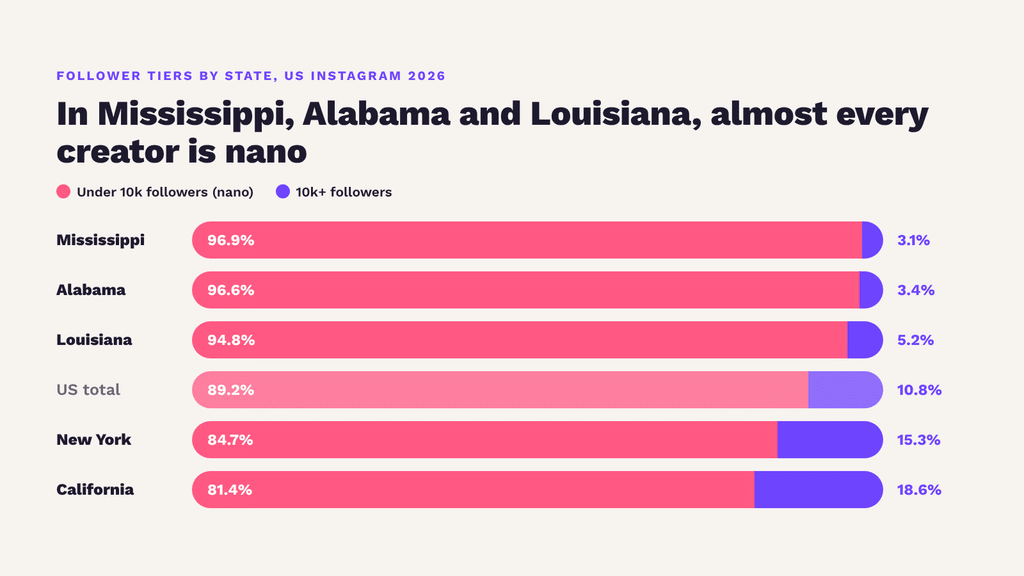
Louisiana, Mississippi and Alabama have dense creator pools, and Cam says the overwhelming majority of their profiles are nano accounts with fewer than 10,000 followers. She suggests these are mostly people sharing everyday life, food, music and local events, and she calls that a plausible explanation. “We try to measure the pattern, but not what caused it,” she says. Part of the effect is arithmetic, because a smaller estimated audience pushes the density ratio up.
Wealth did not explain the pattern either. According to Cam, the study found wealth was not meaningfully associated with how many creators a state had relative to its population, though wealthier states tended to have a higher proportion of accounts above 100,000 followers.
Relatability is the draw, in her view. “It cannot be all Alix Earle or Kardashian kind of content,” Cam says. Alabama’s sorority recruitment season started with ordinary students posting from personal accounts, she notes, and it drew brand activations that included a Nike hoodie embroidery truck and Dunkin’ drinks at sorority houses.
“I think that we have to pay attention to the fact that bigger accounts do not necessarily translate to better performance,” she says. The pattern widens the search for brands without lowering the bar for fit, and food shows how local reach turns into sales.
Local Micro Creators Bring Customers In
Influencity’s food research, which Cam cross-referenced in the state study, shows restaurant chains using creators on two levels. Large national creators build awareness, create spikes in Google searches, and work especially well around limited-time menu launches. City-level micro creators mobilize hyper-local audiences for lower-cost walk-in purchases. “They bring the people through the door,” Cam says.
A chain running a creator campaign across approximately 50 stores can expect a modest but repeatable regional lift of around 5% to 12%, according to the food study as Cam describes it. A single independent location can see a much sharper spike. She cites Franklin Barbecue in Austin, where foot traffic rose 24% in the week after a viral TikTok review.
Cam ties the budget split to the objective, with awareness or an image revamp favoring the national layer. Her own view favors the local one. “I think that the second layer, the more localized micro layer, is the one that actually gets the sales,” she says. “It’s very rare that someone flies across the country just to eat a hot dog.”
Each Layer Needs Its Own Scorecard
Because the layers do different work, Cam recommends measuring them separately. The national layer is judged on reach and branded search, and the city layer on Google Maps directions, local codes and store visits. Ideally, a brand compares a city that received the creator push with a similar city that did not over a set period.
Location data decides whether a creator counts as local at all. “You have to check not just where he’s from, but also where their followers are,” Cam says.
The same discipline applies to the metrics brands lean on. New brands tend to treat followership as everything, Cam says, while experienced teams look at reach and engagement. She calls views a vanity metric. “How many views something has doesn’t imply that those are unique views,” she says. The comment section is where she finds the real signal. “I think there’s such a massive market intelligence that people overlook a lot of the time,” she says.
Creator Density Doesn’t Guarantee Lower Fees
The same focus on real audiences shapes Cam’s view of fees. She rejects the idea that a creator-dense state means cheaper creators. “No, absolutely not,” she says. Technology pays some of the highest fees, she notes. Devices have to be given away for testing, and trusted tech creators would not risk their followers for a free iPhone. “Building loyal followership implies lots of work,” she says.
Fees also differ between Europe and the U.S. Cam links them to creator density alongside supply and demand, which makes density one input among several. She advises brands to arrive with an average idea of realistic fees, since lowball offers can insult creators, and to ask industry peers when they lack one.
“They might not be telling you what they are exactly paying their influencers, but they may help you get in the right salary bracket at least,” she says.
Clear Disclosure Supports Long-Term Engagement
The loyalty behind those fees is what disclosure protects. Influencity’s supplements research found that clearly disclosed sponsored posts performed 12% better on long-term engagement. “Transparency gives people one less reason to distrust the recommendation,” Cam says. Most followers accept that creators work with brands, she argues, and the damage comes from the sense that a partnership was hidden.
“If I’m going to be fully honest, that doesn’t exactly prove that the disclosure per se caused that difference,” Cam says. Creators who disclosed may also have made stronger content or chosen better-fitting partners, she notes.
Brands carry part of the responsibility, in her view. They should push creators to disclose even where regulation is not yet enforced, and sectors such as food and medicine should require it. Micromanaged briefs, she adds, make content sound unlike the creator and perform poorly. “I think it validates your work rather than diminishes it,” she says of labeling an ad.
Shifting Numbers Need Interpretation
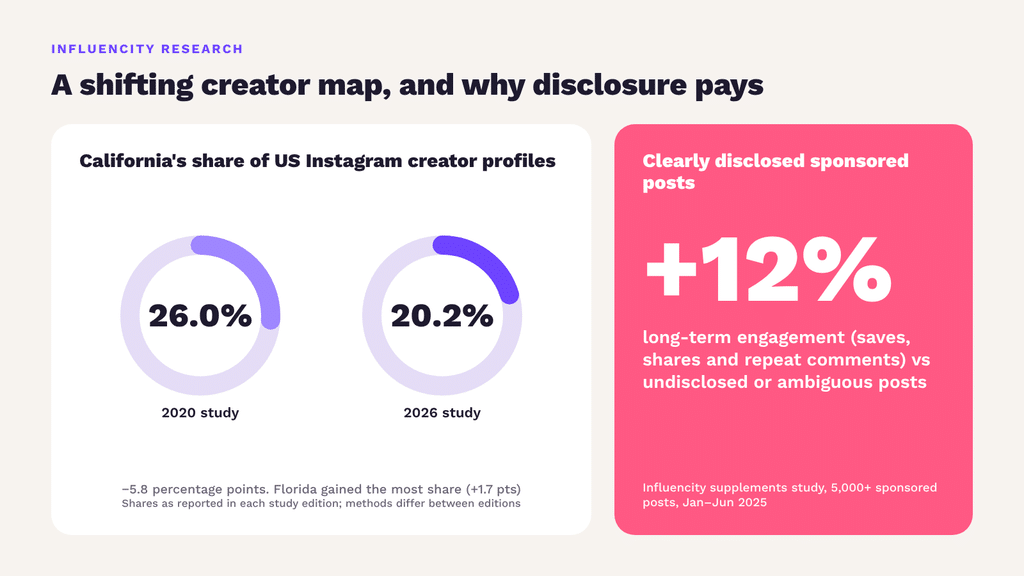
California’s share of the U.S. creator pool fell from 26% to 20%, per Cam. She suggests that smaller states and cities may be growing faster, changing California’s relative position. A brand reading a state ranking as fixed could miss those shifts.
Categories need the same care, she adds. Creators who do not disclose gender, or who cover several niches, produce totals that do not add up. Across Texas, Florida and the small-account states, the advice is consistent. Location data opens a search, and the audience, the objective, and the measurement decide whether a partnership works.
“It is up to us to try to understand why the patterns are there,” Cam says.
Subscribe to Our Newsletter
Check Out Our Podcast